Review: A Place to Belong by Cynthia Kadohata

A Place to Belong by Cynthia Kadohata

A Place to Belong by Cynthia Kadohata, illustrated by Julia Kuo (9781481446648)

Award-winning author Kadohata tells the story of a Japanese-American family forced to return to Japan after World War II because of their Japanese ancestry. After spending years in an internment camp in the United States, twelve-year-old Hanako and her family move to Japan to live with her paternal grandparents. They travel by ship first and then train until they reach the decimated city of Hiroshima, where her grandparents’ farm lies outside. All of Japan is poor and hungry, with black markets and children begging on the streets. Hanako meets her grandparents for the first time, discovering that her grandfather is very like her little brother who is five years old. Her grandmother is stooped over from the hard work in the fields. Hanako must face learning a new language, attending a new school in a different country, and trying to find a way forward for her entire family. It’s a lot of pressure, but Hanako learns steadily to adjust and change.

Kadohata’s novel for children tells the untold story of Japanese Americans forced to repatriate to their country of origin and renounce their American citizenship. It also gives an unflinching look at the aftermath of World War II in Japan, particularly with its setting near Hiroshima. That dark setting is juxtaposed against the warmth and beauty of discovering loving grandparents and building a new relationship. Yet there is a constant sense of loss in the book and a teetering feeling that things may suddenly change at any moment.

As always, Kadohata’s prose is beautiful. She vividly depicts Japanese life during the 1940’s and the unending work of being a tenant farmer. In the midst of all of the sorrow, loss and confusion, she places a loving family who are willing to sacrifice for one another and for brighter futures for the next generation. Through this family, there is intense hope broadcast on the page.

An important and vital book about the horrors of war and its aftermath on individual families. Appropriate for ages 9-12.

Reviewed from copy provided by Atheneum.
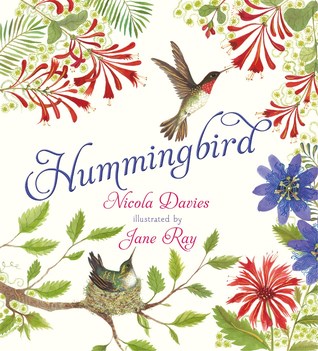
Review: Hummingbird by Nicola Davies

Hummingbird by Nicola Davies

Hummingbird by Nicola Davies, illustrated by Jane Ray (9781536205381)

In a grandmother’s garden in Central America, a granddaughter watches the zooming hummingbirds. The birds will soon be heading north for the summer to their nesting grounds. The tiny birds must cross the Gulf of Mexico, stopping for a bit of rest on boats along the way. They continue on, following the blooming flowers as they stretch northward. When they reach their nesting grounds, the male hummingbirds defend their nearby flowers. There, the same girl, now in New York City, finds an eggshell on the ground and realizes that she has seen both the beginning and end of the hummingbird’s migration.

Davies, a zoologist, beautifully frames the story of the hummingbird with one little girl’s own travels from Central America to her home in New York City. She makes sure that readers have plenty of facts about the hummingbird, from how light they are to what their diets need to how they nest and migrate. Davies has a real skill for sharing just enough facts with young readers and still telling a compelling story that is not derailed by too many factoids.

The illustrations by Ray are phenomenal. Her delicate lines are exactly the right format for these tiny birds. She captures the beauty of their feathers and their coloring. She also shows them in mid-air but still manages to convey their speed and dexterity.

A beautiful nonfiction picture book about an amazing tiny bird. Appropriate for ages 4-7.

Reviewed from library copy.

Review: Moth: An Evolution Story by Isabel Thomas

Moth An Evolution Story by Isabel Thomas

Moth: An Evolution Story by Isabel Thomas, illustrated by Daniel Egneus (9781547600205)

This nonfiction picture book explains a specific process of evolution by following the story of the Peppered Moth. The moths emerge from their cocoons after the long winter, quickly seeking shelter from predators. At first, most of the moths had speckled black and white wings. It allowed them to better hide in the bark of the woods. The ones that happened to be born with dark wings got eaten by predators. So the speckled moths were able to survive to lay their eggs. But then the world around them changed with more soot and pollution covering the bark of the trees and other objects. Now it was the dark moths that survived best and could lay their eggs. Steadily, the moths started to become darker and less speckled. Now though, pollution is lessening and there is no longer as much soot. So the speckled moths are returning alongside the dark moths.

The tale of the Peppered Moth shows many elements of evolutionary process, including natural selection and adaptation. Both of those concepts are more fully described in the final pages of the book but are fully realized in the main part of the book as well. Thomas does a lovely job with the prose, giving the reader just enough information to allow the story to unfold before them. She limits the amount of words on the page, making this accessible for quite young children.

The illustrations are marvelous, inviting readers into the darkness of a moonlit woods as the moths emerge from their cocoons. The pages fill with moths of different mixtures of black and white. When day comes, more predators enter the pages. As the pollution enters, the world becomes dark and filled with dots and specks of dirty soot. The moths glow against the new darkness, or hide well, depending on their color. It’s a stirring and rich look at evolution happening right before your eyes.

Beautifully written and illustrated, this is a very special nonfiction picture book. Appropriate for ages 5-8.

Reviewed from copy provided by Bloomsbury Children’s Books.

Review: Sparky & Spike by Barbara Lowell

Sparky & Spike by Barbara Lowell

Sparky & Spike: Charles Schulz and the Wildest, Smartest Dog Ever by Barbara Lowell, illustrated by Dan Andreasen (9781944903589)

Sparky has a dog that is black and white. His dog knows fifty words, loves to each strange things, and only drinks from the bathroom faucet. Sparky and his father always head to the drugstore every Saturday night to pick up the Sunday comics. Sparky loves comics and also loves to draw himself. His teacher says that he may be an artist one day, but Sparky definitely wants to be a cartoonist. But drawing is hard, especially getting characters right in multiple panels. The kids at school love Sparky’s drawings, but ignore him otherwise. When Sparky realizes that his dog could make the comic for Ripley’s Believe It or Not, he sends it in along with his drawing of Spike. Eventually, his drawing and caption are published! It’s just the start for the kid whose real name is Charles Schulz.

Lowell deftly depicts the growth of a young artist as he develops his own dream, his own art and a path forward. It is a pleasure to see a young Charles Schulz and his connection to the dog who will inspire Snoopy. His connection to comics from a young age is also fascinating to see as well as his struggles with friendship. The art by Andreasen is cleverly done with a realistic touch that both pays homage to the work of Schulz but also stands on its own stylistically.

An inspiring look at the creator of Peanuts. Appropriate for ages 6-9.

Reviewed from copy provided by Cameron Kids.

Review: Grandpa Cacao by Elizabeth Zunon

Grandpa Cacao by Elizabeth Zunon

Grandpa Cacao by Elizabeth Zunon (9781681196404)

A little girl and her Daddy are making her birthday cake, a chocolate one. As they bake the cake, her father tells her about Grandpa Cacao who lives in the Ivory Coast and has a cacao farm. The book looks at the importance of the right soil and weather to grow cacao as well as the skill to know when precisely to harvest the crop. The process of harvest and then scooping out the white beans, curing them in the ground, and then drying them is shown in detail. All the while, the girl and her father are baking together, the smell and taste of the chocolate bridging the two story lines. In the end, as the cake is finished, the little girl gets a special birthday treat.

Zunon’s picture book tells the important tale of where chocolate comes from and the fascinating process of going from farm to product that is not at all what one might expect. The framing of the chocolate farming process by a girl about to celebrate her birthday with a chocolate cake is lovely. It is strengthened even more by her family connection to the Ivory Coast and her grandfather’s farm. The treat at the end makes that even more firmly and tangible for readers.

The illustrations by the author are cleverly done. The little girl’s world is done in full color collages filled with rich touches of patterns and textures. The African farm is done in a more flat format with the people simply white outlines against the landscape. When the two worlds come together, they both become full color and lush.

Everyone loves chocolate and this book explains how it comes to our tables. Appropriate for ages 5-7.

Reviewed from copy provided by Bloomsbury Children’s Books.


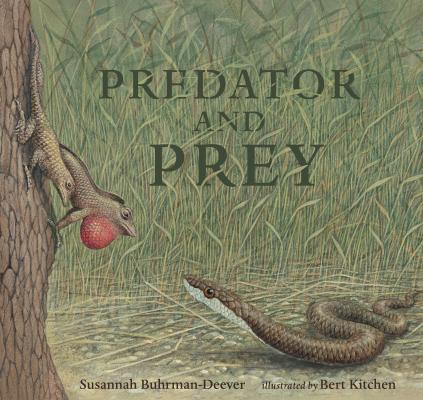
Review: Predator and Prey by Susannah Buhrman-Deever

Predator and Prey by Susannah Buhrman-Deever

Predator and Prey by Susannah Buhrman-Deever, illustrated by Bert Kitchen (9780763695330)

In poems for two voices, this book shows the cunning, evolution and beauty of predators and their prey. From bats to frogs to snakes to hawks to spiders, the poems feature all sorts of animals. Engagingly, often it is sometimes the obvious predator who is actually going to be the prey. That is certainly true in the example of the spider at the center of her web who is being preyed upon by the assassin bug. After each of the poems, there is a section about the animals in nonfiction prose that illuminates the relationship of the two species more clearly.

I was amazed to discover that this is biologist Buhrman-Deever’s first book for children. Her two-voice poems are very effective and could easily be used in classroom activities to be shared aloud by pairs of children who will enjoy being predators and prey since so many of the animals featured are very fascinating. She gives voice to the animals in her poems and then allows scientific information to be shared as well. The end of the book has a lengthy bibliography which is greatly appreciated.

The illustrations by Kitchen are exceptional as well, showing the reader the relationship between the two animals being discussed. They are realistic and dramatic as the animals stand off on the page. Several of the pages also have large gated pages that open to reveal the poem beneath them, allowing Kitchen’s full imagery to be appreciated without words blocking it.

A very successful mix of poetry and science, this one is sure to be preyed upon by hungry readers in classrooms and activities. Appropriate for ages 7-9.

Reviewed from library copy.

Review: The Undefeated by Kwame Alexander

The Undefeated by Kwame Alexander

The Undefeated by Kwame Alexander, illustrated by Kadir Nelson (9781328780966)

Two amazing book creators come together in this nonfiction picture book celebrating the resilience, talents and perseverance of African-Americans throughout history. The text of the book is a poem by Newbery-medalist Alexander that leads readers through the horrors of slavery to athletes and artist. The black Civil War soldiers carry forward into the Civil Rights Movement and the tragedies that accompanied it. It touches on police violence towards African Americans and moves forward to continue to celebrate those that excelled despite the odds, changing America as they did so. The poem ends with a call for all of the children of color to realize that this is them too.

Alexander’s poem is a powerful call to remember the beginnings in slavery, the battles along the way, and the impact of continuing to hope and dream despite what America has done. It calls for hope and inspiration, it calls for action. And it does not shy away from modern or historical issues, placing them right in front of the reader. His words are influenced by other great African-American writers too, paying homage to those who went before.

The award-winning illustrator and author, Nelson depicts so many historical figures on the pages of this book. Some are individual portraits, standing strong against the stark white backgrounds. Others are groupings of people and readers can recognize many of them on sight but will need to refer to the appendix for others. Nelson’s images are stirring in their beauty and the fierceness he captured his subjects.

This one will win awards, let’s hope it’s a Caldecott for Nelson! Appropriate for ages 7-10.

Reviewed from library copy.

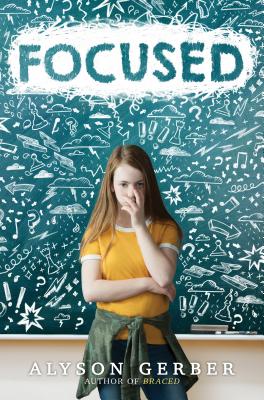
Review: Focused by Alyson Gerber

Focused by Alyson Gerber

Focused by Alyson Gerber (9781338185973)

Clea loves to play chess; it’s her favorite thing to do. She likes it a lot better than her classes at school where she struggles to pay attention and follow directions. She’s also having a lot of emotional outbursts now that she’s in middle school. Clea knows that it’s because she’s just stupid and that she doesn’t try hard enough. She thinks that no one around her wants to tell her the truth. Then Clea gets tested for ADHD, and she discovers the reason for her issues at school. Still, it isn’t as simple as just taking medication and having a written schedule. In fact, before she realizes it, Clea has managed to drive her best friend away with her behavior. Clea must start figuring out how to manage her ADHD, her personal life and keep her schoolwork in hand, all while trying to be chosen for chess tournaments on the weekends.

Gerber has once again created a female protagonist who struggles with something beyond their control. I deeply appreciated Gerber’s focus on Clea finding a voice to ask for what she needed and her ability to fall down and get back up again. The book also shows ADHD not as something to blame but as a true issue that a person must manage and deal with on a daily basis. Gerber writes with a sensitivity about ADHD that comes from experiencing the issues herself.

As with her first book, readers will discover a lot to relate to with Clea. Simply understanding invisible disabilities more clearly is helpful for all readers. Those who face similar challenges will find a main character worth cheering for on these pages. Clea works incredibly hard even when she fails, thinks of others often, is a great sister and friend, and still can’t fix this issue on her own. It’s a testament to the power of getting help on a variety of levels.

A personal look at ADHD, this novel is a compelling and thought-provoking read. Appropriate for ages 9-12.

Reviewed from ARC provided by Scholastic.

Review: Smile: How Young Charlie Chaplin Taught the World to Laugh (and Cry) by Gary Golio

Smile How Young Charlie Chaplin Taught the World to Laugh (and Cry) by Gary Golio

Smile: How Young Charlie Chaplin Taught the World to Laugh (and Cry) by Gary Golio, illustrated by Ed Young (9780763697617)

Growing up on the streets of London, Charlie Chaplin was raised by a single mother who performed as a singer. At age five, Charlie himself started to perform in place of his mother as her voice quit. The family ended up in the poorhouse and when they managed to get back out, Charlie went to school. That was where he learned of his love of attention and the spotlight. At age nine, Charlie joined a boys theater troupe and among other jobs, he worked his way up on stage. Eventually, he made his way to the United States. He starred in a movie but when people in the industry saw how young he was, they doubted him. With one clever costume choice though, Charlie Chaplin invented his iconic tramp character.

Golio’s poetic approach to this nonfiction picture book suits the subject completely. It has a sense of lightness and playfulness with plenty of optimism in the face of hardship. Even as Charlie’s childhood turns bleak, there are moments of light and wonder too. The writing is rich and invites readers to better understand the subject and where he came from. I’d recommend sharing some Chaplin clips with children so they can watch the genius at work. Young’s illustrations are exceptional. The images are bold and full of strong graphical elements. Using colorful silhouettes, they play with light and dark, whimsy and reality.

A mix of humor and sadness, just as Chaplin would have wanted it. Appropriate for ages 6-9.

Reviewed from copy provided by Candlewick Press.