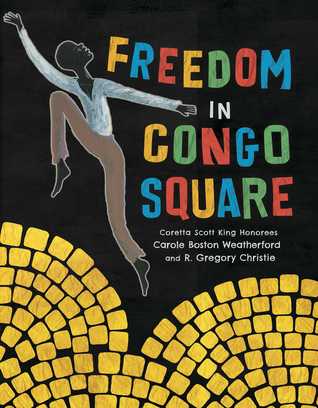
Freedom in Congo Square by Carole Boston Weatherford

Freedom in Congo Square by Carole Boston Weatherford

Freedom in Congo Square by Carole Boston Weatherford, illustrated by R. Gregory Christie (InfoSoup)

A lovely mix of poetry and nonfiction, this picture book takes a serious look at slavery and the unique situation in New Orleans. In New Orleans, Congo Square was the one place where slaves were allowed to congregate once a week on Sundays. The book counts down to Sunday, each day filled with brutal work and the harrowing harshness of slavery. As Sunday approaches, one can feel spirits looking forward to it. When it finally arrived, slaves and free blacks congregated together, able to celebrate the songs and society of the African homes they were stolen from.

This book is carefully framed and placed in history with a combination of a foreward by historian Freddi Williams Evans and an Author’s Note placed at the end of the book. In both places, Congo Square is explained in detail. The real magic though happens with Weatherford’s poetry. It has a rhythm to it, a structure that is almost musical. The text is deceptively simple as it speaks to the depth of human heart even in the face of slavery and the importance of having a place to congregate like Congo Square.

Christie’s illustrations are incredible. They evoke primitive art with the lengthened and stylized people done in deep black. The pages are filled with bright colors that may seem merry, but then they are filled with slaves doing hard work. They also have twisted black trees in the outside scenes, the tortured branches speaking to witnessed horrors.

An important nonfiction picture book that has poetry that sings in mourning about slavery but also sings of the beauty of the strength of the human spirit too. Appropriate for ages 7-9.

Reviewed from copy received from Little Bee Books.

My Top Children’s Nonfiction Picks for 2015

22323666 21965198

The Case for Loving: The Fight for Interracial Marriage by Selina Alko, illustrations by Sean Qualls and Selina Alko

Emmanuel’s Dream: The True Story of Emmanuel Ofosu Yeboah by Laurie Ann Thompson, illustrated by Sean Qualls

23309551 23129884

Enchanted Air: Two Cultures, Two Wings by Margarita Engle

Enormous Smallness: A Story of E.E. Cummings by Matthew Burgess, illustrated by Kris Di Giacomo

25229243 24795948

Finding Winnie: The True Story of the World’s Most Famous Bear by Lindsay Mattick, illustrated by Sophie Blackall

Funny Bones: Posada and His Day of the Dead Calaveras by Duncan Tonatiuh

23217536 22718660

Gordon Parks: How the Photographer Captured Black and White America by Carole Boston Weatherford, illustrated by Jamey Christoph

The House That Jane Built: A Story about Jane Addams by Tanya Lee Stone, illustrated by Kathryn Brown

21548429 22747803

Leontyne Price: Voice of a Century by Carole Boston Weatherford, illustrated by Raul Colon

Mesmerized: How Ben Franklin Solved a Mystery that Baffled All of France by Mara Rockliff, illustrated by Iacopo Bruno

22195449 22551795

My Name Is Truth: The Life of Sojourner Truth by Ann Turner, illustrated by James Ransome

Over the Hills and Far Away: A Treasury of Nursery Rhymes by Elizabeth Hammill and various illustrators

25261696 23379443

Poet: The Remarkable Story of George Moses Horton by Don Tate

The Sky Painter: Louis Fuertes, Bird Artist by Margarita Engle, illustrated by Aliona Bereghici

23417398 18317569

Small Wonders: Jean-Henri Fabre and His World of Insects by Matthew Clark Smith, illustrated by Giuliano Ferri

Swan: The Life and Dance of Anna Pavlova by Laurel Snyder, illustrated by Julie Morstad

22522289 23167689

Tricky Vic: The Impossible True Story of the Man Who Sold the Eiffel Tower by Greg Pizzoli

Trombone Shorty by Troy Andrews, illustrated by Bryan Collier

22747807 22718699

Voice of Freedom: Fannie Lou Hamer:The Spirit of the Civil Rights Movement by Carole Bostone Weatherford, illustrated by Ekua Holmes

Water Is Water: A Book about the Water Cycle by Miranda Paul, illustrated by Jason Chin

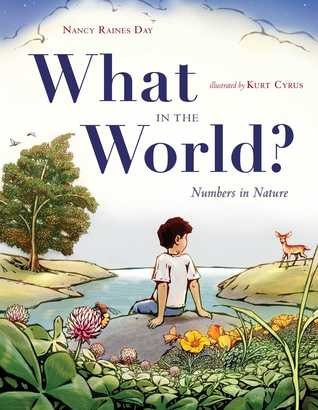
What in the World? by Nancy Raines Day

What in the World by Nancy Raines Day

What in the World?: Numbers in Nature by Nancy Raines Day, illustrated by Kurt Cyrus (InfoSoup)

In this rhyming counting book, the concept of numerical sets is introduced. The book opens asking “What in the world comes one by one?” It then answers, explaining that the moon, your nose and your mouth come in singles. Then the book counts upwards, each time asking the question of what comes in that set and answering it. The book ends by looking up at the stars and the infinity of them. It invites young readers to start to think about the patterns in the natural world around them.

Day has created a rhyme that makes this book an engaging mix of poetry and science. As the rhyme dances along, the book will inspire conversation and thinking of more things that come in that type of set. The book is wisely limited to a coastal area where a young boy plays, dangling his toes and fingers in the water, sets of ten.

The art is simple enough to allow this book to be both a counting book and a book about sets. Smaller children will merrily count the nine spines on the back of a fish while older children will start to think about other things in their world that match the set. The digital art is bright colored, and cheery.

An engaging math book that can be read at different levels, this rhyming science book will be enjoyed by several ages of child. Appropriate for ages 3-5.

Reviewed from copy received from Beach Lane Books.

Ada Byron Lovelace and the Thinking Machine by Laurie Wallmark

Ada Byron Lovelace and the Thinking Machine by Laurie Wallmark

Ada Byron Lovelace and the Thinking Machine by Laurie Wallmark, illustrated by April Chu (InfoSoup)

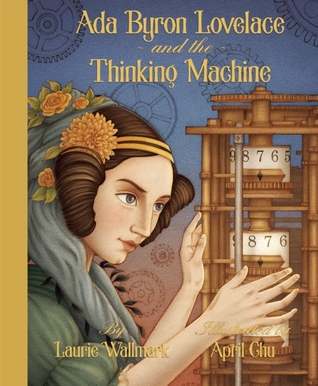
Ada Lovelace was born the daughter of the famous poet, Lord Byron. But she was more like her mother and interested in numbers rather than words. As a young woman, Ada invented a flying machine that she did all of the mathematics for. She spent time experimenting with wind and sails to inform her calculations. Despite a health scare that left her blind and paralyzed for some time, Ada continued to learn math and love numbers. When she met Charles Babbage, the inventor of the first mechanical computer, she found a person she could talk to about her love of numbers. It was his machine that inspired her to write the first computer program ever so that others could understand this amazing computer he had built. This makes Ada the first computer programmer.

It is inspiring to see a girl from such an early time period who was clearly a mathematical genius. She had a mother who was also interested in math and supported her daughter’s education and love of numbers throughout her life. This book shows the power of mathematics to inspire new ideas and inventions. It also demonstrates that women in computing goes back to the very beginning.

Chu’s art is done with pencil on paper and then as the copyright information says “colored on an Analytical Engine” also known as a computer. The illustrations are rich and lovely. They have interesting perspectives like looking down on Ada in the bath with her muddy boots on the floor nearby. Ada is shown as an active person, a youthful presence among older people, and shines on the page as she must have in life.

A powerful and inspirational read for children interested in math and science, this picture book will show young readers a heroine that they may never have met before. Appropriate for ages 7-10.

Reviewed from library copy.

Review: Mary Cassatt by Barbara Herkert

Mary Cassatt by Barbara Herkert

Mary Cassatt: Extraordinary Impressionist Painter by Barbara Herkert, illustrated by Gabi Swiatkowska (InfoSoup)

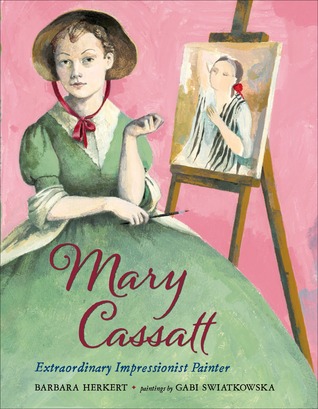
In 1860, girls did not become artists, but Mary knew exactly what she wanted to do. She enrolled in art school and then moved abroad despite her father’s protests. She copied the masters in The Louvre and lingered outside gallery windows. Art judges disliked her style, but she found herself welcomed to the group of independent artists by Degas himself. Soon she was painting exactly the way she liked and capturing life around her in her art.

Herkert tells the story of Mary Cassatt’s life with such poetic brevity. Her brief lines add to the energetic feel of the book, capturing the tremendous focus and passion of Cassatt herself with their tone. Herkert says things simply as they were and are. She states frankly the expectations of women in that time period, the way that the art institutions rejected Cassatt and the place the Cassatt found support and her own voice.

The illustrations by Swiatkowska pay homage to Cassatt’s own work. Done in a variety of media with gouache, watercolors, acrylics, enamel and tempera, the illustrations have a richness that has a vintage feel about it and focuses on capturing the society that Cassatt lived in and moments in her life.

A beautiful nugget of a picture book biography, this is an inspiring look at a woman who refused to be defined by society and instead lived a life all her own. Appropriate for ages 7-9.

Reviewed from copy received from Henry Holt and Co.

Counting Lions by Katie Cotton

Counting Lions by Katie Cotton

Counting Lions by Katie Cotton, illustrated by Stephen Walton (InfoSoup)

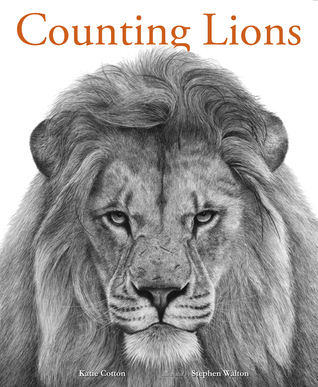
Counting one by one, this book tells the story of ten endangered and threatened animals. It begins with the lion on the cover, solitary and watching the savanna. Two gorillas are next, a mother and child, breathing the same breath together. The book moves on, each creature captured in captivating and brief verse that speaks to their way of life and the behaviors they exhibit. Each one is accompanied by a photo-realistic charcoal drawing that is haunting and incredibly detailed.

Cotton’s verse is profoundly lovely, managing to show each creature as an individual and give voice to their relevance and stature. The tigress and her cubs is a “warrior of the forest” while the macaws are “a colorful, fluttering explosion” and the giraffes are “peaceful patterned giants.” Each short verse will have readers seeing these animals in a new way, entranced by their beauty.

The illustrations are simply phenomenal. They are charcoal but with such detail that you can see the individual hairs in the lion’s mane, the each feather on the penguins, and every wrinkle of the elephants’ skin. Beautiful and powerful, these illustrations are a striking way to introduce these creatures.

A stunningly gorgeous book, the verse and illustrations marry to create a story of the threatened creatures of our world. Appropriate for ages 5-7.

Reviewed from library copy.


Review: Finding Winnie by Lindsay Mattick

Finding Winnie by Lindsay Mattick

Finding Winnie: The True Story of the World’s Most Famous Bear by Lindsay Mattick, illustrated by Sophie Blackall (InfoSoup)

Told by the great-granddaughter of Captain Harry Colebourn, this is the true story of the real bear who inspired Winnie-the Pooh. The book takes the format of a mother telling a bedtime story to her young son. It is the story of his great-great-grandfather, after whom he was named. Harry was a veterinarian sent from his home in Winnipeg to care for the soldier’s horses in World War I. On the train in Canada, he saw a little bear cub at a station and purchased the bear, even though he was headed into war. Winnie soon charmed all of the soldiers and got her own post to climb in the tent city. Winnie stayed with Harry when they were posted in England, but he had to make a difficult decision and put her in The London Zoo when he was headed to the war zone. It was at The London Zoo that a little boy named Christopher Robin Milne met Winnie and inspired his father to write the beloved stories of Winnie-the-Pooh.

Lindsay Mattick has shared the story of her great-grandfather in different formats through the years, including a radio documentary and an exhibition. In this very personal story, she shows real pride in the great heart that her grandfather showed by seeing something special in a small bear cub. It is clear that it is his dedication and care for Winnie that helped her become the loving and approachable bear that could inspire a series of stories. Mattick’s writing contains just the right amount of detail to keep children fascinated.

Blackall is an incredible illustrator and here she shows a beautiful touch for recreating historical scenes. From the expanse of Canada to the big city of London, she offers just enough visual detail to anchor the scenes in those distinct places. She also shows again and again the bond between Harry and Winnie, from sleeping together to sharing food. The historical photos at the end of the book add to the story, letting readers see the real Winnie.

A wonderful read, this book is an inspiring look at what small choices in our lives can lead to if we only follow our hearts. Appropriate for ages 4-7.

Reviewed from library copy.

Review: Drowned City by Don Brown

Drowned City by Don Brown

Drowned City: Hurricane Katrina & New Orleans by Don Brown (InfoSoup)

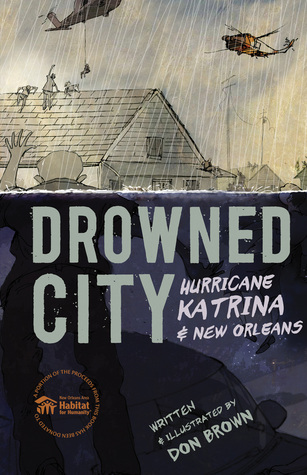
This powerful graphic novel tells the story of Hurricane Katrina from the very beginning as the hurricane forms and grows in power to the slow recovery of New Orleans in the aftermath. As the winds and rains of the storm breach the levees around the city, readers will see the devastation that occurs as 80% of the city floods. The book tells the true story, one where everyday people are heroes, where supplies and help are not sent in a timely way, where presidents make appearances but don’t remedy the problems, and where people looking for help just find more death and despair. It is also the story of selfless people who come in and make a real difference, of rescues and saved lives. It is in short, a true story that unflinchingly tells the story of a storm and a city.

With an enormous list of references and sources at the back of the book, this graphic novel is based entirely on facts and first-person accounts. Brown tells the tale without any need to make it more dramatic, just offering facts about what happened and what went wrong to make it even worse. Brown’s account though is also filled with humanity, offering glimpses of the horrors that people survived, of the losses as they mounted, and of a world turned upside down for people trying to escape the city.

Brown’s art in this graphic novel is done mostly in browns and greens. There are striking pages that stop a reader for awhile, such as the art on pages 30 and 31 which has dead bodies floating past in purple water, even as survivors are being hauled up to a roof. Brown conveys the heat and the desperation of survivors, the desolation of the flooded city, and then the slow rebuilding process.

A riveting and powerful look at one of the worst disasters in American history, this graphic novel is a way to talk with children about Hurricane Katrina. Appropriate for ages 8-12.

Reviewed from library copy.

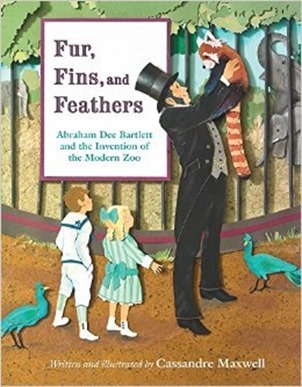
Review: Fur, Fins and Feathers by Cassandre Maxwell

Fur Fins and Feathers by Cassandre Maxwell

Fur, Fins and Feathers: Abraham Dee Bartlett and the Invention of the Modern Zoo by Cassandre Maxwell

As a child, Abraham loved animals. He read all about them, even as he started working as a curator at the Museum of Natural History. As a child he also saw the way that animals were treated, lined up in small cages where they could barely move as people paid to view them. Abraham’s exhibits drew the attention of the members of the London Zoological Society and when they discovered his broad knowledge of animals, they asked him to be the next superintendent of the zoo. Abraham found innovative and kind ways to work with injured animals. He also began labeling exhibits with information about the animals in addition to their names. He figured out that animals need specific diets. Finally, he began to expand the way that the animals were kept, creating larger enclosures filled with trees, where the animals were healthier and people could still view them.

Maxwell has written a captivating biography of Bartlett that focuses on the way that his personal interest in animals led him to revolutionize zoos. Young readers will be dismayed and startled to see the small cages animals were kept in and as the book progresses, they will see the transformation to the modern zoos they know today.

The cut-paper art has an old-fashioned feel that beautifully conveys the 19th century time period. Maxwell incorporates small details of fashion and decor that firmly keep the setting in the past. There are clever touches of other papers with special textures or patterns that make the illustrations worth looking at closely.

A clever and fascinating biography of the man who created modern zoos, this book would be a welcome read for any class before a trip to the zoo. Appropriate for ages 7-11.

Reviewed from copy received from Eerdmans Books for Young Readers.