The Branch by Mireille Messier

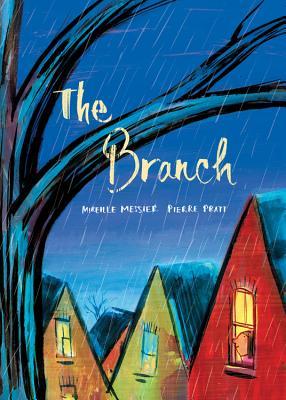
The Branch by Mireille Messier

The Branch by Mireille Messier, illustrated by Pierre Pratt

Released September 6, 2016.

During an ice storm, a little girl is awakened by a loud sound outside. It turns out to be her favorite branch falling from the tree in her yard. It was the branch she played on, dreamed about and that was a big part of her day. The little girl asks to keep the branch after finding out that it can’t be reattached to the tree and her mother agrees. Her neighbor is next door with his chain saw and the girl stands guard so that no one takes her branch. Her neighbor, Mr. Frank, sees her standing there and asks about her branch. He sees “potential” in it and offers to help her make something with it. It turns out to be just the right solution, one that helps the girl remember the fun she had and looks forward to future happiness too.

Messier conveys the little girl’s emotions very clearly. From the feel of the fallen branch to her attachment to it to the importance of creating something new with it. Each moment echoes with emotions, creating a book that is conducive to discussing feelings with young children listening to the story. The book is also anchored in sensations, the feel of the icy branch in her hands, the noise of the chain saw, the hard work of transforming the branch into something else.

The illustrations by Pratt are filled with deep colors that brighten the pages. The beauty and destruction of the ice storm are captured, each branch encased in ice. The change is seasons is also nicely shown, moving from ice and snow to green in the illustrations.

A book about resilience, connections to nature and its power, and the value of memories, this picture book is full of potential itself. Appropriate for ages 4-6.

Reviewed from e-galley received from Kids Can Press and Netgalley.
School’s First Day of School by Adam Rex

School's First Day of School by Adam Rex

School’s First Day of School by Adam Rex, illustrated by Christian Robinson (InfoSoup)

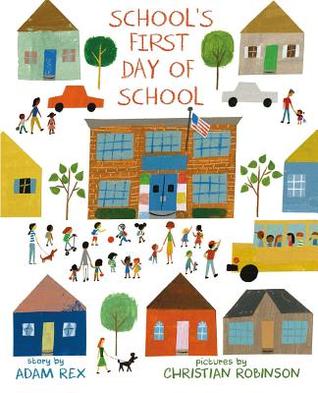
Over the summer, a school was built. The school liked its name, Frederick Douglass Elementary. It liked the quiet summer days with just the janitor who warned the new school that soon it would be full of children. But the school wasn’t sure that it liked the idea of children! And when they did arrive, there were so many of them. They went everywhere. Some children didn’t like being at school, and one little freckled girl in particular caught the school’s attention. As the day went on though, the school started to see what he was built for and the children who didn’t want to be there also started to understand why they were there too.

What a clever clever premise for a book! It takes the school building itself and gives it the angst of the first day of school, the wonder about all of the different kinds of things that go on from the play structures to the classrooms and the cafeteria. Steadily with apparently no effort at all, children will be introduced to all of the parts of an elementary school. They will also find that their fears mirror that of the school and that all they need to do is give it the first day and see how that goes. Like the school, they might just be looking forward to the second one!

The illustrations by Robinson are merry and bright. They too add to the calming feeling of the book, creating a look that is friendly and soothing at the same time. The children are from all different backgrounds, creating a dynamic and diverse atmosphere. The school itself somehow exudes personality, even managing to look at little embarrassed about the fire alarm.

A marvelous book for first-day jitters, this picture book will be loved by everyone headed to their own school. Appropriate for ages 4-7.

Reviewed from library copy.

Steamboat School by Deborah Hopkinson

Steamboat School by Deborah Hopkinson

Steamboat School by Deborah Hopkinson, illustrated by Ron Husband (InfoSoup)

A young boy is sent to Candle School by his mother, though the truth was the he was not very excited to go. His older sister Tassie almost has to drag him there, because he wanted to stop and see everything along the way. They headed down into the dark basement of a church where there were no windows. The school was run by Reverend John who shared his own story of being born a slave and then working to earn the freedom of himself and those he loved. Then one day men came to the Candle School and declared it closed since the State of Missouri had changed the law and no children of color could be taught to read or write. The school closed, but Reverend John did not give up and soon had his school floating in the middle of the Mississippi on a steamboat where the Missouri law could not impact them.

This picture book is based on the true story of Reverend John Berry Meachum whose story is given in more detail in the Author’s Note at the end of the book. The picture book is told through the eyes of a young boy who attends Meachum’s school and then works to reestablish it on the steamboat and pass the quiet word of the school reopening. Throughout the book there is a strong sense of purpose, of the importance of learning to read but also the importance of standing up for what is right.

The illustrations by Husband are exceptional. Using muted colors and fine lines, they capture the darkness of the school and the light on the children’s faces. They show the sorry of losing the right to learn and then the joy of growing up educated and looking to the future.

A luminous look at the harrowing life of African Americans even if they were free in the 1800s, this picture book is beautiful and filled with strength. Appropriate for ages 7-9.

Reviewed from library copy.


Ming Goes to School by Deirdre Sullivan

Ming Goes to School by Deirdre Sullivan

Ming Goes to School by Deirdre Sullivan, illustrated by Maja Lofdahl (InfoSoup)

It is Ming’s first day of preschool. She says hello to new classmates and goodbye to her father. She does show-and-tell and builds sand castles. But she isn’t quite ready for the big red slide. In winter, she makes snow angels. Rests inside in the warmth and has tea parties. In spring she finds worms in puddles and makes flowers for the windows. Finally, it is the end of school. And just then, Ming realizes that she is ready for the big slide after all.

There is a lovely sense of time passing in this book, of seasonality without that being the main focus of the story. Ming herself doesn’t struggle to fit in with her classmates at all. Instead the focus is on what happens in a preschool classroom as the seasons pass and meanwhile the red slide waits, showing up occasionally throughout the book and just being there until Ming herself is ready. There is no sense of pressure for Ming to use the slide and no feeling of anxiety about it either. It is just there and ready to be conquered whenever Ming herself feels up to it.

The illustrations make this book exceptional. Painted with a softness and filled with light, the illustrations are simply gorgeous. They portray the warmth and friendliness of a preschool class, somehow exuding the feel of safety and kindness as well. They are bright yet subdued too and calming.

A lovely book for a child heading to preschool for the first time, this picture book will show there are slides that can wait to be climbed until the time is right. Appropriate for ages 3-5.

Reviewed from library copy.


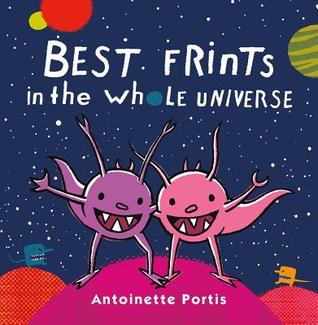
Best Frints in the Whole Universe by Antoinette Portis

Best Frints in the Whole Universe by Antoinette Portis

Best Frints in the Whole Universe by Antoinette Portis (InfoSoup)

Yelfred and Omek come from the planet Boborp where they have been best frints since they were little blobbies. They do everything together from eating yunch to playing eye ball. But sometimes even playing eye ball can lead to a long argument. For his birthday, Yelfred gets a space craft to ride around. He doesn’t want Omek to borrow it because he’s sure that Omek will crash it. When Omek takes it anyway and manages to shmackle it up, Yelfred uses his teef and not his words to express himself. Slowly, their friendship manages to repair itself just like they repair the space craft together.

The wordplay in this picture book is great fun. Portis takes English words and makes them just related enough and placed nicely into context so that the Boborp language can be understood. It makes the picture book a great pick for reading aloud. She also uses a lot of humor throughout the book, comparing the lovely behavior of Earthlings to the rather naughty behavior of those on planet Boborp, when actually the behavior is definitely seen here on Earth too. Children will love the language play and the laughter.

The illustrations are modern and bright with a vintage flair. The two aliens are delightfully friendly on the page, though their teef are quite sharp. The illustrations are critical in helping decode the language and in repairing the space craft and the friendship.

A laugh-out-loud picture book full of playfulness and fun. Appropriate for ages 4-6.

Reviewed from library copy.


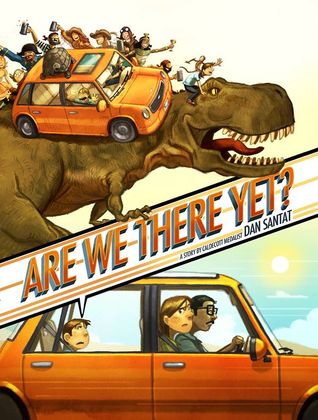
Are We There Yet? by Dan Santat

Are We There Yet by Dan Santat

Are We There Yet? by Dan Santat (InfoSoup)

Caldecott Medalist Santat shows the beauty of a bored mind in his new picture book. On a long car ride to his grandmother’s house, a boy gazes out his window and his brain gets bored. Then time seems to stretch and slow down. The world shifts with the book turning entirely upside down! Suddenly the car is back in time. Next to a steam train with bandits and aboard a pirate ship. They make it to medieval times and then back to the building of the pyramids. Finally, they are all the way back to the time of the dinosaurs.Time can start to move again, too quickly and they find themselves in the future. Then suddenly, they are at Grandma’s house where the boy is all too willing to head back home.

Santat takes the classic dull car ride that every child has experienced and shows how imagination can change the entire trip, aided by a healthy dose of boredom. Told primarily in images, this story does have commentary by the boy and his parents as well as a framing narrative that speaks to the power of boredom. The flip of the book is cleverly done where you have to turn the pages backwards guided by the helpful arrows to remind you. It feels different and wild, adding to the experience.

It is the illustrations here that make the book so much fun. There are small touches like Beekle toys in the car that tie this to Santat’s other works. Watch the parents’ clothing change with each new time period as well as their over-the-top reactions to what they are seeing. The images change from comic-like frames to large double-page spreads. The space is used very intelligently, allowing for new reveals with page turns and creating tension as they move through time.

A great new picture book from a master author/illustrator, this picture book will have you looking forward to your next car ride. May it be filled with boredom. Appropriate for ages 4-6.

Reviewed from library copy.

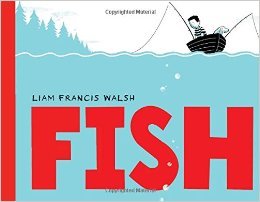
Fish by Liam Francis Walsh

Fish by Liam Francis Walsh

Fish by Liam Francis Walsh (InfoSoup)

A boy and his dog head out onto the lake to fish one morning. Both boy and dog have their own fishing poles. They first catch the letter F. Then the letter I. The letter S is next. But beware the huge letter C that is circling the boat. When they hook a Q, it is thrown back into the water. Soon though they are caught in a whirlpool of letters, swept underwater among schools of them zigging and zagging. When the boy makes it back to the boat, he has the H under his arm, but loses it as the huge letter C reappears. Not to worry, his dog has saved the day with the H to complete FISH. But was that what they were trying to catch?

This wordless picture book depends on its wonderful illustrations to carry the story. And do they ever! Done with a limited color palette of pale blue and bright red, they shine on the page. Each character also shines with personality and energy. The ending of the book is very satisfying, especially since all readers will think that the goal was to catch FISH when actually it was to do something entirely different. It’s a great twist that is filled with jolly cheer.

A standout wordless picture book that illustrates how letters form words in the most energetic and playful of ways. Appropriate for ages 2-4.

Reviewed from library copy.


Lion Lessons by Jon Agee

Lion Lessons by Jon Agee

Lion Lessons by Jon Agee (InfoSoup)

A boy heads into a shop to take lessons in being a lion. First he has to don the appropriate outfit, complete with mane. His instructor is a professional and informs him that there are seven steps to becoming a lion. First though they have to stretch. The first step is looking fierce, but the boy’s poses don’t impress his teacher. The second step is roaring, but the he wasn’t loud enough. The third step was what to eat and the boy only wanted spaghetti, not the various animals. Prowling Around came next but the boy kept forgetting his tail. Sprinting had the boy running far up a hill and exhausted by the end. Pouncing didn’t work at all. Looking Out for Your Friends though suddenly had the boy acting a lot more lion-like than ever before!

I love Agee’s surreal picture book and his absurd look at life. This picture book is a delight with the farcical attempts of a boy trying to act like a lion alongside the stern professorial lion himself. The pairing of the two of them is wonderfully funny. Children will relate easily to the joy of pretending to be an animal and will see the humor in this much more formal way to learn something that is usually done so casually.

Agee’s illustrations are done in his signature style that is minimalist and effective. The illustrations are simple and will work well with a group thanks to their large format. There is plenty of humor in the illustrations as well, from the lion stretches as yoga poses to the glower of the lion himself. It is all filled with lovely timing too, all designed for maximum joy.

A great and surprising pick for back-to-school, this picture book will have them roaring with laughter. Appropriate for ages 4-6.

Reviewed from library copy.

City Shapes by Diana Murray

City Shapes by Diana Murray

City Shapes by Diana Murray, illustrated by Brian Collier (InfoSoup)

Various shapes are shown in a vibrant urban city in this picture book. A young girl walks through the city, takes public transportation and notices shapes as she goes. There are the squares of boxes and trucks. Rectangles form glass on the skyscrapers, windows and benches. Triangles are flags and sails. Wheels are circles along with manhole covers. Musical instruments in a band show oval shapes in their drums and lights. Diamonds fly as kites and stars fill the night sky. The girl returns home to bed, just as the pigeon who took flight on the first page returns to her nest, both listening to the noises of the city around them.

This dynamic picture book celebrates the beauty of urban life, the movement and rush of it all, the variety you find there. Seen through the lens of finding shapes in real life, this picture book would be a great way to look outside your own windows and see shapes there too. The bright friendliness of the city streets makes for a refreshing picture book. The text reads as a poem, filled with rhymes and rhythms that match the city setting.

Collier’s illustrations are a gorgeous mix of media, incorporating collage in a way that makes the shapes stand out but also fit into the setting too. It’s very cleverly done. The little girl in the book is based on Collier’s own young daughter. Her face is filled with enthusiasm throughout the book, her attitude wonderfully contagious.

A beautiful, colorful and shape-ly book that celebrates urban life. Appropriate for ages 3-5.

Reviewed from library copy.