The Night Gardener by The Fan Brothers

The Night Gardener by The Fan Brothers

The Night Gardener by The Fan Brothers (InfoSoup)

William wakes up one morning to discover that the tree outside his window has been changed into an owl topiary. Day by day, more topiary appear along Grimloch Lane. There is a cat, a rabbit, a parakeet, and an elephant. Then one day, there is a dragon, that inspires the community to hang lanterns in its branches and along the road. It is that night that William notices a stranger with a ladder walking along. He follows the man to the local park where the man turns and invites William to help him. It is the night gardener and William helps him until he falls asleep. The next morning William awakens to see the park transformed by his work. As seasons change, the topiary disappear but the community spirit doesn’t.

This is one beautiful book. The text is simple, allowing the detailed illustrations to shine. Still, the text has gorgeous moments such as William watching the first topiary until it was too dark to see it anymore. This book is slow and steady, magical but also homely. It is filled with community spirit that readers can watch build steadily as the night gardener gives his gifts.

The community spirit is shown as homes with boarded-up windows turn into a dynamic community right before their eyes. The illustrations are beautiful, filled with touches that show the where the gardener gets his inspiration. The illustrations tell much of the story, showing that William lives in an orphanage and vividly demonstrating the inspiration a community can get from art.

A gorgeous and vibrant read, this book can be paired nicely with Lane Smith’s Grandpa Green for a topiary triumph. Appropriate for ages 4-6.

Reviewed from copy received from Simon & Schuster.

Miss Mary Reporting by Sue Macy

Miss Mary Reporting by Sue Macy

Miss Mary Reporting: The True Story of Sportswriter Mary Garber by Sue Macy, illustrated by C. F. Payne (InfoSoup)

Mary Garber was one of the first female sports journalists in the United States. At a time when women were not newspaper reporters, Mary was a sports reporter. Her big break came during World War II when the men were sent to war. After the war, Mary was moved to a news desk but then a year later permanent came back to sports. She was there to witness Jackie Robinson join the Brooklyn Dodgers. Mary herself was barred from the press box and forced to sit with the coaches’ wives rather than the other reporters until her editor complained. Locker rooms were also a challenge. Mary continued writing about sports for more than 50 years, retiring in 2002. Along the way she garnered awards and honors and a reputation for being fair and unbiased.

Macy captures the story of this groundbreaking woman beautifully. The tone is playful and humble with Garber’s quotes often given credit and thanks to others rather than taking praise for herself. At the same time, one understands the courage it took for Mary to continue doing this job in such a male-dominated field. This story is inspirational in the best possible way.

Payne’s illustrations add to the playful feel of the title and the humor. Mary is shown as very petite, dwarfed by those around her. Yet she is clearly the center of attention on the page, her face lit from within by her big eyes and large glasses. Her short hair and can-do attitude mark her uniquely on the page as well.

A great picture book biography to share with children who enjoy sports or writing. Appropriate for ages 7-9.

Reviewed from copy received from Simon & Schuster.


There Is a Tribe of Kids by Lane Smith

There Is a Tribe of Kids by Lane Smith

There Is a Tribe of Kids by Lane Smith (InfoSoup)

A boy sets off on a journey alone and encounters all kinds of creatures along the way. There is a tribe of young goats (kids). There is a colony of penguins, a pod of whales, a flight of butterflies, and much more. He also sees different groups of objects like a formation of rocks, a family of stars, and a growth of plants. Finally his journey ends as he meets up with a tribe of children (kids) who wear outfits of leaves just like he does. He is clearly home again.

This book is filled with collective nouns. There is one after another that manage not only to show children the beauty of the language of collective nouns but also move the story ahead. They form into a cohesive journey for our young hero to embark upon. It is a book that only works this well due to the skill of the author.

Smith is of course also a great illustrator and here his illustrations shine. They show a playful magic that is impressive. They are filled with textures that were created by oils being sprayed with acrylic varnish. The result looks like sponge painting and fills the book with space and light.

A masterful look at collective nouns that is also a great read aloud. Appropriate for ages 4-6.

Reviewed from library copy.

Excellent Ed by Stacy McAnulty

Excellent Ed by Stacy McAnulty

Excellent Ed by Stacy McAnulty, illustrated by Julia Sarcone-Roach (InfoSoup)

Everyone in Ed’s family is excellent except for Ed. He doesn’t understand why he isn’t allowed to eat at the table, ride in the van, sit on the couch or use the inside bathroom like the rest of the family. So he decides that he’s just not good enough and sets out to find something that he is the best in. But each time he finds something, one of the others in the family shows how much better they are than he is at exactly that thing. Finally, Ed shows why he is the perfect pet in a perfect family, though he still wonders about the inside bathroom.

This book uses humor and a dog’s perspective to take a look at being the underachiever in a family. The family is oblivious to Ed’s self-esteem crisis, continuing to excel and to applaud one another along the way. The book is cleverly crafted with Ed figuring out what he is good at and then another family member putting a twist on it and showing a new interpretation of the skill. Additionally, the list of things that Ed isn’t allowed to do serves as the basis for what he is actually very good at. It’s a lovely concept that brings the entire book full circle.

The illustrations are jaunty and delightful. In a book about a dog and not about race at all, it is great to see a family of color as the central figures. There is a lot of energy throughout the book and it is made all the more energetic by the illustrations which pack plenty of action on each page, moving the book along at a lively pace.

Dynamic, funny and very satisfying, this picture book is dog-gone good. Appropriate for ages 4-6.

Reviewed from digital galley received from Penguin Random House and Edelweiss.

Hammer and Nails by Josh Bledsoe

Hammer and Nails by Josh Bledsoe

Hammer and Nails by Josh Bledsoe, illustrated by Jessica Warrick (InfoSoup)

Darcy’s day is ruined when her best friend gets sick and has to cancel their playdate. Her father suggests that they do a Darcy-Daddy Day instead, where they pick alternating things from their to-do lists until both lists are done. They start with coffee time, or chocolate milk time for Darcy. Then comes dress up where Daddy gets super fancy in a tutu and flannel shirt. Next the lawn gets mowed in a glamorous way. Hair Salon comes next until both Darcy and Daddy are fabulous. Laundry is a sock battle and then a quest to match each sock. The day ends with repairing the fence, something new for Darcy to try, and a manicure for the both.

An ideal father and daughter book that shows how open minds and playfulness can save a day from disaster. Parents will recognize their chores as the day goes on and then their aches and pains after playing too hard. Children will love seeing a dad get into imaginative play, wearing both a tutu and a headband with no care at all. There is a real sweetness to this book that captures the adoration between a father and daughter and one special day they shared together.

Warrick nicely captures the play as the two of them have their day together. Princess dresses and tutus get grass stained and hammers nicely fit into red purses too. The lawnmower takes on royal status with its umbrella and garlands too. Each little flourish is used to great effect and the interplay between the two characters is radiant.

A testament to the power of positive parenting, this picture book will be loved by fathers and daughters alike. Appropriate for ages 3-5.

Reviewed from library copy.


This Is Not a Picture Book by Sergio Ruzzier

This Is Not a Picture Book by Sergio Ruzzier

This Is Not a Picture Book by Sergio Ruzzier (InfoSoup)

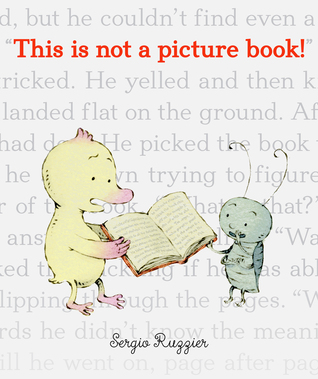
Duck discovers a book that doesn’t have any pictures in it. He takes a look at it but kicks it away. When his friend Bug asks if he can read it, Ducks starts to try. But words can be difficult to read. He does see some words that he knows and keeps on trying. Soon Duck is finding that words can take him special places, on wild adventures or into quiet calmness. Words can be funny or sad. And words return you home again in the end, where they stay with you. Even in a book with no pictures!

Ruzzier has created a picture book that proudly sends children on their way to harder reads where they won’t have pictures to ease the way. The way that Duck deals with it, first to be frustrated and then to work hard at it speaks volumes about the way that children work to learn to read better and better. There is also a strong and soaring message about the power of words themselves and how they can convey emotions and meaning.

The book design here is wonderful. The end pages are filled with words that are just jumbled enough to be confusing, but if readers work like Duck did, they can puzzle their way into making sense of them. Ruzzier’s illustrations are always a bit wacky with strange landscapes and bright colors. The settings match what Duck is reading, showing through pictures what the words are conveying.

An inspirational book that will encourage reading, this book certainly IS a picture book that belongs in all libraries. Appropriate for ages 4-6.

Reviewed from copy received from Chronicle Books.


Twenty Yawns by Jane Smiley

Twenty Yawns by Jane Smiley

Twenty Yawns by Jane Smiley, illustrated by Lauren Castillo (InfoSoup)

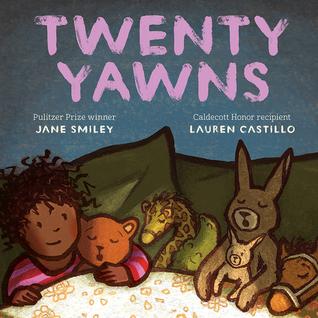
Lucy spent a long time playing at the beach with her mother and father. The three of them played in the waves, dug holes in the sand, and rolled down the dunes. Soon they were all yawning and Mom declared it was a day for early bedtime! As they got ready for bed, everyone was yawning and Lucy’s mom even fell asleep reading the bedtime book. In the middle of the night the moon shone brightly through Lucy’s window and she was suddenly wide awake. She tiptoed out of bed and through the living room where her father was asleep in a chair. Lucy was looking for Molasses, her bear. She found not only Molasses but all of her stuffed animals who all wanted to come with her to bed. Once again everyone was yawning, even the pictures on the wall, as Lucy fell asleep with her bed full of stuffed friends.

Smiley has done a brilliant job of capturing a day at the beach and then the wonder of being awake at night as a small child. She keeps the language simple, so this book can be shared successfully with very small children who will relate to the joy of playing at a beach, the quiet of early bedtime and then the pure loveliness of moonlight, tiptoeing to find a treasured toy and the imagination at play.

Castillo’s illustrations are glorious. She captures the brilliant light of summer sun at a sandy beach, the hours of play, and the languid sleepiness that rolls over you after a day like that. Her illustrations keep the dark night from being dangerous or frightening, instead keeping the house dimly lit and easily navigated. It is much more a delight than a fright to be alone and awake.

A lovely book of celebrating the warmth of both family togetherness and then the joy of being little and awake alone. Appropriate for ages 2-4.

Reviewed from copy received from Two Lions.


This Is My Dollhouse by Giselle Potter

This Is My Dollhouse by Giselle Potter

This Is My Dollhouse by Giselle Potter (InfoSoup)

Released on May 10, 2016.

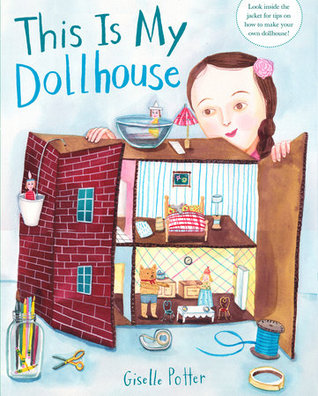
A little girl shows readers the dollhouse she has made from a cardboard box. It is filled with inventive furniture, food made from string and paper, and a set of dolls that don’t all match. The house has an elevator on the side and even a swimming pool on the roof. Then she sees her friend Sophie’s dollhouse where everything matches. The dolls all look the same, all of the rooms match with furniture that is all perfect. But when the girls play a little with the dollhouse, it doesn’t really work. When Sophie comes over, the girl is very nervous about showing her the handmade dollhouse, but soon the two girls are playing together in a way that they never did with Sophie’s perfect dollhouse.

I absolutely adored this book. It captures the wonder of creating your own toys and your own world of play. The cardboard dollhouse and all of the art supplies allows a little girl’s imagination to really soar. The book does include instructions for making your own dollhouse out of a box. And the story also shows how to make furniture from blocks and a TV from a small silver box. Children will be inspired to make their own.

The illustrations here are such an important part of the story. They clearly show that there is a warmth and homeyness to the handmade dollhouse. When the girls play with the perfect purchased one, readers will immediately feel the chill of that dollhouse and realize all that it is missing. This plays so beautifully against children’s own expectations too.

A grand picture book that will inspire creative play and the building of a place for adventures of your own. Appropriate for ages 4-6.

Reviewed from digital galley received from Schwartz & Wade and Edelweiss.

Hector and Hummingbird by Nicholas John Frith

Hector and Hummingbird by Nicholas John Frith

Hector and Hummingbird by Nicholas John Frith (InfoSoup)

A bear named Hector was best friends with Hummingbird. But sometimes Hector wanted to just eat a snack in peace and Hummingbird would not stop talking. He wanted to scratch his back on a tree, but Hummingbird kept chatting. He wanted a nap and Hummingbird wanted to tell a story. One day Hector had had enough and stormed away from Hummingbird and into the jungle. Hummingbird let him go, kind of. But having complete quiet was not what Hector expected and soon he was missing Hummingbird. Luckily, Hummingbird was right there when Hector needed him.

Frith captures the dynamics of friendship in a very clear and clever way in this picture book. You have a rather quiet bear and a very talkative bird and the two of them may be best friends but sometimes it’s too much. Seeing an existing and strong friendship run into problems is a good set up for a picture book where often you are seeing new, budding friendships instead. The choice of animal for each of the characters makes the book a joy to share aloud, from the fast high Hummingbird to the slower and grumpier Hector.

The art in this picture book shines. Filled with lovely tropical colors of bright pinks, greens and teal blues, the illustrations have a vintage feel but a modern zing and energy. The color palette changes when the friends are reunited, becoming even more pink and filled with the energy of their friendship. It’s a clever transition that shows visually what is happening emotionally.

A great pick for friendship story times, this book is a winner as a read aloud. Appropriate for ages 4-6.

Reviewed from copy received from Arthur A. Levine Books.