Review: Peace Is an Offering by Annette LeBox

Peace Is an Offering by Annette LeBox

Peace Is an Offering by Annette LeBox, illustrated by Stephanie Graegin (InfoSoup)

This picture book explores the concept of peace. It begins with simple examples, ones that are found every day like trips to the beach or giving someone a muffin. Peace is also mentioned as being gratitude for simple things in life and the book goes on to elaborate those with kisses, walks and food. The book transitions into questions about support and peace, asking about staying together, drying tears and listening to stories. It then moves to places you can find peace, whether that is with family or even in the wake of a tragedy or a loss. It finishes with a few ideas of how children can create peace themselves, by doing things like walking away from a fight or comforting a friend.

LeBox does so much more than a list of peaceful ideas here. Instead she moves from one stage to the next, showing not only what peace is but how it can be created and strengthened. Readers will appreciate the focus on small and everyday things that either are peaceful or bring peace. Because of that focus, children will not only understand peace as a larger concept from this book but feel empowered to create it themselves.

Graegin’s pencil, watercolor and digital illustrations have children and families from various backgrounds mixed together. Readers can follow the boy with the cast on his arm from the very first page through the book. While he may not appear on all of the pages, he creates a feel of a larger story happening as peace is explored.

A strong and interesting look at peace and the way its created, this book is both inspiring and peaceful. Appropriate for ages 3-5.

Reviewed from copy received from Dial Books.
Review: Wild about Shapes by Jeremie Fischer

Wild About Shapes by Jeremie Fischer

Wild about Shapes by Jeremie Fischer (InfoSoup)

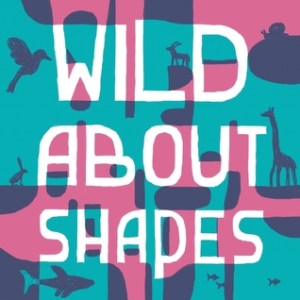
A wonderfully simple idea, this book features abstract patterns on each facing page. Turn the clear plastic page with its abstract design so that it overlaps the first page and suddenly an animal is revealed. While some of the animals can be guessed from the designs or from the short text, many of them are complete surprises. Children will have to be paying close attention to spot some of the animals like the fish made from the white space on the page and the octopus that floats on another.

Spiral bound, this book is printed on card stock that will stand up to little hands. Even the acetate pages are strong and thick, limiting the amount of tearing that libraries will see. The text is very limited in the book, giving full attention to the clever illustrations. They are entirely playful and fun, the book less of a guessing game and more of art that you get to experience.

Children will want to turn the pages themselves, so that they are able to look back and forth between the abstract and the tangible on the page. So it’s best for sharing with only a few children at a time. Appropriate for ages 2-4.

Reviewed from library copy.

Review: Ally-Saurus & the First Day of School by Richard Torrey

Ally Saurus and the First Day of School by Richard Torrey

Ally-Saurus & the First Day of School by Richard Torrey (InfoSoup)

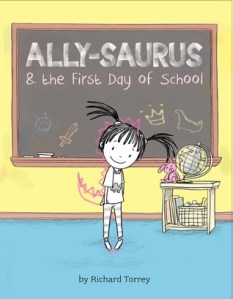
Ally loves dinosaurs, so when she heads off to her first day of school she is hoping to find lots of other kids who love dinosaurs too. But Ally seems to be the only one who is chomping her snack like a dinosaur or answering questions with dinosaur answers. As she starts to talk with the other kids though, she discovers the things that they love too. But some of the kids are not very friendly, like the bossy threesome who loves princesses the best and who don’t let Ally sit at their table during lunch. So Ally sits by herself. She is joined quickly though by other children who want to sit with her and they love dinosaurs and dragons and lunchboxes and lions. Soon she has a group of kids to play with at recess, who are willing to run wild and roar along with her. Even the princesses who snubbed her end up playing along too.

Torrey captures the joy of imaginative play as a child where that subject is all the child thinks about and their major focus of their day. Ally faces her first day of school with positive feelings which is good to see. Torrey doesn’t overplay the negative encounter with other children in the class either, allowing it to unfold naturally and be remedied in the same way. Ally’s use of roaring and munching to make friends adds a silly element that is very welcome in the book, and it also shows the other children who seek her out what kind of girl she is.

Torrey’s art adds to the imaginative play piece of the story. With pastel and black and white illustrations, the imaginative piece looks as if a child drew it on with crayon. As Ally learns more about her classmates they too get their own crayon elements, so the boy interested in astronauts gets a helmet and the princesses get crowns. It’s a clever way to indicate that these are imaginary but still there

A positive and humorous look at the first day of school, this is perfect for sending your own imaginative little one off or for sharing during that first week of school. Appropriate for ages 4-5.

Reviewed from copy received from Sterling Children’s Books and Raab Associates.

Review: Bear and Duck by Katy Hudson

Bear and Duck by Katy Hudson

Bear and Duck by Katy Hudson (InfoSoup)

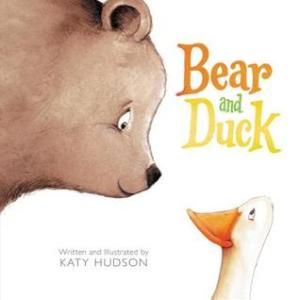
Bear doesn’t want to be a bear anymore. He’s sick of sleeping during the winter, his fur is too hot in the summer, and there are all of those angry bees. Then Bear notices a family of ducks walking along and decides that he could be a duck instead! So he joins their line and starts acting like a duck. But when the adult duck notices Bear in the line of ducklings, he gets sent away. Bear does get a book on how to be the perfect duck. So he starts to work on it. The first step is building a nest and sitting on an egg. But Bear loses his egg in the twigs. Second step is swimming, but Bear splashes too much. The third step is flying, ouch! Bear is thoroughly discouraged and climbs up a tree to hide. From there, he starts to show both himself and Duck the good things about being a bear after all.

This is Hudson’s first book. It has a great freshness to it and an exceptionally light touch. The humor in the book feels unforced and natural. In the middle of the book there is a change to the format focusing on the rules of being a duck, which creates its own pacing and energy. The ending feels organic and real as both Duck and Bear together discover the joy of climbing trees and sharing a treat with a new friend.

Hudson’s illustrations are ink and watercolor which combine into friendly images of flowering meadows, furry bears and swimming ducks. They have the fine details of ink and then the washes of watercolor paint. Hudson enjoys the visual humor of Bear in the line of ducklings and then other times creates touching moments where you can see the characters forming new bonds.

This is the second picture book about bears and ducks trying to live together that has been released this year. Pair it with Room for Bear by Ciara Gavin for a double duck and bear treat. Appropriate for ages 3-5.

Reviewed from copy received from HarperCollins.

Review: My Bike by Byron Barton

My Bike by Byron Barton

My Bike by Byron Barton (InfoSoup)

Tom rides his bicycle to work each day. On the way, he passes all sorts of other vehicles like cars, buses, and trucks. As he gets closer to work, he passes lots of people. Then he passes monkeys, acrobats, tigers, lions and elephants! Once he reaches the tent where he works, he changes into his costume and puts on his makeup. He heads into the circus ring as a clown, ready to do his act. Once he’s up on the tightrope, he hops aboard another mode of transportation, a unicycle.

This jolly picture book will appeal to fans of transportation books and circuses alike. Barton has written other classic titles in this series like My Car and My Bus. The book reviews the various parts of a bicycle and then through very simple sentences and words eventually reveals Tom’s job to the readers. The book is straight forward but cleverly done so that readers will wonder what his job is all along his route to work. The final panel of him riding off in his regular clothes and a clown nose is a great farewell.

Just as with the text, the illustrations are simple too. Done in Photoshop, the art is clean and bold, the colors bright and cheery. The transformation into a clown in handled well and Tom never turns creepy on the reader, instead keeping his friendly demeanor and appearance throughout. The final panel of him riding off in his regular clothes and a clown nose is a great farewell.

The simplicity of both the text and the illustrations make this a great pick for smaller children. Appropriate for ages 2-4.

Reviewed from copy received from Greenwillow Books.

Review: Water Is Water by Miranda Paul

Water Is Water by Miranda Paul

Water Is Water: A Book about the Water Cycle by Miranda Paul, illustrated by Jason Chin (InfoSoup)

A poetic look at the various stages of water in the water cycle, this book moves logically from one to the next as water evaporates, condenses and changes. Seen through the lives of two siblings, the book begins with pages where the children are down near the lake and then rain drives them back home. Once home, they get a glass of water then water is boiled for a cup of cocoa out on the porch. Clouds come out in the evening, lit by the setting sun. Then autumn arrives with its foggy school mornings. Rain falls down as the school bus reaches school and then there are puddles to jump in at recess. Winter arrives with ice and snow and then spring returns with more puddles and mud. Apples are picked and turned into cider that the children drink up.

Shown through seasonal changes and a very personal view, this water cycle book makes everything very tangible and real. At the end of the book children can learn more about evaporation, condensation and precipitation which are tied directly to the forms of water that they experienced in the bulk of the book and the story. Keeping the focus on the ways that children themselves experience the water cycle makes this book particularly accessible.

The illustrations by Chin are done in watercolor and gouache. They are filled with nature and beauty from the wonder of the sky in evening to the bright colors of the fall leaves to the brisk cool colors of winter. The illustrations capture the beauty of weather and forms of water in a vivid way.

A dynamic and personal book about what can be an abstract theory, this book on the water cycle is exactly the sort of science book that will inspire additional investigation in the world and science. Appropriate for ages 4-6.

Reviewed from copy received from Roaring Brook Press.

Review: The Amazing Age of John Roy Lynch by Chris Barton

Amazing Age of John Roy Lynch by Chris Barton

The Amazing Age of John Roy Lynch by Chris Barton, illustrated by Don Tate (InfoSoup)

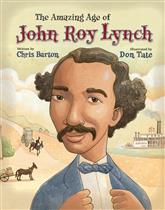
John Roy Lynch grew up as a slave in Mississippi, the son of an overseer who tried to free his children from slavery. Unfortunately, his untimely death led to them continuing to be enslaved until the Emancipation Proclamation. Lynch found a job, his first paying job, on a steamer ship and worked his way up. At age 17, John Roy went to work for a photographer whose studio was right across from a school. Listening in on the classes and attending night school, John Roy was able to learn to write eloquent letters. He also started being active in politics, buying land, and speaking out. He was appointed Justice of the Peace at age 21. Soon he was elected as the Mississippi Speaker of the House and then in 1872, he became the first African-American US Congressman. Throughout, John Roy Lynch spoke to the needs of the people he represented and the importance of civil rights for all.

Barton provides just enough information for children to understand the time period and the implications of the Emancipation Proclamation. This look at the Reconstruction Period offers a view of an important time in American history, one that is often overlooked in children’s books. The amazing fortitude and resilience of John Roy Lynch keeps this book moving as his own life progresses forward in unexpected ways. Clearly it is his intelligence and gift for communication that carries Lynch forward into a very different life than others around him. More information on Lynch is offered in the final pages of the book with a complete timelines and bibliography.

The illustrations by Tate are done with a light touch, creating a book that depicts darker subjects at time but also infusing the book with a sense of hope and wonder. This makes a book covering such a heavy topic as well as such an important part of history much more appealing and approachable.

An important book focused on an important figure in a dynamic time in American history, this picture book biography will inform new audiences about the potential for both progress and defeat during the Restoration. Appropriate for ages 7-10.

Reviewed from copy received from Eerdmans Books for Young Readers.

Review: My Dog Is the Best by Laurie Ann Thompson

My Dog Is the Best by Laurie Ann Thompson

My Dog Is the Best by Laurie Ann Thompson, illustrated by Paul Schmid (InfoSoup)

A little boy adores his dog, despite the fact that the boy is full of energy and his dog…well, he’s not. When the boy offers the dog a ball, the dog dozes off. The boy then demonstrates the tricks his dog can do, like playing dead. His dog can also roll over, while sleeping. And even turn into a ball, still asleep. The plays tug of war, by lying on the boy’s blanket and not moving. And even chase, well, not really. The dog can do so many things, like listen to stories, provide a base for playing with toys and even blow bubbles when the bubble wand is put in front of his dozing face. In the end, the little boy gets sleepy and after a big hug falls asleep next to the dog. The dog wakes up and is ready to play now.

I loved this book with the patient sleeping dog who allows himself to be clambered over, played with, and piled on while he is sleeping. There is no sense ever that the dog is anything other than a very happy and willing partner to all of this. The boy is eager but also gentle, his imagination creating worlds where the dog is an active participant in his merry games. The ending is completely adorable with the boy asleep and the dog awake.

Schmid’s illustrations are just right for this book. Done in simple lines on pastel backgrounds, the illustrations show the lovely interplay between little boy and dog. The round dog makes a perfect foil for the active little boy, one a whirl of motion and the other almost motionless.

A book that celebrates having a pet as a small child and the incredible connection one develops. Appropriate for ages 2-4.

Reviewed from copy received from Farrar, Straus and Giroux.

Review: Look! by Jeff Mack

Look by Jeff Mack

Look! by Jeff Mack (InfoSoup)

A little boy won’t look away from the TV even with a very active gorilla in the room. The gorilla tries wearing books as a hat and then starts balancing them on his nose. The little boy just pushes him to the side. The gorilla ties to balance on three books set end to end, managing to knock the TV over. The boy kicks him out of the room. But the gorilla returns juggling books and riding a tricycle. When he falls over, the TV is broken and smoking on the floor. The boy is furious and kicks the gorilla out. But then a book captures his attention and soon the two are looking at stories together.

Told in just two words, Mack masterfully takes those two words and makes them work in a variety of ways. “Look” and “out” pair up over and over again, creating moments where the gorilla is demanding the boy look, times when the boy throws the gorilla out the door, and other times when disaster is about to happen. It’s a clever use of just the pair of words and the concept really works well.

The art is particularly interesting. The gorilla is a puff of watercolor where his fur is almost touchable on the page. The backgrounds of some of the pages are book covers, used both subtly and to strong effect. The page where the boy is truly angry is filled with ripped paper and jagged edges.

A celebration of books and words, this simple picture book will have new readers and young listeners alike enjoying the interplay of the two characters. Appropriate for ages 3-5.

Reviewed from ARC received from Philomel Books.