Review: Eerie Dearies by Rebecca Chaperon

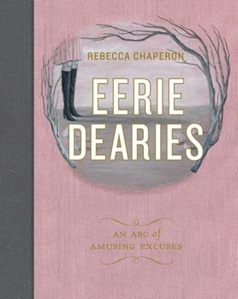
eerie dearies

Eerie Dearies: 26 Ways to Miss School by Rebecca Chaperon

Don’t expect your sunshiny ABC book here!  Instead you get to enter a creepy world where each letter of the alphabet is paired with a way to miss school.  Just to make sure you know what you are getting into, the book begins with A is for Astral Projection paired with a picture of a girl floating off the page.  The images are haunted and dark, yet with a quirky sense of humor as well.  The book goes on with the alphabet with C is for Contagious, K is for Kidnapping, and M is for Mononucleosis.  It all ends with Z is for Zombie Apocalypse. 

This book certainly is not for everyone.  But for those kids who enjoy a shiver along with their ABCs, this is a perfect picture book.  I was one of those strange kids myself and would have adored this picture book as a child.  The art is creepy, showing children without heads and clearly hearkening back to Edward Gorey and gothic horror.  Yet there is no blood on any of the pages, so it’s not graphic in any way.

This book will work well around Halloween, but thanks to its sense of humor will please haunted children throughout the year.  Appropriate for ages 6 and up.

Reviewed from library copy.
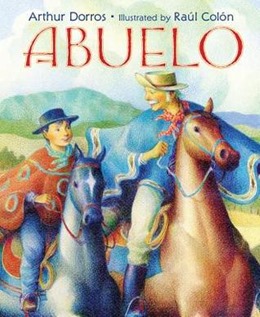
Review: Abuelo by Arthur Dorros

abuelo

Abuelo by Arthur Dorros, illustrated by Raul Colon

A boy and his grandfather spend time together riding horses and camping.  They have adventures outdoors losing the trail and even facing a mountain lion.  His grandfather taught him to stand strong like a tree.  Then one day the boy moved with his family to the city, leaving his grandfather behind.  The city was very different.  The stars were hard to see, but they were the same stars.  The boy learned to use what his grandfather taught him in the countryside.  He even stood up to a bully on the first day of school, standing strong as a tree.

Told in graceful free verse, this book reads quickly rather like a brisk horseback ride.  Completely controlled and peppered with Spanish, the book evokes the freedom of the countryside and also the lessons of strength being taught across generations. 

Colon’s illustrations evoke the differences between the country and the city.  The open freedom of the countryside is contrasted against the constraints of the city, yet the sky ranges wide above both and there is freedom when riding your bike just as when riding your horse. 

Free verse mingles with the freedom of the range in this multi-generational title, a perfect masculine accompaniment to Dorros’ Abuela.  Appropriate for ages 4-6.

Reviewed from copy received from HarperCollins.

Review: Galapagos George by Jean Craighead George

galapagos george

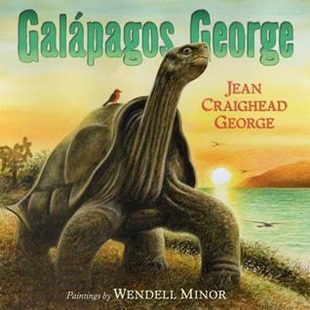
Galapagos George by Jean Craighead George, illustrated by Wendell Minor

A story of evolution and extinction, this picture book explores the incredible life of the famous Lonesome George a tortoise who was the last of his kind.  The book begins by explaining how a million years ago a tortoise was driven from South America and carried to the island of San Cristobal near the equator.  There she laid eggs, used her long neck to reach food, and passed on her genetics.  Thousands of years later, all of the turtles looked different with long necks and shells that curved back to give their necks more room.  When humans discovered the Galapagos Islands, they quickly decimated the turtle population which dwindled down to only a few thousand from the hundreds of thousands that had lived there.  A hundred years later, the giant tortoise population had reduced even further, so that one lone turtle remained.  He was moved to the Charles Darwin Research Station and protected but no other turtle of the species was ever found.

George creates a vivid story of the power of evolution in our world and the effects of humans on animal species.  She steadily shows how weather forces and natural disasters impact animals as well, moving them from place to place and changing their habitats.  As the animals change slowly, George keeps the text clear and factual, making for a book that moves quickly and is filled with fascinating scientific information.

Minor’s illustrations are lush and lovely.  They are filled with the light of sun, bursting on the horizon in tropical colors.  He also shows the barren landscape of the Galapagos clearly and the frank regard of a tortoise looking right at the reader.  There is a sense of loneliness for much of the book both when the book is about the first tortoise and then later when there is one left.  That connection between the two lone turtles is made clearly in the illustrations.

Fascinating, distressing and yet ultimately hopeful, this nonfiction picture book will work well in science classrooms as well as library collections.  Appropriate for ages 6-9.

Reviewed from copy received from HarperCollins.

Review: The Mermaid and the Shoe by K.G. Campbell

mermaid and the shoe

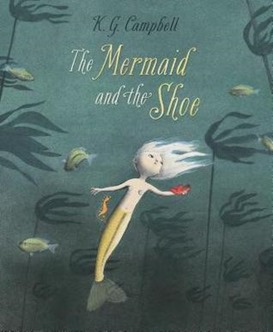
The Mermaid and the Shoe by K.G. Campbell

King Neptune’s 50 daughters are all special and talented in their own ways.  All except for Minnow who tries to be like her sisters, but only manages to ask lots and lots of questions about things.  Minnow did not fit in with her sisters at all, often drifting alone on her own.  Then one day, she found a remarkable object in the water, a red shoe.  She tried asking her sisters what it was for, but none of them knew, so Minnow headed out to answer her own questions and find out what the red object was for.  Minnow swam closer and closer to shore, discovering answers to some of her other questions like why crabs don’t have fins.  Then she found out exactly what shoes were for and headed home to tell the others.  In the end, Minnow not only discovers the answers she is looking for, but she discovers exactly what her special talent is too.

Campbell, author of the uproarious Lester’s Dreadful Sweaters, returns with a quieter book that shows the same sort of depth as the first.  This book beautifully wrestles with deep questions about one’s purpose in life and how to remain true to oneself rather than give in to external pressure.  Disney’s The Little Mermaid comes to mind throughout the story, but in the end this is a unique mermaid story that holds up well against the Disney version.

The illustrations are rather haunting.  They pair the darkness of the deep water with a near glowing brightness of the mermaids.  The mermaids have drifting white-blonde hair that moves with the currents, fish tails that look like real fish, and small seashells to cover their chests. 

Beautiful, quiet and deep like the ocean, this book will find readers in Little Mermaid fans who may just have found a new favorite mermaid to adore.  Appropriate for ages 4-6.

Reviewed from copy received from Kids Can Press.

Review: Count on the Subway by Paul Dubois Jacobs

count on the subway

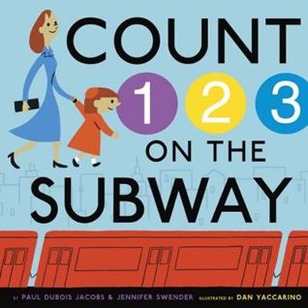
Count on the Subway by Paul Dubois Jacobs and Jennifer Swender, illustrated by Dan Yaccarino

Told in a bouncy rhyme, this picture book counts its way through a trip on the New York City subway.  It starts with a mother and daughter heading down the steps into the subway and counting their one MetroCard.  They go down 2 flights and catch the 3.  Onward the story goes, merrily counting the turnstiles, the people, seats and stops.  Once the book reaches ten, it counts its way right back down again, ending when the pair climb there way up into the one and only Union Station. 

The rhyme here is completely infectious.  It bounces along, skips and dances.  It appears effortless and free and is very readable.  In fact, it is hard not to read it aloud.  The illustrations by Yaccarino show the main characters in full color while the others are one solid color and a black outline or just a colored outline.  It makes for a book that is bright and bold. 

Perfectly paced and brightly rhythmic, this counting book will be enjoyed by all sorts of children, not just the ones who have taken a subway before.  Appropriate for ages 2-4.

Reviewed from copy received from Random House Children’s Books.

Review: Under the Freedom Tree by Susan

under the freedom tree

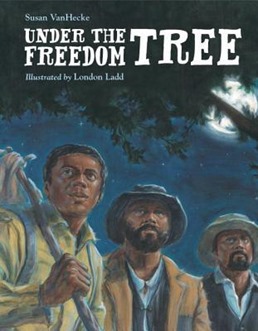
Under the Freedom Tree by Susan VanHecke, illustrated by London Ladd

Told in free verse, this picture book is the story of how the first contraband camp formed during the Civil War.  It all started with three runaway slaves who escaped across a river to a Union-held fort.  Though the Confederate Army tried to demand their return, the general at the fort declared them “contraband of war” and offered them protection and a place to live.  The three were quickly joined by a flood of people crossing the line into Union territory and they began to build a home for themselves near the fort.  The freedom tree is the Emancipation Oak which stood witness to the events that unfolded, including the Emancipation Proclamation, which set all of the residents of the camp free.

VanHecke’s verse is loose and beautiful.  She captures the danger the slaves faced in crossing the Confederate line, the risks they took asking for shelter, and the clever solution found by the general.  She offers an author’s note in prose to give more historical context to the camp and the Emancipation Oak. 

Ladd’s illustrations are lush and detailed.  His paintings capture the hope of emancipation, the darkness of escape by water and night, and the beauty of the oak.  The illustrations clearly honor the first three men who escaped to the fort, showing them as they wait for the judgment of whether they must return to slavery or not. 

A little-known part of the history of the Civil War, this book in verse pays homage to the courage of the men who created the contraband camp.  Appropriate for ages 6-10.

Reviewed from copy received from Charlesbridge.

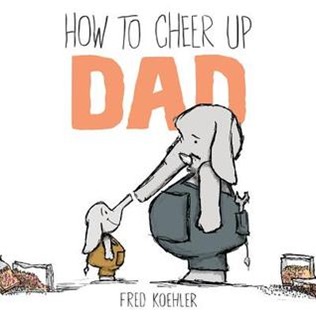
Review: How to Cheer Up Dad by Fred Koehler

how to cheer up dad

How to Cheer Up Dad by Fred Koehler

Little Jumbo’s dad is having a very bad day, but Little Jumbo can’t figure out why.  When Little Jumbo spits his raisins at the ceiling, his dad should have remembered not to put them in his oatmeal since Little Jumbo doesn’t like them.  His dad also should have remembered that Little Jumbo doesn’t like his brown overalls, but he didn’t so Little Jumbo ran out of the house naked.  Little Jumbo had to figure out how to cheer up dad, especially after getting a time out when it seemed like Dad needed one himself.  So Little Jumbo sets out to make the perfect cheering-up afternoon with Dad, and it works.  Maybe.

Koehler tells one story with his words and another in the pictures.  This makes for great fun especially with his dead-on sense of timing for humor.  The story is told in Little Jumbo’s voice, but the images show the point of view of the father quite clearly and the mishaps that Little Jumbo has all morning long.  The blissful afternoon together makes this book a little deeper and less madcap, much to the book’s credit.  But the final twist at the end brings the laughter right back again.

Koehler’s art will appeal to fans of Mo Willems with its clear lines, silly humor and a strong relationship between the two characters.  Little Jumbo and his father are two charming characters who related together with a mix of frustration and love. 

Filled with laughs, this is sure to cheer up bedtime at any house but particularly if shared by a dad.  Appropriate for ages 4-6.

Reviewed from copy received from Dial.

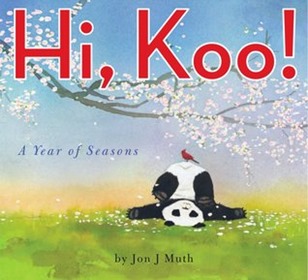
Review: Hi, Koo! by Jon J. Muth

hi koo

Hi, Koo!: A Year of Seasons by Jon J. Muth

Join Koo, a panda, on an exploration of the seasons through haiku poems.  The book begins with fall and haikus about fall leaves, wind, and rain.  Winter comes next with poetry about snow and ice.  Spring is bridged into with a glimpse of crocuses and then grass, insects, and birds.  Summer arrives with fireflies, flowers and water.  In 26 poems, this is a lovely celebration of the small things that make each season special.

Muth has created haikus that are beautifully written.  They capture small moments in time and also point to the larger importance of these moments.  They continue Muth’s Buddhist focus in his picture books, offering children a way to see these times of mindfulness as important and worthy of exploration. 

Muth’s watercolor illustrations have a wonderful spirit to them.  The palette changes colors as the seasons change with spring bouncing in green especially after the white cold of winter.  He captures the seasons so well that your attitude changes with each season as well.

A stellar collection of haiku, this book will invite young readers to see nature and seasons in a fresh new way.  Appropriate for ages 5-9.

Reviewed from copy received from Scholastic.

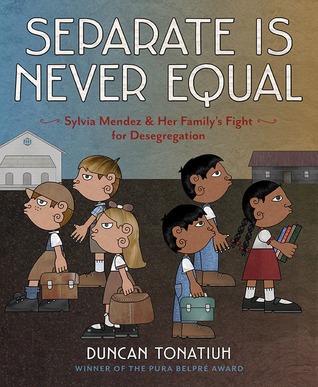
Review: Separate Is Never Equal by Duncan Tonatiuh

separate is never equal

Separate Is Never Equal: Sylvia Mendez & Her Family’s Fight for Desegregation by Duncan Tonatiuh

Explore an early battle for desegregation of the California public schools in this picture book.  In a court battle that took place seven years before Brown v. Board of Education, Sylvia Mendez and her family fought the system.  Having been placed in a Mexican school rather than a “whites only” one due to her Mexican and Puerto Rican heritage, Sylvia and her family realized that she was being given a second-class education because the facilities and teachers were much better in the white school.  After appealing the school placement, the full extent of the racism of the system was revealed as the school proceeded to inform Sylvia who spoke perfect English that the other school would help her learn English better.  Sylvia’s parents took the battle to court and also organized the Hispanic community to find other students who were being clearly discriminated against.  This is a book where people took on a fight for what was right and managed to get things changed. 

Tonatiuh emphasizes the small and poor vs. large government and wealth throughout this book.  He makes sure that young readers understand the extent of the racism against Hispanics and the reality of the policies that they were living under.  The issue is complex, but he keeps it clear and concise, offering a solid view of the courage that it took for the Mendez family to fight the system and also making it clear why they were able to fight back when others could not.

Tonatiuh’s stylized illustrations pay homage as always to folk art.  His characters have glossy hair in different colors that are cut-outs of photographs.  The same is true of the fabric of clothes and other objects.  This is paired with a flat paint and clear black outlines making a combination that is modern and ageless. 

An important addition to the civil rights history of the United States, this nonfiction picture book tells a story of courage and determination.  Appropriate for ages 6-9.

Reviewed from copy received from Abrams.