Review: Pomelo’s Opposites by Ramona Badescu

pomelos opposites

Pomelo’s Opposites by Ramona Badescu, illustrated by Benjamin Chaud

Pairs of opposites are shown together, one on each page.  But this is no regular opposites book, instead it is filled with sly humor.  The first surprise is how think this small square book is with page after page of opposites, more than you would have thought possible.  And it’s those unusual opposites, the ones that you have to stretch to understand that make this such a winning little book.  There are the expected opposites like far and near, left and right, high and low.  Turn a few more pages though, and you will see dream and reality, handsome and weird.  Filled with surprise after surprise, this is an opposite book that children of all ages will enjoy.

Chaud’s illustrations are really the winners here.  The text is so simple, just word pairs that the illustrations have to carry the book.  In and out is shown as eat and poop, which is sure to delight children.  Others are completely strange like evident and unimaginable.  I’ll let you explore to find out the images for that. 

This is a book that gets you thinking about the nature of opposites.  Children can use it as a jumping off point for creating their own unusual opposites and illustrating them.  Or just read it and laugh out loud at the great surprises waiting for you.  Appropriate for ages 3-6.

Review: Fog Island by Tomi Ungerer

fog island

Fog Island by Tomi Ungerer

Always expect to be surprised by a picture book by Ungerer.  The Three Robbers is one of our favorites in our house and we’ve also loved the short film of the book and quote lines and sing the song from it years later.  This new book from Ungerer has some of the feel of that earlier title, with fog and darkness and danger.  It is the story of Finn and Cara who lived by the sea.  Their father built them a small boat, a curragh, and warned them to only use it in the bay and never go near Fog Island because people who go there have never returned.  But one day, the two of them were trapped in the fog and a current pulled them out of the bay and towards the doomed island.  Once there, they explored and met the Fog Man, who created the fog from sea water and heat from the center of the earth.  He entertained them and fed them well, but when they awoke the next morning, they were in a ruin rather than his castle.  But where had the warm quilt and hot stew come from?

Ungerer weaves a tale of rural life by the sea and folklore together.  The book could be set during any time at all, with the timeless nature of the story and the way of life.  It has the cadence of a story from oral traditions.  He takes the time to fully introduce the characters, the setting and create a world that contrasts beautifully with the wonder of Fog Island itself.  At the same time, Ungerer is happy to leave the magic of the island unexplained and amazing. 

The art is especially atmospheric, particularly the scenes in the fog with the children adrift.  There is one double page spread with no words that leaves a sense of wistfulness, dread and longing.  One can almost here the bell on the buoy and the silence and muffled world beyond.  Throughout the book, the double spreads are worth lingering over, showing rather than explaining the world that Ungerer has created here.

Magical, dark, and filled with fog, this book would make a great story time paired with The Three Robbers.  Appropriate for ages 4-6.

Reviewed from library copy.

Review: Water in the Park by Emily Jenkins

water in the park

Water in the Park: A Book about Water and the Times of the Day by Emily Jenkins, illustrated by Stephanie Graegin

This picture book opens with the sun rising just before six in the morning on the park.  The turtles warm their shells in the pond and the glow of the sun lights the water.  Dogs and their owners arrive for their morning walks.  When they arrive, the turtles slip back under the water.  By seven, babies have arrived at the park and are getting their drinks from the drinking fountain and setting up for a day of play.  At eight, the sprinkles in the water play area are turned on.  The day progresses with puddles, plants being watered, an ice cream truck, people cooling off in the shade, and lots of splashing.  In the evening, the rain comes and everyone clears out of the park, leaving it again to the turtles and the silence.

Purely satisfying, this book shows the cyclical nature of the day as well as the water cycle too.  All of the many ways that people use water in a park are shown here with a glorious sense of watching people’s lives from a bit away.  We get to know the personalities of children and dogs, the joy of the sprinklers, the heat of the day, and the merriment of a full day spent at the park.  It is also a celebration of the neighborhood park, where people from all over come together in a love of green space and water.

Graegin’s illustrations are filled with small touches that make them a pleasure to explore.  This book is not ideal for sharing with larger groups because so much of its charm is in the details.  It is those details that let us get to know the different people and animals without any explanation.  Small dramas play out in these pictures.

A wonderful book, this story will speak to children from both country and urban settings who know the joys of parks, ponds and community.  Appropriate for ages 4-6.

Reviewed from digital galley received from Edelweiss.

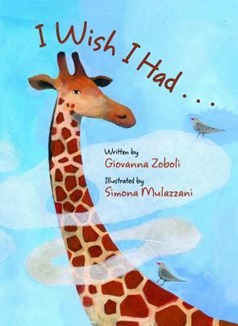
I Wish I Had… by Giovanna Zoboli

i wish i had

I Wish I Had… by Giovanna Zoboli, illustrated by Simona Mulazzani

Originally published in Italy, this thoughtful picture book takes children on an exploration of different types of animals, looking at some of their unique abilities.  Blackbirds can see every blade of grass with their sharp eyes.  Tigers can walk almost soundlessly through the jungle.  Lemurs have tails that let them swing through the high branches.  Whales can fill the ocean with their songs.  Done in pairs of animals with each line beginning with “I wish,” this book is poetic and rich.

Zoboli writes in verse here that has a gentle rhythm and repetitive structure that is particularly soothing and warm.  Through it all, the skills of the animals that are mentioned are all perceptive and sensory, all leading to better understand of one’s world or expressing oneself.  It is peaceful and has a great inclusive and unifying feel.

A large part of the success of this book are the incredible illustrations by Mulazzani.  Her art has a timelessness about it, thanks to the worn texture of the paint in places.  That quality plays against the modern lines of her art, creating a synthesis that is dynamic and invites readers to look more closely.

Perfect for bedtime with its quietness, this book could also be used very nicely for poetic exercises where children look for admirable qualities in animals and write their own poems of appreciation and wonder.  Appropriate for ages 4-7.

Reviewed from copy received from Eerdmans Books for Young Readers.

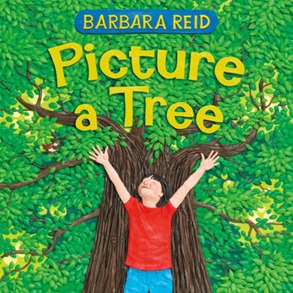
Review: Picture a Tree by Barbara Reid

picture a tree

Picture a Tree by Barbara Reid

How do you picture a tree?  Do you see a drawing on the sky?  A tunnel?  An ocean?  A sun umbrella to stop on your hot walk home?  What do you see?  These are just some of the ideas that Reid puts forward in her picture book that pays homage to trees and their ever-changing beauty.  Starting with the spring and moving through all of the seasons, this book will have you looking into the trees around you and noticing them even more.

Reid’s text here is simple but very effective.  She gets you dreaming of your own answers and also seeing trees from all angles and all seasons.  The true focus here though is her art.  Done entirely in Plasticine clay, they have a wonderful three-dimensional quality to them and are anything but simple.  In fact, the detail is amazing and will keep readers gazing long after they complete the words on the page.

An awesome addition to any Arbor Day, Earth Day, tree-related or seasonal story time or unit, this book should inspire all of us to wonder about trees.  Appropriate for ages 4-6.

Reviewed from library copy.

You can also see the trailer for the book for a glimpse of Reid’s art and words:

Review: Gandhi by Alice B. McGinty

gandhi

Gandhi: A March to the Sea by Alice B. McGinty, illustrated by Thomas Gonzalez

This nonfiction picture book focuses on Gandhi’s 24-day March to the Sea in 1930.  Joined by over 70 others, this was a nonviolent protest of British rule of India and the taxes they had levied on salt.  Told in verse, this picture book explores how the march united the different faiths and castes of India into a common cause.  The book and journey ends with Gandhi scooping salt from the sea, inspiring many others to do the same.  Many were imprisoned for their actions, but they proved too numerous for the prison system and had to be released.  This is a profound and impressive look at a nonviolent action that was noticed around the world and still serves as inspiration today.

McGinty’s verse is free and flowing.  She nicely integrates imagery that is moving and speaks volumes about the situation.  Just one line from when Gandhi reaches the sea: “white salt dusting dark sand.”  McGinty also weaves in the way that Gandhi inspired others to spin their own thread rather than relying on British cloth, how he prayed together with all faiths, truly how he created a single community out of so many different ones.

The illustrations by Gonzalez are exquisite.  His paintings capture the stones on the path, the crowds that gathered, and finally Gandhi by the sea, alone and strong.  All of the images show a man of strength of conviction and a spirit that was unfailing.  They are stunningly evocative of the man and his mission.

This is a top-notch picture book that truly conveys the difference one man can make in the world being nonviolent.  Appropriate for ages 6-9.

Reviewed from library copy.

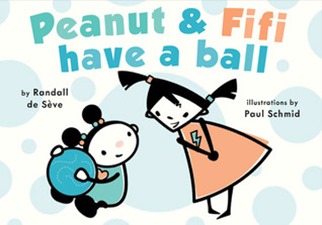
Review: Peanut & Fifi Have a Ball by Randall de Seve

peanut and fifi have a ball

Peanut & Fifi Have a Ball by Randall de Seve, illustrated by Paul Schmid

Peanut had a brand new ball.  It was blue and special.  But Fifi wanted to play with the ball too.  She tried grabbing it away from Peanut, and she tried being polite and asking “Please.”  But Peanut would not share it.  Then Fifi got creative and started coming up with ideas of how they could play with the ball.  It could wear a hat.  It could be a crystal ball and Fifi could tell fortunes.  It could be bread dough and Fifi could be a chef.  This book about sharing as siblings ends with a believable twist that is clever and satisfying.

De Seve’s text really comes alive when Fifi starts to imagine what she can do with the ball.  He is consistently simple and clear throughout, allowing the story to play out with a natural rhythm and flow.  The pacing is nicely done as well, allowing both sisters to have their space to think and react.

Schmid’s art is what makes this book really stand out.  His hip and modern visual style uses strong black lines and tropical colors.  In just a few lines, Schmid manages to convey a character’s mood clearly but not in an over-the-top manner.  His art is simple and very effective.

A great pick for toddlers and early preschoolers that would make a nice addition to story times or book lists about sharing.  Appropriate for ages 2-4.

Reviewed from copy received from Dial Books.

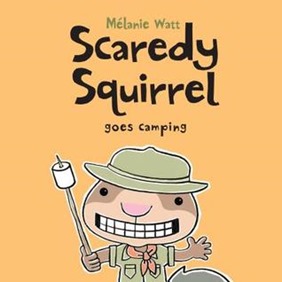
Review: Scaredy Squirrel Goes Camping by Melanie Watt

scaredy squirrel goes camping

Scaredy Squirrel Goes Camping by Melanie Watt

Scaredy Squirrel is back!  This time he wants to stay far away from camping outside, much happier to watch a TV show ABOUT camping.  Unfortunately though, he needs to plug his TV in for it to work.  So he has to find an electrical outlet which means heading outside and into the campground.  As always, Scaredy plans his trip carefully.  He lists what he is scared of, packs important survival supplies, picks out a wilderness outfit to keep himself safe from things like nasty odors and bugs, and has a map of his mission timed to the minute.  But things do not go as planned, showing Scaredy that sometimes it’s not about the plan itself but the journey on which it takes you.

Watt has a wonderful comedic timing that she displays in all of her Scaredy Squirrel and Chester books.  It is all about those moments of hesitation that make the humor all the more funny.  Scaredy is a great character with his obsessive planning and worrying.  Many children will see themselves in Scaredy and also be able to see the humor as well.  As always, the illustrations are clear, clean and add to the fun.

Another great book in a strong series, this one is perfectly timed for spring and summer camp outs.  Appropriate for ages 4-6.

Reviewed from copy received from Kids Can Press.

Review: It’s Monday, Mrs. Jolly Bones by Warren Hanson

its monday mrs jolly bones

It’s Monday, Mrs. Jolly Bones! by Warren Hanson, illustrated by Tricia Tusa

Mrs. Jolly Bones has specific tasks that she does each day of the week, but you will be surprised at how she works!  Monday is laundry day.  She starts normally enough with sorting the clothes, washing them, drying them, ironing them.  But then she flings them out the window and decorates the street!  On Tuesday it is gardening day and that one ends in a similar way.  Wednesday is cleaning day and my she works hard.  It all looks so normal until you find out where Mrs. Jolly Bones takes her bath.  The week continues on in this silly fashion with shopping on Thursday, baking day on Friday, friends over on Saturday, and resting on Sunday.  They are all done in surprising and striking fashion. 

Hanson has written a rhyming story that has just enough of a lilt and a rhythm to add to the silliness of the entire book.  This is a wild frolic of a book that needs that gentle sway and not more.  The humor is entirely over the top, much to my great joy.  Hanson takes jokes all the way, ending up with surprises and humor that will have children howling.  It is the type of book that simply must be shared.

Tusa’s illustrations have her signature style to them, resulting in a book where the humor is spot on and the pictures have a cheery, bright quality all their own.  They are done in subdued colors with primarily white backgrounds, making the action pop.

A kindred spirit to Amelia Bedelia, this humor doesn’t rely on wordplay so Mrs. Jolly Bones makes a great early friend for silly kids.  Appropriate for ages 3-5.

Reviewed from library copy.