Review: Stephen and the Beetle by Jorge Lujan

stephen and the beetle

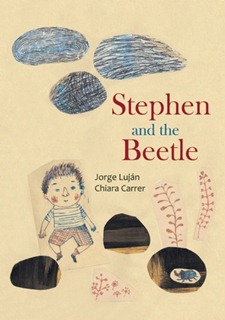
Stephen and the Beetle by Jorge Lujan, illustrated by Chiara Carrer

This very simple story explores philosophical areas while still remaining a picture book that is accessible to very young children.  Stephen was walking in the garden and sees a beetle.  He took off his shoe and was about to smack the beetle.  The beetle continued on its way, unaware of the threat.  Stephen raised his shoe higher, but then started to wonder about what the beetle was doing and where it was walking to.  So Stephen set down his shoe and put his head on the ground.  The beetle came closer, reared back on its back legs and seemed about to attack, but then seemed to think about it and instead just continued on its way.  The parallel pieces of this story make it all the more thought provoking and should get children thinking in a new way about even their smallest decisions during their day.

Lujan’s writing is simple and pure.  He tells the story and what is happening with a straight-forward tone and allows the story itself to create the points of discussion.   The only point where the writing gets complex and lush is when the beetle is about to attack.  Suddenly the tone changes and the rhythm gets wild.  But then, it is back to the simple tone to finish the story.

Carrer’s art is done in mixed media that includes collage, paint, pen, chalk and ink.  She very successfully plays with dark and light images that mirror one another.  The beetle is shown to be just as complex a creature as Stephen himself. 

This is a book that will certainly generate discussion.  There are etchical implications here, the question of impact of our decisions, and the aspect of choice.  And yet, there is also a small boy playing in a yard with a beetle.  It is a perfect example of a small scene that speaks to much larger issues.  Appropriate for ages 5-7.

Reviewed from library copy.
Review: A Is for Musk Ox by Erin Cabatingan

a is for musk ox

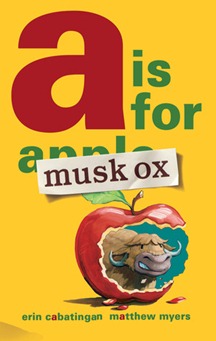
A Is for Musk Ox by Erin Cabatingan, illustrated by Matthew Myers

The story begins right at the cover with Musk Ox chomping on the apple that would have been what “A” stands for.  Instead, he insists that A is really for musk ox.  Zebra argues with him, after all there isn’t even a single letter A in musk ox.  Musk Ox explains using lots of words that start with “A” that musk oxen are Awesome; they live in the Artic and even Alaska.  Turn the page and you will see that B is also for musk ox, rather than baby.  Again, Musk Ox has plenty of explanations for exactly why.  This silliness continues through the book, forming a pattern until you reach the letter M.  And I don’t want to spoil the surprise, but I bet you won’t guess what M stands for.  This zany book is filled with humor, pure cheer and a jolly spirit.

This is not an alphabet book for those first learning their letters.  Instead, children who know how the alphabet works and who are veterans of ABC books will enjoy it most.  They will get the jokes that are being poked at more normal alphabet books as well as the more pointed humor of the storyline.  Cabatingan’s writing, done entirely in dialogue, is a pleasure to read aloud.  It has a natural flow and a great sense of timing.

Myers’ illustrations are simple and quite silly when called for.  The personalities of the two characters come across in their body language. 

A hilarious alphabet book that is guaranteed to get kids giggling.  Appropriate for ages 5-7.

Reviewed from library copy.

Review: The Santa Trap by Jonathan Emmett

santa trap

The Santa Trap by Jonathan Emmett, illustrated by Poly Bernatene

Bradley Bartleby was born bad and as he got older, he got even more bad.  Bradley’s parents were immensely rich and gave Bradley everything he wanted because they were scared of him. Every year, Bradley would make an enormous list for Santa Claus but Santa knew about how bad Bradley was and never looked at the list, instead giving him a small token gift of socks.  Even though Bradley’s parents gave him everything he had put on his Christmas list, Bradley hated that Santa himself didn’t give him what he wanted.  So Bradley decided to build a trap for Santa.  He worked on it for a year, until by Christmas Eve his parents had moved out of the house because it was so dangerous.  Now all it would take was Bradley to stay awake and watch the trap work.  But staying up and waiting for Santa on Christmas Eve is notoriously difficult to do.

Emmett has created a holiday picture book with a lot of edge, plenty of weaponry and some pretty spectacular explosions.  This is a holiday book that will appeal to children who feel a bit too old for elves and reindeer.  Happily though, at the heart of the story there really is a Christmas spirit about what the real meaning of Christmas should be.  Emmett though does not let that ruin the fun, delighting in turning Christmas on its ear in this picture book.

The art by Bernatene works so well here.  It has plenty of zing and pop with its bold colors and modern feel.  One just has to look at the cover to know this is not your normal holiday book.  The illustrations were done digitally, adding to the modern feel, but they are also made warmer by brushstrokes showing on the images. 

A dynamic and very funny holiday book that will work particularly well for elementary-aged children who will delight in the weaponry, the trap, and the twist at the end.  Appropriate for ages 4-7.

Reviewed from ARC received from Peachtree Publishers.

Review: Lemonade in Winter by Emily Jenkins

lemonade in winter

Lemonade in Winter by Emily Jenkins, illustrated by G. Brian Karas

Pauline is the one who looks out on a blustery winter day and thinks of running a lemonade stand.  Her little brother John-John immediately thinks it’s a great idea, but her parents are sure it won’t work.  So the kids set out to collect enough money to open their stand.  They dig in the couch, search pockets, and look in their piggy banks.  At the store they spend 24 quarters or six dollars on supplies.  They rush back home to make the lemonade, the limeade and the lemon-limeade and then out onto the street to set up their stand.  But no one comes.  Then they decide to start marketing their stand more, and surprisingly, there is a market for lemonade in the snow.

Jenkins has taken a picture book and inserted math in places that make sense of the story.  This is one book where the math really works, the counting of coins, the discounting of items, and the profits made.  It’s a book that can be read just for the cheery enjoyment of lemonade and snow too.  The writing is clever with the adults constantly warning the children that it won’t work and an ending that is realistic, warm and refreshing.

Karas’ illustrations are done in his signature style.  I enjoyed seeing children with brown skin in a story that is not about their brown skin at all, it’s just the way they look.  Karas’ art is lively and rich with small details.  The careful counting of the quarters at the grocery store is just one example of how he too skillfully melded in the math with the story.

A winning picture book with math at its heart, this is a story that will have you asking for some more lemonade on a winter’s day.  Appropriate for ages 4-6.

Reviewed from copy received from Random House Children’s Books.

Review: I’m Bored by Michael Ian Black

im bored

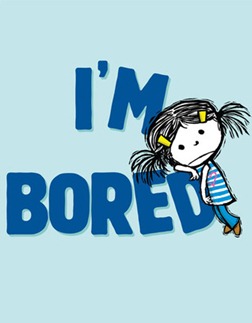
I’m Bored by Michael Ian Black, illustrated by Debbie Ridpath Ohi

The dreaded boredom has set in in this very funny picture book.  A little girl is so bored she is flat on her back moaning when she notices a potato.  When she tosses the potato away, not knowing what to do with it, the potato says that it too is bored.  The potato goes on to tell the little girl that kids are boring.  She insists that no, kids are fun and the potato challenges her to prove it.  She shows the potato all the physical things she can do, then demonstrates using her imagination, but through it all the potato stays unimpressed.  There is a great twist at the end of the book that you will have to read for yourself.  A funny read that will have even the most bored child enjoying themselves.

Done entirely in dialogue, this is a fast-moving picture book.  It begs to be read aloud with a grungy, dusty potato voice.  The ever-bored potato is a great foil to the little girl who despite herself loses herself in her imagination and actions.  It’s a lesson that kids are anything but boring, even when they themselves are bored.

The illustrations have a great rough feel to them.  Done digitally, there is a feel of the organic roughness of a block print.  I particularly enjoy seeing a little girl not in pink or done up cutely.  This little girl is a real one, one that throws herself into things and that includes being willing to argue with a potato.

This is one book that is anything but boring.  Appropriate for ages 4-6.

Reviewed from copy received from Simon & Schuster Books for Young Readers.

Review: Little Chick and Mommy Cat by Marta Zafrilla

little chick and mommy cat

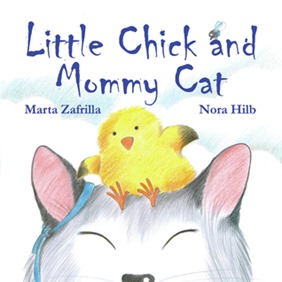
Little Chick and Mommy Cat by Marta Zafrilla, illustrated by Nora Hilb

Little Chick has been raised by Mommy Cat since she was still in an egg.  When Little Chick was very small, he thought that he was a cat too.  He tried to be a cat, but it didn’t work.  He couldn’t meow, or lick his paws or flick his tail.  His mother explained to him that he was not a cat, but a chick and his real mother was a hen. When the two of them would go out, others would stare at them because they were different.  His mother told him that it’s not bad to be different, what is bad is to want to be like everyone else.  His mother also made sure to give him time to be with other chicks by taking him to the Bird School so he could learn everything he needed to about being a chicken. The other chicks asked him all sorts of questions because his mother was so different from the others.  Little Chick though is happy to be part of his different but very loving family.

This picture book speaks directly to the issues of diversity and different types of families.  It will also be happily embraced by families who have adopted children, because it manages to explain clearly and with no hesitation the basic love and acceptance of diversity in adoptive families.  Small children will respond to the animal characters but easily also draw connections to themselves.

Zafrilla’s text is straight forward, tackling larger issues and bringing them to a level that small children will easily understand.  She builds an unlikely family and happily shows the love and attachment between a cat and a chick.  This is a book that is unlikely to be read as a straight animal story, because the connection to adoption is so clear.  That said, the clarity and honesty here is what makes it shine.

Hilb’s illustrations add a colorful touch to the story.  The colored pencil illustrations use delicate lines and soft colors to tell the story.  The feathers and fur beg to be petted with their textures. Hilb maintains the size difference throughout the story, further emphasizing the differences between the cat and her chick. 

This picture book focuses on diversity, love and the many forms it can come in.  Appropriate for ages 4-6.

Reviewed from copy received from Independent Publishers Group.

Review: Bear Says Thanks by Karma Wilson

bear says thanks

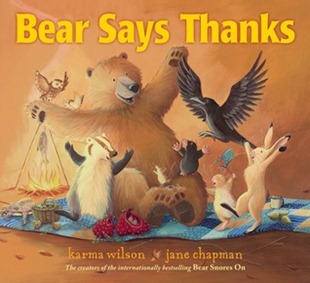
Bear Says Thanks by Karma Wilson, illustrated by Jane Chapman

The Bear series by Karma Wilson continues to impress with its latest entry.  There are only a few children’s picture book series that have maintained the quality of both writing and illustration as this series has.  In this latest tale, Bear has an idea to create a big feast and invite his friends over to share.  The only problem is that Bear has nothing in his cupboard at all.  Mouse shows up with a pie to share, and Bear says “Thanks!”  Bear continues to fret that he has nothing to share when Hare pops by with a batch of muffins to share.  Badger then arrives with fish, Gopher and Mole bring warm honey nuts, and Owl, Raven and Wren have herbs for tea and pears to munch.  But with no food to offer at all, what in the world can Bear give his friends?

I’ve always enjoyed the rhythm of this series and the repetition that makes them ideal to read aloud to toddlers.  There is also a wonderful friendly warmth to the books, captured both by the colors of the illustrations and the story itself.  That same warmth is here, friends offering food and sharing time with one another with no expectations.  Chapman’s illustrations stay true to the series, offering pictures large enough to share with a group.

While this book is perfect for Thanksgiving story times, I’d also use it throughout the year when talking about sharing.  This is a bear’s den that any of us would love to crawl into and spend some time in no matter what time of year it is.  Appropriate for ages 2-4.

Reviewed from copy received from Margaret K. McElderry Books.

Review: Hide and Seek by David A. Carter

hide and seek

Hide and Seek by David A. Carter

My confession of the day is my love for pop-up books.  It is exacerbated by my younger son’s equally adoration for them.  That means that I have a small voice in my head pleading to open the pop-ups as soon as we get them, and then my son pipes in too.  So I gave in and in this pop-up discovered a wonderful, colorful world to explore.  Carter has created a landscape of objects to explore, ranging from black and white to wild punches of color that create a skyscraper.  He manages to make a book that invites children to move things and look closely, but will also appeal to the aesthetics of adults.  I just opened the book in my office and immediately had co-workers around my desk interacting with it. 

Just as with most delicate pop-up titles, this book will not withstand being circulated in a library.  But if you have a young pop-up fan at home the way I do, this would make a grand holiday gift or a great pick for a long holiday drive.

Appropriate for ages 4-7 (and adults).

Review: The Insomniacs by Karina Wolf

insomniacs

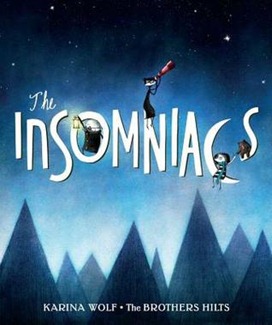
The Insomniacs by Karina Wolf, illustrated by the Brothers Hilts

When Mrs. Insomniac gets a new job, the family moves 12 time zones to their new home.  They had been a regular day-light family, but in the new place they found it hard to stay awake in the day and fall asleep at night.  They tried everything from warm milk to meditation, but nothing worked.  Looking out of their dark windows, they discovered that there were many nocturnal animals out there.  There were bats, bears, and owls.  So the family decided to spend their awake time in the darkness.  They had breakfast at dusk, grew moonlight cactuses as a garden, studied the stars and attended night school.  They are a happy night-time family.

Wolf has created a gorgeous tribute to the wonders of the night here with a delight of a strange family as the lens.  There are such lovely little moments like watching “the fishes nipping at the surface of the sea: when the family goes moonbathing.  The family adventures out and finds the flower market open and the bakeries bustling.  It makes one want to head out in the darkness and see what is happening in your community.  There is also a memorable tribute to the dark side of nature and nocturnal animals that removes the scare and makes the entire nighttime welcoming.

The Brothers Hilts’ illustrations glow with the light of the moon and play darkness upon darkness.  The entire book is shadowy, but somehow also cheery and dazzling.  Darkness is celebrated in all of its black and blue beauty.

A treat of a picture book, this is a quirky winner that will have everyone staying up well past their bedtimes.  Appropriate for ages 4-6.

Reviewed from copy received from G. P. Putnam’s Sons.