Review: Charley’s First Night by Amy Hest

charleys first night

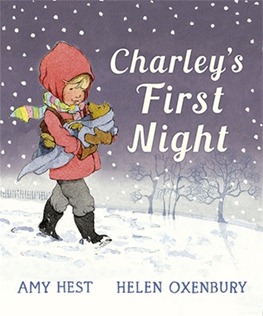
Charley’s First Night by Amy Hest, illustrated by Helen Oxenbury

Pure bliss, that’s what this book is.  This is the story of Henry who brings Charley, a new puppy, home.  When they get home, Henry makes sure to show Charley all around his new home, even showing him where his mother hides the birthday presents.  Henry’s parents inform him that he’s the one in charge of walking Charley and feeding Charley.  Henry is thrilled and can’t wait to do those things forever.  Then there’s the discussion of where Charley is going to sleep.  Henry knows that Charley wants to sleep in his room, but his parents want Charley to sleep in the kitchen.  Henry worries about Charley alone in the kitchen, but goes about setting up a pillow, a bear to keep him company, and a ticking clock for a heartbeat sound.  Henry stays with Charley until he falls asleep, but Charley doesn’t stay asleep for long.

Hest’s writing here is so dazzling.  She captures perfectly the swooning adoration of a child with a new puppy.  She shows the instant connection, the small memorable moments together, and the communication and understanding that flows.  Henry loves Charley with a purity that is piercing and Hest’s text makes it all the more real and true.  She uses quiet repetition and brings the reader into the intimacy of this new relationship, allowing them to notice the small things that Henry is seeing and feeling.

Oxenbury’s illustrations are classic and lovely.  They lift the story up, making it feel all the more timeless.  There is a beautiful warmth to her art that works particularly well for this subject.  The small images of Charley eating, romping and even making a mess will be sure to charm.

Two master picture book creators have come together to give readers a radiant book about the first love of child and puppy.  Appropriate for ages 3-5.

Reviewed from library copy.

Review: The Iciest, Diciest, Scariest Sled Ride Ever! by Rebecca Rule

iciest diciest scariest sled ride ever

The Iciest, Diciest, Scariest Sled Ride Ever! by Rebecca Rule, illustrated by Jennifer Thermes

Released November 9, 2012.

After sleet and snow have created a thick crust of ice on the ground, what are Lizzie and her friends going to do?  It’s almost impossible to even walk on the stuff!  They slide downhill on their backs and it was a lot of fun, but they wanted to really find a good place to slide.  Snow saucers just spun on the ice, and that’s when Lizzie remembered the sled with metal runners that her grandpa had, a travis sled with an extra long seat. Grandpa remembered his own childhood when they were able to sled down the roads on days like this.  He warned them to stay off the roads, stay safe, and not go too fast.  But when the children finally reach the summit of the huge hill, they wonder if they will be able to keep that promise!

Rule has created a book that captures the wildness and pure joy of sledding.  Growing up in Wisconsin, we had a sledding hill that we would build ramps on and have a great time.  My father also had his childhood runner sled that could only be used in perfectly icy conditions.  So this book took me right back to those childhood memories of days that were blistery cold and icy, but you were having too much fun to care.  Rule builds suspense really well here, having the children figure out what sled to use, where to get it, and then the puzzle of how to climb an icy hillside without all sliding back to the bottom. 

Thermes’ illustrations have a wonderful old-fashioned quality to them but also show modern sledding and a modern community.  The colors are bright and fun, the sky often adding a punch of coral to the white landscape.  There is also plenty of action and movement throughout, creating a perfect pacing along with the text.

Get this one on your shelves for the holidays and sledding season.  You may just see your breath in the air as you read it aloud.  Appropriate for ages 4-6.

Reviewed from copy received from Islandport Press.

Review: I Like Old Clothes by Mary Ann Hoberman

i like old clothes

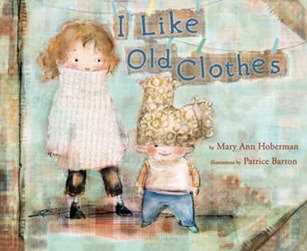
I Like Old Clothes by Mary Ann Hoberman, illustrated by Patrice Barton

Celebrate reusing clothes along with this book’s radiant narrator.  She’s a little girl who simply loves old clothes, especially those that come from other people.  She wears them for dress-up, but also on just regular days.  She loves clothes with patches that used to be too-good for play and are now just right.  There are also some clothes that she changes a bit to make them her own.  It’s the faded, broken-in and comfortable clothes she loves.  Don’t you too?

Hoberman’s rhyming verse has a sweet playfulness to it that keeps the book from becoming heavy handed.  Instead it is about this girl and the reasons she loves to wear old clothes.  It’s persuasive and kindly done.  This book is perfect for children who wear hand-me-downs from relatives or siblings, but also for families who are buying used clothes to be more environmentally conscious. 

Barton’s illustrations are filled with soft colors and textures.  The entire book speaks to the ease and comfort of used fabrics.  On some pages there are buildings made from blue jeans, rules that run through the pages, and a general homage to reuse.

This book is as comfortable and cozy as my favorite old sweatshirt that I got from someone else when it didn’t fit them and I’ve had for 15 years.  Appropriate for ages 4-6.

Reviewed from copy received from Alfred A. Knopf.

Review: The Adventures of Little Nutbrown Hare by Sam McBratney

adventures of little nutbrown hare

The Adventures of Little Nutbrown Hare by Sam McBratney

In this follow-up to the classic Guess How Much I Love You, McBratney gives us four new stories about the beautiful relationship between Little Nutbrown Hare and Big Nutbrown Hare.  In the first story, the two wake up to discover that the Hiding Tree has fallen over during the night.  Big  immediately climbs the fallen tree, but Little is much more cautious until he’s playing hide-and-seek.  The second story has the two rabbits climbing Cloudy Mountain.  Little has a lot of fun finding dandelions and blowing them.  So when the clouds start coming and making it hard to see, he gets cross when Big insists that it’s time to go.  The third story has a lot of danger that Little seems to find and Big is always watching to keep him safe.  Soon though, Little’s own inner voice is showing him the right choice.  The final story returns the rabbits back home as they discuss Little’s favorite place.

All of the stories carry that same loving warmth as the original book.  There is the ever-present but not smothering parental character and the mischievous child character.  McBratney has managed to incorporate situations that human parents will face into a cloudy mountain and a large field.  Children will recognize their parents’ efforts to keep them safe, redirect them, and be forced to change plans sometimes and spoil the fun.

McBratney’s The art is a large part of the charm here, but so is his writing style.  He keeps it simple but sunny, always giving a cheery outlook in both images and text.  Perhaps my favorite image is when Little is caught thinking of going into a big hole.  His odd leap away from the hole when caught captures exactly the body-language of a child in the same situation.

This is bound to be embraced by parents who loved the first book.  They will find themselves happily right back in the same loving, warm place.  Expect plenty of bedtime repeat reads.  Appropriate for ages 3-5.

Reviewed from library copy.
Review: Penguin and Pinecone by Salina Yoon

penguin and pinecone

Penguin and Pinecone by Salina Yoon

One day Penguin found something strange in the snow.  It was a pinecone and realized that it was cold.  Penguin quickly knitted Pinecone a scarf that matched his, but Pinecone just kept shivering.  So Penguin headed on a journey to return Pinecone to his forest home.  When they got to the forest of towering pines, Penguin built a nest for Pinecone and a heart of stones around him.  Penguin returned home but kept wondering what had happened to his friend.  So he set off once again to find out.  Readers will be charmed by the conclusion of this tale of an unusual but heartfelt friendship.

Yoon excels at simple illustrations and simple words.  Here she has created a world of sunny friendship in the chill north.  The words are simple enough to use with toddlers and they will appreciate the love of a found object at that age too.  Yoon’s illustrations have a wonderful jolly nature, creating a world that is clearly safe and loving.

A great pick for friendship or penguin story times, this book will also work well for winter units.  Appropriate for ages 2-4.

Reviewed from library copy.

Review: Mossy by Jan Brett

mossy

Mossy by Jan Brett

Mossy loved living at Lilypad Pond.  She spent so much time along the banks that moss and then small plants started to grow on her shell.  She became a walking garden and liked to look at her reflection in the water to see how her garden was growing.  On day, she met a male turtle named Scoot at the pond.  The two were smitten immediately.  But just as they were about to meet, Dr. Carolina, who owned a museum, picked up Mossy and took her away to be the center of a new display.  Mossy spent several seasons at the museum, missing Scoot but being well cared for.  She was a very popular exhibit.  So when Tory, Dr. Carolina’s young niece, noticed how sad Mossy seemed and how lonely, there was a big decision to be made.

Brett’s story speaks to the importance of leaving living creatures in their native habitat to live their own lives.  It is a subject handled delicately here with no abusive storyline at all, just a general sense of sadness, which is perfect for young children.  The book is set at the turn of the century with the clothing and use of horse-drawn carriages giving clues.

As always, Brett’s artwork is simply beautiful.  In each two-page spread, she gives the main image a frame and then has several additional pictures that either add to the story or the setting.  We get to see different plants up close, glimpses of the museum even when it is not in the storyline, and Scoot waiting at the pond. 

This is not a book to be read quickly or with a group, instead it’s one to linger over and see the details of the artwork.  Appropriate for ages 4-6.

Reviewed from copy received from G. P. Putnam’s Sons.

Review: This Is Not My Hat by Jon Klassen

this is not my hat

This Is Not My Hat by Jon Klassen

I never expected to see a sequel to I Want My Hat Back but I am so thrilled that Klassen saw things differently.  This second book has a similar theme to it with a stolen hat, but it has entirely different characters.  This time the story is set underwater with fish playing the major roles.  One little fish has stolen a hat from a big sleeping fish.  He knows it was wrong, but justifies it by the fact the hat looks so much better on him and fits better too.  As he flees to the thick reeds to hide, he thinks to himself about how clever he has been, that the fish would never notice it missing, that he wouldn’t know where to look for the thief, on and on.  And with each sentence, the readers will see that he’s wrong, very wrong.

This sequel has the same understated style of the first and the same wonderful sense of humor that is exquisitely funny.  Klassen maximizes the humor with his flawless ability to tell one story in the words and an entirely different one with the action of what really happens. 

For all the fans of the first book, this is one that works best if you have read the first, but also stands on its own completely.  Appropriate for ages 4-6.

Reviewed from library copy.

Review: Black Dog by Levi Pinfold

black dog

Black Dog by Levi Pinfold

When the Hope family woke up one morning there was a great big black dog outside.  Mr. Hope thought it was the size of a tiger and called the police who advised him to just stay inside.  Mrs. Hope compared it to an elephant and the family shut the lights off so it wouldn’t know they were there.  Adeline woke up and saw a black dog the size of a T-Rex outside the window.  She closed the curtains.  Maurice woke up and thought it was the size of a Big Jeffy, deciding to stay under the covers.  But the littlest member of the family, Small, headed outside to meet the dog.  The dog was huge, the size of a house, and Small knew it could eat her up.  She ran off, telling the dog that it would just have to shrink to follow her.  As she ran, the dog got smaller and smaller, until it was able to fit into the house through the cat flap in the door.  That’s when the rest of the family realized that they had been very silly to be that worried about such a small black dog.

Pinfold manages to capture a certain quirkiness that creates a unique look and feel for this book.  His text builds the tension very high by the time that Small heads outside.  The frenzy of the other characters puts Small’s reaction in stark relief, making it all the more brave and amazing.  Her approach to the enormous dog is also wonderfully strange, running from it and having it shrink to follow her.  It makes a delicious sort of sense while you are wrapped in the spell that this book weaves.

The art is exceptional, filled with tiny details.  Pinfold has offered both smaller sepia toned illustrations that show the outside of the house and the continued reaction of the family, and also larger colorful images that add to the unusual feel of the book.  The size of the dog that Small confronts is astounding.  His eyes alone are her size, his nose the size of a car.  Breathtaking.

Highly recommended, this book is an unusual but very successful book.  Appropriate for ages 4-6.

Reviewed from library copy.

Review: Oh No! by Candace Fleming

oh no

Oh No! by Candace Fleming and Eric Rohmann

A virtuoso picture book by two masters, this is bound to be a new favorite for toddler and preschool story times.  The story begins with Frog falling into a deep hole.  Oh no!  Mouse came along and tried reaching down but she fell in too.  Oh no!  Loris slowly came down from her tree to help, but an allergy made her sneeze and you guessed it, she fell in too.  Oh no!  Sun Bear tried to help, Monkey swung by and fell in, and then Tiger reveals himself fully above.  Sharp-eyed readers will have noticed him lurking from the very end papers right on through.  He’s ready to pounce on this hole full of juicy animals.  But wait!  There’s one more animal headed for the hole!  Oh yes! 

Fleming has written such a simple and yet jaunty text here.  It reads aloud so well, so vividly that there is no other way to read this book.  The text doesn’t rhyme, instead it is filled with so much repetition and rhythm.  There is the chorus of “Oh no!” that meets each animal as they tumble into the hole.  But there are also words that repeat as each animal is introduced. 

Rohmann did the illustrations as relief prints.  They have bold lines, lithe animals, and lots of action.  They also have that wonderful texture of prints that make them such a great choice for children’s books.  The illustrations lift this book even higher.

Get your hands on this for your programs.  I guarantee it will be part of your regular story rotation.  It’s also a great pick for children’s reader theater.  Appropriate for ages 2-4.

Reviewed from library copy.