Review: Machines Go to Work in the City by William Low

machines go to work in the city

Machines Go to Work in the City by William Low

This is an inventive look at machines, combining it with large flaps to open and questions to engage.  Low looks at one machine after another that works in the city and then asks a question about it.  The questions are not simple either, this is not a book that talks down to its young audience.  Instead you have to think a bit.  Do the garbage men go home after picking up the garbage?  Can the crane operator still work when the building grows taller than the crane?  Is the airplane ready to leave when the passengers are on board and the baggage is loaded?  Little listeners get to turn the flap to learn the answer and the reason. The answer is given with a quick explanation and then the book moves on to the next machine. It’s just enough information for a preschooler to really enjoy.

Low has created a brisk pace here, never lingering too long and offering exactly the right amount of information.  This makes the book very readable, something that can be happily shared at bedtime unlike a lot of nonfiction vehicle books.  More information on each machine is offered at the end of the book, complete with labeled parts.  Those are pages that young truck fans will linger on.

Low’s illustrations are richly colored.  The painted textures add to them with some pages having individual bricks done solely in texture alone.  At other times, the sleek metal stands out. 

A great pick for your own little machine fan or for public library shelves.  Don’t let the flaps scare you off, they are large and just as durable as a regular page.  Appropriate for ages 3-5.

Reviewed from library copy.

Review: The Town Mouse and the Country Mouse by Helen Ward

town mouse and country mouse

The Town Mouse and the Country Mouse by Helen Ward

Never has there been such a beautiful example of this Aesop Fable.  This is the classic tale of the county mouse who is happy in the simplicity of the country until his cousin from the city comes to visit with his claims of the wonders there.  The country mouse goes to visit, discovering things like elevators, electric lights, and enormous banquets.  But when they are both chased by a city pet, in this case a little dog, the country mouse realizes that while the city is fast-moving and filled with bright lights, he misses his quiet life in the country.  Merrily, the book ends with an image of the city mouse asleep in a wheel of expensive cheese.

It is the illustrations here that make this such a noteworthy book.  Ward takes special care in depicting the beauty of the countryside and the country life.  She moves between seasons, the apple tree decked in pink blossoms and then hearty with ripe apples.  The two mice are shown without any little clothes or any anthropomorphic touches.  Instead these are two sleek and life-like creatures. 

The illustrations are sumptuous, rich and superb.  They invite you to explore the county and the city and see beauty in both.  They bring you into the cozy winter nest of the country mouse.  They linger on the many blossoms of the country landscape.  They focus you close in from a mouse point of view. 

Highly recommended, this book belongs in library collections for both its beauty and the simple way it is written.  Appropriate for ages 3-5.

Reviewed from library copy.
Review: Lester’s Dreadful Sweaters by K. G. Campbell

lesters dreadful sweaters

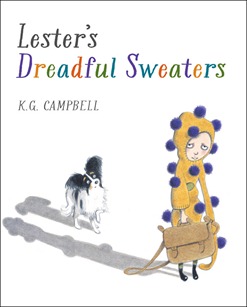
Lester’s Dreadful Sweaters by K. G. Campbell

When Cousin Clara’s cottage was eaten by a crocodile, she moved in with Lester and his family.  No one knows quite whether she is actually their relative, but she stayed with them anyway.  She brought her knitting along with her.  She just sat and knitted all the time, until one morning she announced that she had made Lester a sweater.  It was horrible, an ugly yellow with one arm far too long and purple pom-poms dotted all over it.  Lester was made to wear it to school where the others made fun of him, of course.  That sweater mysteriously shrunk in the laundry.  But the next morning, there was another sweater.  This one was pink with strange upside down pockets.  That one got caught in the mower.  Every time Lester did away with one awful sweater, another appeared to take its place, until one morning he awoke to a mountain of sweaters.  He did what anyone would do, and murdered them quietly with a scissors. But even then, there was one left intact.  There doesn’t seem to be anything Lester can do to end the parade of awful sweaters, but there just may be a solution in a most unlikely place!

This is a dynamite picture book that has a fabulous strangeness about it that works particularly well.  There is the oddness that Lester has already.  He keeps lists of dangerous things that start with the letter C and collects items for the Lost & Found he has.  He is particular about his socks being even and keeping his hair tidy.  He could be an unlikeable character, but those little oddities as set aside when the horrible sweaters start coming.  One immediately understands Lester’s desperation to get rid of the sweaters without confrontation and as the story unravels, it gets more and more fun to read.

Campbell’s art adds to the strangeness of the book.  She has strange objects set around the house: a pickaxe near the front door, a Viking helmet in the Lost & Found.  The pages are done in a matte finish that adds to the vintage feel, the Victorian feel of the book.  And yet, there is that unwavering sense of humor, that lifts everything to feel modern too.

For slightly older children than most picture books, this would make a great read aloud for elementary classrooms.  There is plenty of humor, moments of surprise, and a great ending that I refuse to even hint at.  Appropriate for ages 5-7.

Reviewed from library copy.

Review: Nighttime Ninja by Barbara DaCosta

nighttime ninja

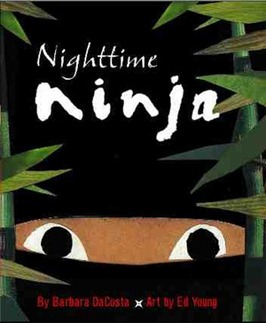
Nighttime Ninja by Barbara DaCosta, illustrated by Ed Young

A ninja moved stealthily through the night in this picture book.  The clock struck midnight and the ninja tossed a grapple hook up.  He climbed up the sheer wall.  He crept down the hallway of the house where everyone was asleep.  He hid in the shadows.  Then he got out his tools and went to work.  Until his mother woke up!

DaCosta’s simple text slowly builds the tension as the ninja moves through the night.  The entire book is hushed and the mood brittle with stealth.  She playfully leads the reader through thinking that this is a real ninja sneaking into a house until the reveal.  It’s a great reveal that works particularly well thanks to Young’s illustrations. 

His collage art shows a shadowed ninja figure using expert skill and stealth.  At the same time, that cover clues us into the jolly nature of this book.  Young’s art is as beautiful as always, using subtle colors to evoke the world of the ninja and the darkness of night.  They have the sharp angles of Japanese architecture built into each page too, immediately conjuring another land.

Get ready to have your own little ninja prowling your house after you share this book.  Appropriate for ages 3-5.

Review: Bedtime for Monsters by Ed Vere

bedtime for monsters

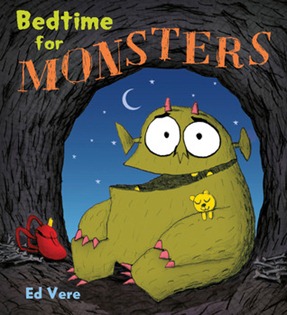
Bedtime for Monsters by Ed Vere

Do you think that if monsters really exist that there might be a monster out there licking his lips and thinking about YOU?  And what if that monster is coming to find you?  Riding his bicycle through a dark forest on his way?  What if he is thinking about what you might taste like with ketchup as he wades through the gloopy swamp?  What if he thinks about you on toast while tiptoeing through thorns?  He’s getting closer and closer… you aren’t scared are you?  Are you?

Filled with great noises and ways to get little hearts pitter-patting, this book is an impressive read aloud.  Vere paces the book just like a traditional campfire tale, it’s the build up that makes the entire thing work along with the fact that this monster is headed for you! 

Vere’s silly artwork provides a lightening effect that will get kids giggling despite the tension of the story.  There are also softening hints throughout like the teddy bear, the bicycle with a bell, and even the pink toenails that make this monster more friendly than frightening.

Pair this one with A Dark, Dark Tale by Ruth Brown for some sinister stories that end well.  Appropriate for ages 4-6.

Reviewed from library copy.

Review: Waterloo & Trafalgar by Olivier Tallec

waterloo and trafalgar

Waterloo & Trafalgar by Olivier Tallec

Released October 22, 2012.

In this wordless picture book, two men watch one another over neighboring walls, separated only by a thin line of grass dotted with flowers.   Both sides of the wall are very similar, both men have spyglasses, drinks and umbrellas.  Their days are filled with boredom and suspicion, broken only by the appearance of a snail who visits them both and moments where they bother one another with music and loud noises.  It isn’t until a bird arrives and lays an egg that hatches and runs away that the truth of the conflict is revealed.  Tallec has managed in no words at all to show the fallacy of conflict and the way to peace.

Tallec uses humor here to bridge any divide.  It is mostly physical humor that will have children laughing, successfully mocking the conflict without any words at all.  The snail is a particularly inspired piece of humor that is sure to surprise and please.  So much of this book is about the surprises that life brings with the ending of the book providing the biggest and best surprise of all.  There is a great playfulness that invites readers into this serious situation to a degree that without it would not have been possible.  The wordless nature of the book also makes it particularly suited to a subject of crossing barriers.  I can see using this with people who speak different languages, allowing a depth of discussion that would be unusual with other wordless books.

This book is outstanding.  It speaks to peace without any preaching, allowing the reader to come to their own conclusions.  It is a striking and vibrant example of what can be achieved with no words at all.  Appropriate for ages 6-8.

Reviewed from copy received from Enchanted Lion Books.

Review: Helen’s Big World by Doreen Rappaport

helens big world

Helen’s Big World: The Life of Helen Keller by Doreen Rappaport, illustrated by Matt Tavares

This picture book biography of Helen Keller celebrates both the accomplishments of Helen Keller in overcoming her world of darkness and silence and those of her teacher Annie Sullivan.  The book begins with Helen as a small baby, before she had an unknown illness at 19 months that took her sight and hearing away.  It then moves through her attempts to continue to communicate, the frustration that caused her tantrums, and the slow progression of learning that led to the seminal moment at the water pump that connected the letters in her hand to the outside world.  Readers will see how Helen learned to write, read in Braille, and put her hands on people’s faces to feel their lips move so she could understand their speech.  The book continues to show how Helen Keller spoke up for social injustices that she felt were wrong.  This is a testament to what a brilliant mind and a great teacher can create.

Rappaport has somehow condensed the complicated story of Keller’s life into a very readable picture book that has a brisk pace and invites readers to find out more about this remarkable woman.  Throughout the book, Keller’s own words are used to illustrate points in the story.  Shown in their own font that is colorful and set apart from the rest of the text in size too, her words shine.

Tavares’ illustrations reveal the marvel of Helen Keller’s learning and education.  There is a light to the images once the learning begins that contrasts with the darkness of her earlier life.  Throughout Keller is shown experiencing the senses she does have, from the scent of a rose to the feel of the breeze on her face. 

An inspirational figure, Helen Keller continues to be a beacon for overcoming obstacles and using one’s mind.  This book is a beautiful tribute to her.  Appropriate for ages 8-11.

Reviewed from library copy.

Review: Lovabye Dragon by Barbara Joosse

lovabye dragon

Lovabye Dragon by Barbara Joosse, illustrated by Randy Cecil

Once there was a girl who lived in a castle and longed to be friends with a dragon.  There was a dragon who lived far off in a cave who wanted a girl for a friend.  The girl was so sad that she wept silver tears of loneliness.  Those tears trickled all the way out of the castle and to the cave of the dragon where they awoke him.  The dragon followed the trail of silver back to the castle where he found the girl waiting for him.  The two became immediate friends, spending all of their time together.  Best friends forever.

Remarkably, Joosse does not feel the need to make the friendship between the girl and the dragon scandalous or attack it in any way.  The two of them long for one another, find one another, meet and are immediately friends, and it works.  A large part of why it works is Joosse’s writing which has them doing many things together but also explains their friendship clearly in passages like this:

On the outside, Girl is little.

On the outside, Dragon’s biggle.

But they’re just the same size

exactly the same size

in the middle.

Cecil’s illustrations are done in oils and have a wonderful richness and depth to them.  The palette is more blues and greys than many primary-colored picture books.  It plays to the sophistication of this story.  Often the girl is the only spot of bright color in her yellow dress.

This solid picture book offers a shimmering story of unlikely friendship that really works.  Appropriate for ages 3-5.

Reviewed from library copy.
Review: Apple by Nikki McClure

apple

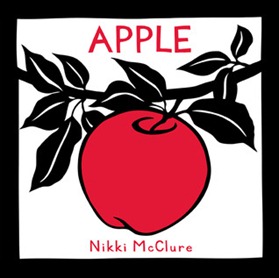
Apple by Nikki McClure

Follow the life stages of an apple from the time it falls from the tree, ripe and red, to its return to the soil.  Written in single words, the story is told primarily through the images that are done in exquisite cut paper.  In each image, red is used solely to illuminate the apple with the rest of the image in black and white.  This serves to not only highlight the apple as the focus, but also makes for a dynamic minimalist style.

The simplicity and minimalism really work here.  It is a stunning book both in the strength of the illustrations and the focus on life stages.  This is a book I would suggest for parents reading to infants, because it has that strong contrast of black, white and red that infants’ brains respond to.  Even better, it’s a book that adults will enjoy reading again and again.

Appropriate for ages 0-3.