Review: Love, Mouserella by David Ezra Stein

love mouserella

Love, Mouserella by David Ezra Stein

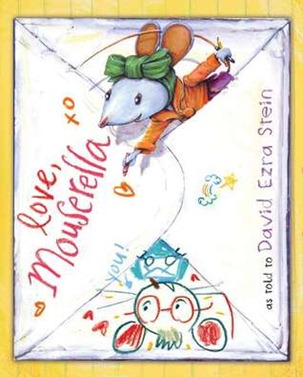
Mouserella misses her grandmother.  She had to go back to the country, and Mouserella lives in the city.  So her mother suggested she write a letter, and she did!  The pages are filled with drawings, photographs, and plenty of great details.  Though Mouserella doesn’t think there is much to share, she actually finds lots of everyday things to talk about: creating seed parachutes, visiting a museum, experiencing a blackout, and playing with her brother.  The story is jolly and warm, filled with homey details, a loving family and the joys of the small things in life.

Stein’s writing and art here create a harmonious whole.  The writing is winningly child-like and wandering.  Mouserella’s voice is clear and personal throughout, creating a solid base for the book.  Stein then embellishes the book with art that ranges from Mouserella’s drawings to photographs of her world.  The combination of crayon art with Stein’s own more realistic but still whimsical art makes for a striking read.

This warm, wonderful picture book will be enjoyed by grandmothers and grandchildren alike.  It is a perfect accompaniment to letter writing units or story times about grandparents.  Appropriate for ages 4-6.

Reviewed from copy received from Penguin Young Readers Group.

Also reviewed by A Year of Reading.
Review: The Artist Who Painted a Blue Horse by Eric Carle

artist who painted a blue horse

The Artist Who Painted a Blue Horse by Eric Carle

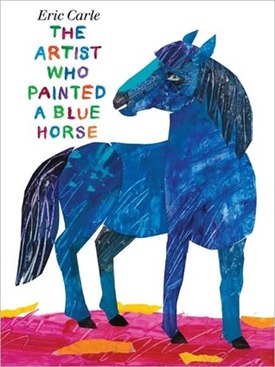
A young artist paints a blue horse running against a yellow sky, then continues to paint animals in amazing colors.  There is a red crocodile, a yellow cow, a pink rabbit, and an orange elephant.  The book speaks powerfully and simply to the spirit of creativity, the ability to change the world through art, and the right to express yourself.  This becomes even more clear as the book ends with Carle’s own childhood experiences in Nazi Germany where he first saw the forbidden work of Franz Marc who painted Blue Rider.  This is not a picture book biography, but rather a statement of support for all artists who see the world in unique ways.

Carle’s art is really the center of the book with the words just naming the color and animal.  As I read it, I could see it being used very nicely in elementary art classes to encourage children to break away from the norm.  In toddler story times, it could also be used to learn colors and animals perhaps even with some animal noises thrown in to add to the fun. 

This is a book that will speak to many ages, adapt well to projects and conversation, or simply be used as a color and animal book.  It is infinitely flexible, wonderfully expressive, and makes a powerful statement.  Appropriate for ages 2-8.

Reviewed from copy received from Philomel Books.

You can also check out the auction of art by artists and celebrities that was inspired by this picture book.

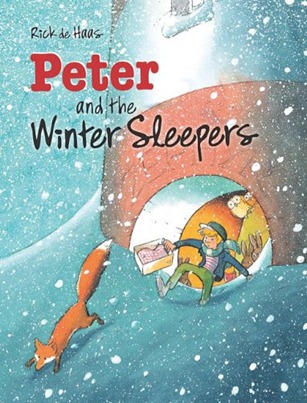
Review: Peter and the Winter Sleepers by Rick De Haas

peter and the winter sleepers

Peter and the Winter Sleepers by Rick De Haas

This snowy book is the story of Peter, who lives with his grandmother and pet dog in a lighthouse.  One day, it snowed, a wonderful clean fluffy snow that was perfect for making snowmen.  But then it just didn’t stop snowing.  They moved the chicken and goat inside to be safe, and then there was a scratching at the front door.  It was a rabbit.  Peter made a bed on the stairs for the rabbit when there came another noise at the door.  It brought more animals: squirrels, mice, hedgehogs, birds, a bat.  It got hard to sleep at night and the droppings were smelly.  After a few more days, the came another knock on the door.  It was a fox.  At first, Peter was eager to welcome a new animal to the lighthouse.  But how in the world was a fox going to live with the animals that it usually eats?

De Haas has created a friendly, cozy world here.   There is a gentle feel to the entire book, a hominess.  Anyone who has been stuck at home during a blizzard will recognize the feeling, and will probably start to wish that the animals would knock at their door next time.  The text of the book has a gentle quality as well, a quiet building as animals enter the lighthouse.

The lighthouse is filled with curved lines from the arched doorways to the curve of the stair to the gentle arc of the walls.  Complementing the curves is the warm yellow tones of the interior, that contrasts well with the cool blues of the snowy landscape outside.  This is a haven that is deliciously warm and welcoming.

A great pick for wintry story times, this book is quiet, gentle and welcoming just like its storyline.  Appropriate for ages 4-6.

Reviewed from copy received from NorthSouth.

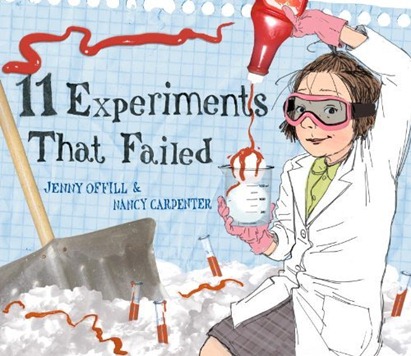
Review: 11 Experiments That Failed by Jenny Offill

11 experiments that failed

11 Experiments That Failed by Jenny Offill and Nancy Carpenter

A series of experiments take place in this book, each one funnier than the next.  They attempt to answer questions like: Can a kid make it through the winter eating only snow and ketchup?  Do dogs like to be covered in glitter?  Will a piece of bologna fly like a Frisbee?  The only way to find out is for the protagonist to test it scientifically.  That means trying to eat only ketchup and snow and observing the results.  Sprinkling her dog with glitter to see what happens.  Testing flight capabilities of bologna in the lunchroom of school.  All of the experiments have a question, a hypothesis, instructions, and results.  Budding scientists are sure to find plenty to laugh along with in this book, along with new ideas for experiments of their own.

This very funny book and also great fun to share.  The book design plays a big role in the fun.  Since the results are after a page turn, we enjoyed guessing what the results of the experiments would be.  Each experiment is unique, silly and entirely engaging.  The other winning part of the book is that this is a girl doing science, wearing her pink goggles and gloves, and her lab coat. 

The illustrations add to appeal.  The collage illustrations mix photographs and drawing.  They are quirky, colorful and glorious.

Get this one in the hands of science teachers who are teaching the scientific process.  Young scientists will also love it as well as any kid who enjoys silliness in their books.  But beware of flying bologna!  Appropriate for ages 5-8.

Reviewed from copy received from Schwartz & Wade Books.

Also reviewed by Pink Me and Young Readers.

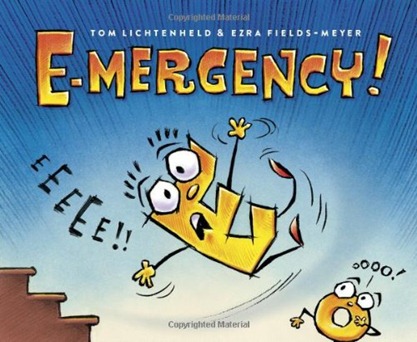
Review: E-mergency! by Tom Lichtenheld

e-mergency

E-mergency! by Tom Lichtenheld

The entire alphabet lived together in one house.  Every morning they all ran down the stairs to breakfast, but one morning there was an accident.  E was running down the stairs too fast and took a tumble.  The ambulance arrived and took E off to the ER.  With E gone, A took charge and assigned E’s duties to O.  In order for E to heal, no one could use that letter.  The letters took to the airwaves to ask people not to use the letter E until E recovered.  They even went to DC to tell the government.  With O filling in for E, things got vory confusing.  But E wasn’t gotting any bottor.  Who could bo causing tho problom?

This book had me laughing aloud.  First was the puns with the different letters, the jokes told in the asides.  They are the real treasure of this book and will get young readers laughing too.  Then readers have to watch the letter characters too.  They tend to spell out appropriate words as the action in the book changes, adding another layer of humor to the book.  Add into that the humor of trying to read a book without the letter E, and you have this zany, silly wonderful book.

Lichtenheld’s illustrations are filled with humor and motion as well.  They are bright, busy and great fun to look closely at.  My favorite spread is the double-page illustration of a busy city street where E is not being used.  It results in lots of humor. 

This book reads aloud well, but I would not recommend it without reading it first, especially the many pages with O filling in for E.  It makes for a tongue-twister, but also one that young listeners will love to see you attempt. 

Hilarity, alphabet, and word play, what more could one ask for?  Appropriate for ages 4-7.

Reviewed from copy received from Chronicle Books.

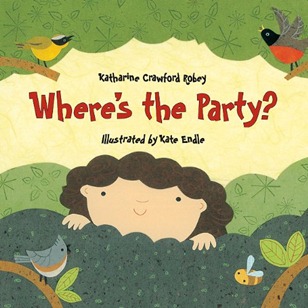
Review: Where’s the Party? by Katharine Crawford Robey

wheres the party

Where’s the Party? by Katharine Crawford Robey, illustrated by Kate Endle

When Kate wakes up, a robin is sitting on her windowsill and sings about “news!”  Then a cardinal whistles about a party.  Kate definitely wants to go!  So she heads outside and follows one bird to the next as they lead her along a path, to the wild strawberries, along the brook, and to the duck’s nest.  Finally, she arrives at the party, and it’s a very special one!  The birds in the story include a titmouse, meadowlark, yellowthroat, oriole, bluebird, heron, ducks, and killdeer.  

Robey’s text is just enough to keep the story moving.  The calls of the birds are translated into words that help Kate find the party.  Nicely, the birds are not humanized except for their calls being heard as words.  They are described with their markings and some of their habits.  The end pages include some more details on the species in the book.

Endle’s illustrations are done in collage and are filled with texture, pattern, and color.  The cut paper gives clean lines that work well with the natural setting and birds.  There is a simplicity thanks to the medium used that keeps this book very friendly to the youngest readers.

A great pick for young birdwatchers or for units about birds.  The illustrations are clear and crisp and will work well with a group, so this will also make a good choice for summer story times.  Appropriate for ages 3-5.

Reviewed from copy received from Charlesbridge.

Review: A Ball for Daisy by Chris Raschka

ball for daisy

A Ball for Daisy by Chris Raschka

Daisy, the dog, adores her red ball.  She plays with it and even sleeps next to it on the couch.  When her owner takes her for a walk, Daisy brings along her ball.  At the park, she plays and chases after it.  When it gets stuck behind a fence, Daisy frets until it has been retrieved by her owner.  But when another dog tries to play with Daisy’s ball… it pops!  Daisy is broken-hearted, carrying the tattered remains of her ball.  And there is nothing that will make her feel any better.  Or is there?

This wordless book works because of the gorgeous illustrations.  Daisy is a black-and-white dog and her world is colorful and bright.  From the bright red of her ball to the striped couch in green, the book embraces color.  Raschka also uses color to convey emotion, which is particularly effective when the air itself is colored with purples and blues after Daisy’s ball is popped.  Before that, the background was done in pale blues and yellows, light and airy, even playful. 

The storyline is clear with the illustrations filling double page spreads or broken into panels.  Children will immediately relate to Daisy’s loss of a favorite toy and to her emotions throughout.  It is a book that naturally leads to discussion of when the child lost something, or something was broken, and the way that they felt about it.

A winning wordless read, this book is a joy to share with children or perhaps with your favorite furry friend.  Appropriate for ages 2-4.

Reviewed from library copy.

Also reviewed by:

Review: One Little Chicken by Elka Weber

one little chicken

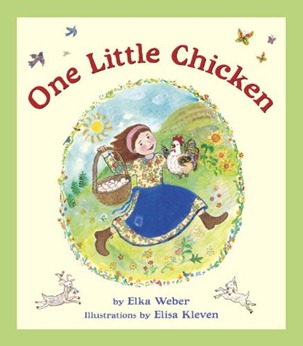
One Little Chicken by Elka Weber, illustrated by Elisa Kleven

When Leora finds a chicken has wandered into their house, her mother reminds her that finders aren’t keepers.  When her father returns from work, he agrees.  But it is their duty to take care of the chicken until its rightful owners claim it.  So, they build a chicken coop.  When the hen lays eggs, they do not eat them but the eggs hatch into chicks.  Soon there are chicks everywhere.  So they take them to market and sell them for coins that they use to purchase a little goat.  They milk the goat, turn the milk into cheese, but again do not eat it, because it is not their cheese.  They sell the cheese for coins and buy another goat.  Soon they have a family of goats who are often causing mischief, creating odors, and wreaking havoc.  Finally, Leora’s mother has had enough and runs off down the road with the goats chasing after her.  And who do you think she meets on the road?

This is the retelling of a story from the Talmud and retains the feel of a classic story.  The story is not only about “finders aren’t keepers” but also speaks to the responsibility of community to care for one another.  Weber’s writing incorporates small details that add to the depth of the story.  For example, when Leora and her father are building the chicken coop: “Sawdust flew, wood shavings scattered, nails bent.”  It reads aloud with a lovely rhythm and ease.

Kleven’s illustrations are done in mixed-media collage using watercolors, ink, pastels and colored pencils.  They have a detail that is very engaging.  Some of the panels are framed in flowing flowers, others have interesting textures, and all have a warmth that is welcoming.

A great addition to units on cooperation or community, this book will also be a good pick for chicken story times.  Appropriate for ages 4-6.

Reviewed from copy received from Tricycle Press.

Also reviewed by Journey of a Bookseller.

Review: After the Kill by Darrin Lunde

after the kill

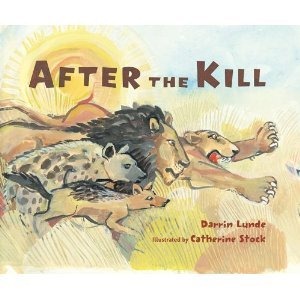
After the Kill by Darrin Lunde, illustrated by Catherine Stock

Explore what happens after the lioness kills a zebra on the Serengeti Plain.  While the hunt and the kill are part of the story, they are only the beginning.  After the zebra is killed, the lion pride comes to eat and then other species start to gather.  There are the vultures who share with the lions.  Then the hyena clan that is able to drive the lions away and claim their share.  Jackals use trickery to grab some food for themselves.  The lions reclaim the carcass and continue to eat until they are sated.  Other vultures arrive.  The small scraps of flesh that remain are eaten by meat-eating beetles until the bones are white in the African sun. 

Lunde, a mammalogist at the Smithsonian Institute, creates a compelling story here.  There is no shying away from predator and prey, just a frank description of the food chain.  Nicely, Lunde injects his narrative with plenty of detail, noises, and an obvious love of his subject.  He paints a verbal picture of what is happening, helping young readers better understand what is actually happening.  The pieces of the book in the smaller font have additional scientific information that readers will find fascinating. 

Stock’s illustrations have a bright, hot quality to them thanks to the yellow tones throughout.  The heat of Africa is built into every page.  She also embraces the kill, the scavenging, and the story, creating a book filled with action-filled images.

An unflinching look at the battle for food on the Serengeti Plain, this book will be riveting for young readers.  Appropriate for ages 5-8, though this is a book that some children may find upsetting, so it is important to be aware of the sensitivity of the child you are sharing it with.

Reviewed from copy received from Charlesbridge.