Review: School for Bandits by Hannah Shaw

school for bandits

School for Bandits by Hannah Shaw

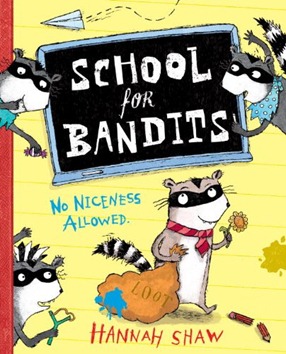
Ralph was not a normal raccoon.   He looked like any other raccoon, but he certainly didn’t act like them.  He was polite, clean, and tidy.  His parents were frustrated and so sent him to Bandit School where he could learn to be naughty, dirty and thieving.  Ralph had an awful time in school because he was just too nice.   When his teacher announced the Best Bandit in School competition, Ralph just knew that there was no way he would ever win.  He spent his break reading inside instead of causing trouble out on the streets like his classmates.  Can a nice raccoon ever come out ahead? 

Shaw captures the naughtiness of raccoons with glee.  They are shown with frizzy fur, bad breath, and are often playing pranks and taking other animals’ things.  Yet they are never frightening, despite the worry on other characters’ faces, they are rascals rather than being gang-like.  Children will love many of the touches here, including burping in class and brushing teeth with chocolate.

The text is simple and tells a good story, often crooked on the page.  The illustrations and text work well together, sometimes playing off of one another in style. 

This is a book that speaks to the importance of manners but in a way that remains fun and light-hearted throughout.  Appropriate for ages 4-6.

Reviewed from copy received from Alfred A. Knopf.

Also reviewed by:

New Halloween Books

Here are some newly released Halloween books that are sure to mix shivers and giggles:
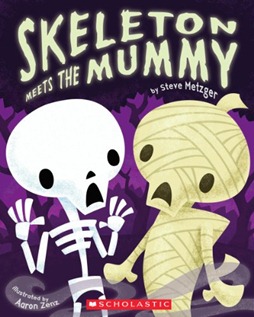
skeleton meets the mummy

Skeleton Meets the Mummy by Steve Metzger, illustrated by Aaron Zenz

Sammy is looking forward to trick-or-treating with his best friend on Halloween night.  His mother catches him before he can leave and asks him to run some soup to his grandmother.  To get there, he has to head through the woods.  He gets scared along the way by a bat, the wind, and even a tree that looks like a monster.  So he’s already jumpy when he hears the footsteps behind him and sees the mummy chasing him!

Told in straight-forward prose, the illustrations are a large part of the appeal here.  They are crisp, clean and vivid.  The characters glow against the dark Halloween backgrounds.  This is a story with a funny twist, plenty of appeal and even a couple of bumps in the dark.
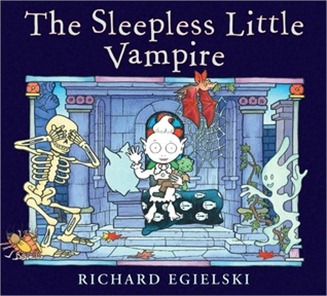
sleepless little vampire

The Sleepless Little Vampire by Richard Egielski

Little Vampire can’t figure out why he is having trouble falling asleep.  It could be the spitting spider.  It could be the flitting bats.  Maybe the cockroaches crawling on the floor?  Or the werewolf howling?  More and more Halloween characters enter the story and create their own noises:  a witch, skeletons, ghosts.  But none of them are the reason he can’t sleep.  Nope, it was just that he was trying too sleep too early.  It wasn’t morning yet!

Egielski bridges the pages brilliantly, moving from one possible cause of being unable to sleep to another.  The final reason will surprise most readers, though as they see the sky lighten they will be able to guess the ending on the final page.  The illustrations get increasingly busy as more characters enter.  The detail makes this a better pick to use one-on-one or with a small group of children. 
frangoline

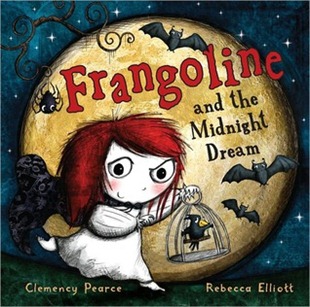
Frangoline and the Midnight Dream by Clemency Pearce, illustrated by Rebecca Elliott

Frangoline was a perfect child, neat and clean.  Until the deep of night, when she put on her black cape and escaped the house.  The moon tried to warn her about being in bed, but Frangoline replied, “I’ll do exactly as I please!  I’m Frangoline!”  She climbed down the tree outside her window, ran across the lawn, blew raspberries.  She woke the forest animals but then yelled so loud that she scared them all away rather than them ever scaring her.  She danced and pranced in the graveyard and woke up the ghouls.  When they chased her up the church steeple, she finally got worried.  But where can she go if she’s cornered up there? 

There is a wild delight in this book and in the naughtiness of a little girl having such fun alone in the middle of the night.  The moon plays a big role in the book, warning her of the dangers but also being a sort of parental figure on each page.  The story is silly, clever and has the dark night creepiness along with the ghouls.  But nothing is drawn in a particularly scary way, instead it stays inviting with a strong sense of fun.

All three books are appropriate for ages 4-6. 

All were provided for review by Scholastic.
Review: The Princess and the Peanut by Sue Ganz-Schmitt

princess and the peanut

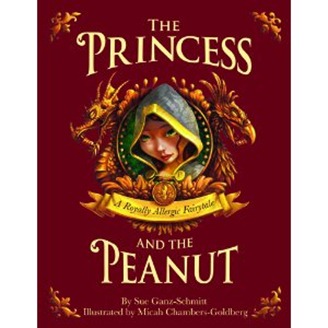
The Princess and the Peanut by Sue Ganz-Schmitt, illustrated by Micah Chambers-Goldberg

Food allergies are booming in children today with nearly six million children in the U.S. suffering from food-related allergies.  Here allergies are merged into a fairy tale world to nice effect.  When a prince despairs of finding his perfect princess, a princess appears on his doorstep looking for shelter from the storm.  To test to see if the princess is indeed real, the queen places a peanut between her tower of mattresses.  But this princess doesn’t have trouble sleeping, instead she awakens with an allergic reaction!

Following the storyline of The Princess and the Pea, this book skillfully and with effective humor tells the story of having an allergic reaction and what should be done.  It is a book that reflects what children today are dealing with and also supports children who have allergies.  The book also has a question and answer section on allergies for adults and a glossary for kids.

The illustrations have the feel of an animated film with dramatic lighting, interesting perspectives, and touches of humor.  They will be an inviting style for children, who will enjoy the juxtaposition of modern allergies and fairy tale themes.

Make sure to check out Ganz-Schmitt’s first book that was about diabetes: Even Superheroes Get Diabetes.  Both books have a charm and an honesty about medical situations that children are dealing with.  Appropriate for ages 4-7.

Reviewed from copy received from Raab Associates.

Review: Do You Know Which Ones Will Grow? by Susan A. Shea

do you know which ones will grow

Do You Know Which Ones Will Grow? by Susan A. Shea, illustrated by Tom Slaughter

This interactive and engaging book will have children eagerly answering the questions inside.  The book is all about whether something is alive or not, whether it will grow or not.  Told in rhyming sets of questions, the final rhyme and answer is hidden beneath another flip-out page that makes it into a guessing game for the rhyme.  So in the first pages, “If a ducking grows and becomes a duck, can a car grow and become…”  Turn the page and you find “a truck?”  The flaps also have die cut holes in them that add to the appeal.  It’s a game and a book that will intrigue and fascinate young readers.

A large part of the appeal of this book is the rhyming couplets that create the guessing game.  Pairing living creatures and inanimate objects make for an appealing educational book.  Adding the rhyming guessing game takes it to another level.  The rhymes have a great humor to them, and will have children giggling at the thought that a stool could grow into a a chair or a sweater into a coat.

Slaughter’s illustrations are bright and graphic.  Using bold color combinations and strong lines, the cut-paper illustrations are very effective.  They have an colorful and inviting tone that is modern and striking.

Ideal for classroom use or in any library, this book should be enjoyed by many children.  The flap structure is large and sturdy, meaning it will work well for public or school libraries.  This book tackles a subject I haven’t seen in many picture books too, adding to the appeal. Appropriate for ages 3-5.

Reviewed from library copy.

Also reviewed by:

Review: Blue Chicken by Deborah Freedman

blue chicken

Blue Chicken by Deborah Freedman

This vibrant picture book plays with color and perspective as well as characters who leave the flat page and enter the real world.  The picture is almost finished when one of the chickens in the picture pops her head out.  She then stands up and walks over to the paint pots that are waiting to finish the picture.  When the chicken peeks into the blue paint, she accidentally tips it over and ends up painting herself.  She is joined by a little duckling and then more who splash around in the new blue puddle, turning themselves and the cat who walked past blue.  Soon all of the animals are blue.  Now what can be done to turn them all back to normal?

There is a wonderful playfulness about this title.  Even the grumpy animals end up enjoying the escapade.  At the same time, there are lots of options to discuss colors, perspective, and art.  The book has real depth to it, allowing it to be read just as a cute story, or used more seriously with children. 

The words are simple and try to stay out of the way, allowing the art to really shine here.  And shine it certainly does.  It dazzles and glows, inviting young readers into the humor of the book and revealing a magical quality that is lovely.  From the freshness of the first spill of the blue to the sogginess and flatness that results, there is an exploration of the media here right on the page. 

Highly recommended, this is one of my favorite picture books of the year.  It is a charming jewel of a picture book that is fun, silly, yet offers plenty to learn.  Appropriate for ages 3-6.

Reviewed from copy received from Viking Books.

Also reviewed by Fuse #8.

Review: Good Night, World by Willa Perlman

good night world

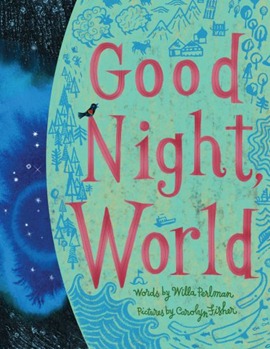
Good Night, World by Willa Perlman, illustrated by Carolyn Fisher

A small child says good night to the world around him before he goes to bed. He says goodnight to the sun and stars, planets, and the Earth.  He then says goodnight to the deserts, mountains, oceans, and jungles.  Then the book moves closer to home as he bids goodnight to animals, twisting roads, and houses.  The book returns to where it began, right in his bedroom where he curls up and sleeps.Told in rhyming couplets, this is a gentle, soothing book that is just right for bedtime.

Perlman’s verse is simple and quiet.  The circular feel of the book as it moves far away and then comes back again creates a hug of a story, where children will feel warm and secure.  Yet at the same time, it is a book with a strong arc that invites children to think beyond themselves and far out into space.  So it has a touch of adventure and an outward looking approach that is welcome.

Fisher’s art is a mix of painting and collage that is lovely.  She evokes both the larger world outside and the closer, comfort of home in a way that makes both equally beautiful and welcoming.  The illustrations are colorful, intriguing and have a sense of fun as well.  Children should watch for the red-winged blackbird in each picture too, a friendly guide throughout the story.

This book manages to be both a bold, colorful picture book and a quiet bedtime story that evokes warmth and coziness.  An ideal picture book appropriate for ages 2-4.

Reviewed from copy received from Beach Lane Books.

Also reviewed by:

Review: Zoozical by Judy Sierra

zoozical

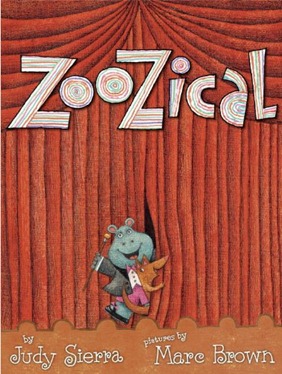
Zoozical by Judy Sierra, illustrations by Marc Brown

This sequel to Wild About Books continues with the same vivacious spirit of the first.  It is winter and the visitors to the zoo start to stay home.  All of the animals had the winter blues too.  But just when the blues seemed to be inescapable, a very small hippo and young kangaroo started to hop.  Soon everyone was dancing along with them and then everyone started to sing.  The dancing and singing turned into their own stage show complete with sets and costumes.  Once again, the zoo was the place to be despite the snowy weather.

Told in rhyming verse, there is a bubbly, bouncing feel to the book.  The verse also reads aloud tremendously well thanks to the rhymes and the natural rhythm that Sierra has created in each line.  The thrill and creativity of the theatre are captured in the jaunty text as is the slow, winter dullness. 

Brown’s art is boisterous, big and bright.  The colors change from the blues and grays of winter into an almost tropical feel when the animals are feeling themselves again.  Greens, oranges, yellows and reds pop and glow on the page.  There is always plenty to keep your eye on in the illustrations as well, giving children a reason to read this one again and again.

A standing ovation to Sierra and Brown for this bright, bubbly, boisterous book.  Appropriate for ages 4-6.

Reviewed from copy received from Random House Children’s Books.

Review: An Annoying ABC by Barbara Bottner

annoying abc

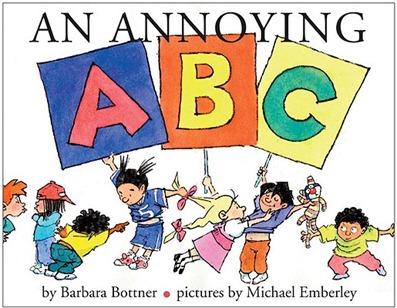
An Annoying ABC by Barbara Bottner, illustrations by Michael Emberley

Take a very funny trip through the alphabet in a series of mishaps in this silly picture book.  When Adelaide starts the story off by annoying Bailey the chain of events carries all the way through the classroom from A to Z.  Children are crying, fuming, howling, and evening stumbling and tumbling before it reaches the end.  But then, when everything is done, Adelaide apologizes! 

Bottner has created a zany way to do the ABCs filled with plenty of action and nonsense.  This is a modern classroom filled with characters that are depicted in detail by Emberley.  He manages to imbue each of them with their own sense of personality and style, all 26 of them.  It is a book that races along thanks to the pacing of Bottner’s words, but readers who linger on each page will get a better sense of the story itself as told through the illustrations.  It’s a pleasant mix of words that are welcoming and fast, and pictures that are worth exploring.

A thrilling ABC, this is one of those books where children act like children and laughter abounds.  Appropriate for ages 3-5.

Reviewed from library copy.

The Amazing Wangari Maathai

Sadly, Wangari Maathai, died at age 71.  She was the first African woman to receive the Nobel Peace Prize and was responsible for the Green Belt Movement in Kenya which planted millions of trees.  Happily, there are several great children’s picture books about her inspirational story.  What a great way to celebrate the life of this incredible woman.  Here are my three favorites with links to my reviews:

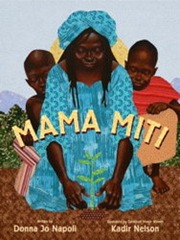
mama-miti

Mama Miti by Donna Jo Napoli, illustrated by Kaddir Nelson

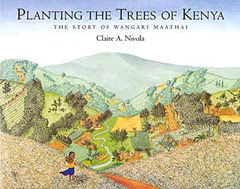
planting_trees_of_kenya

Planting the Trees of Kenya by Claire A. Nivola

Seeds of Change by Jen Cullerton Johnson, illustrated by Sonia Lynn Sadler