Review: Butterfly Tree by Sandra Markle

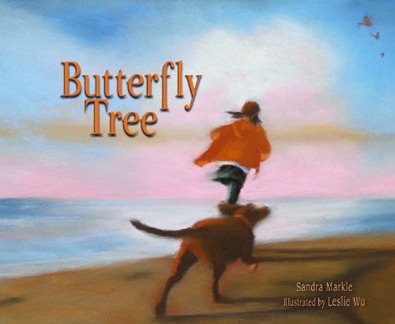
butterfly tree

Butterfly Tree by Sandra Markle, illustrated by Leslie Wu

A girl is playing at the beach in early September when she sees something odd in the air.  At first it looks like black pepper raining down, then it turns into a shimmering orange cloud.  Jilly runs to get her mother because she is scared of what it might be.  Her mother heads toward the beach and then to the neighboring woods.  As they walk, Jilly tries to figure out what the cloud might be.  As they enter the dim, cool woods she tries to spot orange things.  She sees an oriole and a kite, and then a tree that is completely orange.  It’s not until her dog rushes at the tree chasing a squirrel and the monarchs fly into the air that she realizes that the orange are monarch butterflies on their migration.

Markle has written this book in very evocative language, describing what Jilly is seeing with details.  The book is in verse, so the language is just right, creating a sense of mystery and wonder that readers are sure to feel clearly as they read.  The imagery here is clear and well drawn, comparing the butterflies to clouds and jewels.  Markle also draws the setting very clearly, showing the touch of sand on feet, the chill of the woods after the beach, and the play of light and dark in the woods.

Wu’s illustrations add to the beauty here.  Her pictures range from hazy, long-distance looks at the shore to the soft close-ups of the girl and her mother.  Everything is soft and filled with rich colors of fall.  The author’s note at the end of the book has information on Markle’s own experience with migrating monarchs as well as other resources for more information.

This is a perfect book to share in the autumn, but children will enjoy it year round.  The stellar writing and rich illustrations create a book that is impressive and enjoyable. Appropriate for ages 4-6.

Reviewed from copy received from Peachtree Publishers.
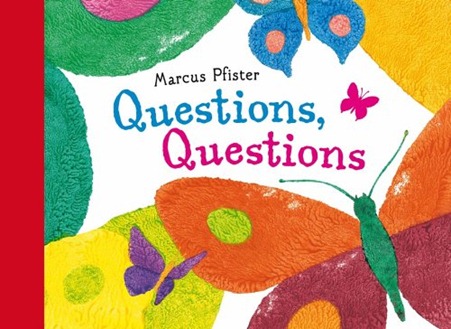
Review: Questions, Questions by Marcus Pfister

questions questions

Questions, Questions by Marcus Pfister

This colorful book asks question after poetic question about our world.  The questions range in subject, but are all simply and beautifully written:

What makes fire burn red and gold

and makes it much too hot to hold?

and

Does a whale make up a song

so other whales will sing along?

Told in gentle verse, the book celebrates life, including whales, fish, seeds, butterflies and much more.  The simplicity and tenderness of this book make it exceptional.

Pfister’s art work is done with a different technique here.  He explains it in an author’s note at the end of the book.  He transferred his drawing to cardboard and then used the cut outs to stamp with acrylic paints.  The result are intriguingly textured illustrations that are bold and colorful.  On each page there is also a foil element, though I find the illustrations themselves to be far more interesting.

A lovely poetic book that is worth sharing, it is appropriate for ages 2-4.

Reviewed from library copy.

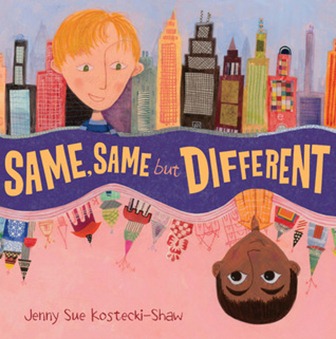
Review: Same, Same but Different by Jenny Sue Kostecki-Shaw

same same but different

Same, Same but Different by Jenny Sue Kostecki-Shaw

Elliot and Kailash are new pen pals.  As they share letters, they share the differences and similarities of their lives in Elliot’s America and Kailash’s India.  Both boys like to climb trees.  Their families are very different with Elliot living with his mother, father and baby sister and Kailash living with an extended family of 23.  They both have pets, but the pets are different.  Both boys take a bus to school, but the communities are very different except for the traffic.  The boys discover that they can be friends despite their obvious differences by looking to see how much they are actually they same.

Kostecki-Shaw writes with a very positive tone here.  Through the two boys, she demonstrates how we are all so much more similar than we may realize.  At the same time, she rejoices in the differences between the two characters, allowing us to see the different cultures side-by-side.

Her art is very effective as well, rendering both cultures with bright colors, plenty of motion, and a natural energy that captures the eye.  She makes the differences between the cultures quite compelling. 

A perfect book to share in a class along with a pen pal unit, this book is also a good pick for sharing when discussing differences since it takes such a positive approach.  Appropriate for ages 5-7.

Reviewed from copy received from Henry Holt & Company.

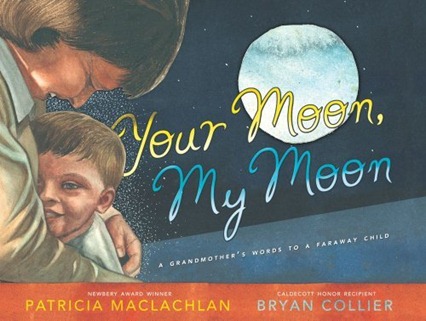
Review: Your Moon, My Moon by Patricia MacLachlan

your moon my moon

Your Moon, My Moon by Patricia MacLachlan, illustrated by Brian Collier

In her signature poetic text, MacLachlan has created a picture book that celebrates the continued connection between family members who are apart.  Here, a grandmother lives in a cold area of the world, while her grandchild lives far away in Africa.  She watches the snow start to fall while he is in the hot sun.  She wishes they were together to ice skate or together to swim in the lake where he lives.  There are many things that connect them, from the dogs in both places to the sun, but especially the moon, which shines on them both.

MacLachlan weaves two very different places together into one story filled with a poignancy and longing but also a story of love and connection.  For both settings, she pulls the best out of them, celebrating their differences and their similarities at the same time with great skill.  She invites us into memories, special moments, and also into the day-to-day of lives. 

Collier’s illustrations elevate this book further.  Their watercolor and collage use the color of the light to great effect as it moves from African gold to the cool of a northern winter.  People of all colors fill the pages, making it feel all the more inclusive and global.  Collier also uses lines to great effect, sometimes swirling and creating color or intensity changes in the illustrations, otherwise showing currents, mountains or forest. 

Beautifully written and illustrated, this book may be specifically about grandparents and grandchildren, but could also be used for any adult being away from a child they love.  Appropriate for ages 4-6.

Reviewed from copy received from Simon & Schuster Books for Young Readers.

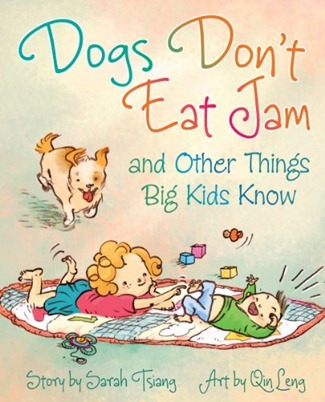
Review: Dogs Don’t Eat Jam and Other Things Big Kids Know by Sarah Tsiang

dogs dont eat jam

Dogs Don’t Eat Jam and Other Things Big Kids Know by Sarah Tsiang, illustrated by Qin Leng

Here in this cheerful picture book, an older sister explains to her new baby brother that he has a lot to learn.  She covers things like the potty, learning to walk, and that things fall down (a lot).  She also covers other things that will delight, like the fact the baby has already done something amazing: made her a big sister.  The book is filled with small encouragements and nothing negative towards the baby coming into the family and no jealousy.  Instead it is a celebration of a new baby, the growth that he will see, and the warm adoration of an older sibling.

Tsiang’s writing here is joyful, filled with the small moments that create a growing baby, the milestones and those smaller times that are too often ignored.  She writes with a gentle tone that suits the subject beautifully, tying all of the moments together into one wise older sister’s encouragement for a new baby.

Leng’s illustrations have a great sense of humor and whimsy.  The lines are loose and flowing, filled with bright colors and plenty of white space as well.  

There are so many books about new babies, but this one is definitely worth looking at.  The text and illustrations combine into a noteworthy package that will delight.  Appropriate for ages 3-5.

Reviewed from copy received from Annick Press.

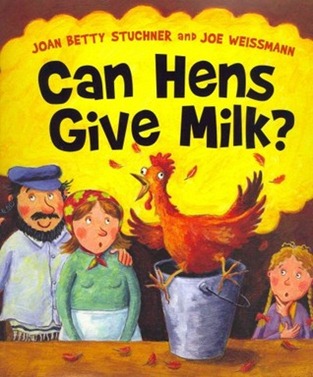
Review: Can Hens Give Milk? by Joan Betty Stuchner

can hens give milk

Can Hens Give Milk? by Joan Betty Stuchner, illustrated by Joe Weissmann

Shlomo and Riva live on a farm where they have five children, twelve hens and one rooster.  Rivka wishes that they had a cow to give the family milk and cheese.  That night, Shlomo had a dream that showed him what they could do.  Cows eat grass and give milk, so he reasoned that if the hens were fed grass, they would give milk too.  But the hens refused to eat the grass.  One of the daughters, Tova, came up with the idea of rolling the grass into pellets that look like the grain that the hens usually eat.  But even then, the hens would not eat the grass.  There was only one thing to do, and that was to force the hens to each eat one pellet of grass.  The family then left them to lay eggs and give milk overnight.  What do you think happened next?  All I will say is that in the end, the family had eggs AND milk.  But how?

This story of a fool and his family is written with great humor.  Children will immediately recognize the nonsense of the logic that Shlomo and his family are using, so they will enjoy seeing the story play out.  There is plenty of opportunity for laughter as new solutions are generated and then also proven to not work.  It’s a story that will have you grinning just because of the silliness of the entire book.

Weissman’s art is bright and silly as well, reveling in the humor of the text.  The dreams of milk and cheese are brought to life as are the hiccupping and indignant hens. 

A silly book that will lend a lot of laughter to a unit or storytime on food, this book reads aloud well.  Appropriate for ages 4-7.

Reviewed from library copy.

Also reviewed by

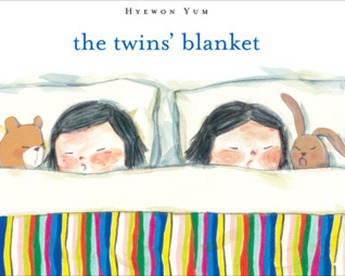
Review: The Twins’ Blanket by Hyewon Yum

twins blanket

The Twins’ Blanket by Hyewon Yum

Two twin girls look just alike and share everything, especially a blanket that they have had ever since they were born.  But now the blanket has gotten too small for them to share.  Neither girl wants to give it to the other though.  Their mother tells them that they are going to be moving to big kid beds and that she will make each of them a new blanket.  They each pick out a fabric, one yellow with flowers, the other pink with birds and flowers.  They wash the fabric, dry it on the line, and then their mother sews the blankets.  When they are done, they have two new blankets that each have a piece of the original as well as their own personality.  Then they have to see what sleeping apart for the first time is like!

Yum has created a charming story about twins that shows the sibling relationship in all of its complexity, yet remains accessible for small children.  The girls both want to be alike and together, yet yearn to be different and apart at the same time.  Down to their stuffed animals that are alike but different, the story is really about their relationship rather than the blanket which is more of a symbol.

Yum’s illustrations are done in deep, rich colors and strong lines.  They have hints of color in unexpected places, creating an additional richness.  The girls while identical are always seen separately and uniquely in the art.

Charming and honest, this book about twins has a clever storyline and lovely illustrations.  Appropriate for ages 3-5.

Reviewed from library copy.

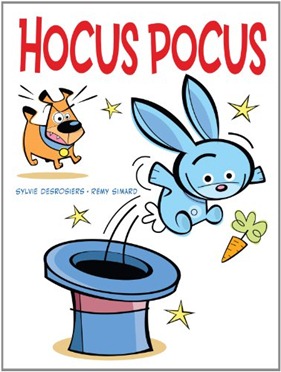
Review: Hocus Pocus by Sylvie Desrosiers

hocus pocus

Hocus Pocus by Sylvie Desrosiers and Remy Simard

This wordless picture book has the feel of a graphic novel, but one designed for very small children.  It tells the story of Mister Magic who heads home with his pet dog, feeds the dog, and then settles in listening to music with his headset.  Once he has fallen asleep, the rabbit jumps out of his hat.  On the counter is a grocery bag and he spots some carrots up there.  But he has to sneak past the sleeping dog to get there.  He has the great idea of wearing slippers to be quieter, but then he crunches on a peanut.  The dog wakes up and discovers the rabbit’s activity, but the rabbit is able to soothe him back to sleep with some violin music.  But that is only the first round, as the dog and rabbit try to outwit each other.

This is a very funny picture book that emerging readers will enjoy.  It’s not a wordless book for toddlers who would miss the humor of the story, but rather one for slightly older children who will read this book like watching a silent cartoon.  The humor is pure slapstick fun, channeling the Daffy Duck and Bugs Bunny feel with plenty of physical gags. 

The art here is crisp and clean with a modern vibe.  The colors are vibrant, bright and very appealing.  Children who pay close attention to the illustrations will see some of the jokes coming, making it all the more fun to read.

A modern picture book that is full of classic humor, this book has great appeal.  Appropriate for ages 4-6.

Reviewed from copy received from Kids Can Press.

Also reviewed by 100 Scope Notes and Sal’s Fiction Addiction.

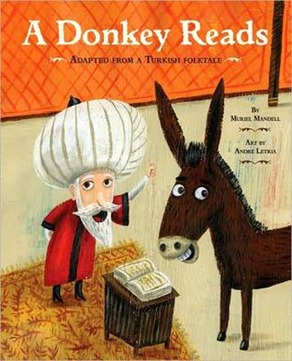
Review: A Donkey Reads by Muriel Mandell

donkey reads

A Donkey Reads by Muriel Mandell, illustrated by Andre Letria

This adaptation of a Turkish folktale features Nasreddin Hoca, a 13th-century teacher, judge and imam whose writings are well known in the Middle East.  This is the story of a village in Anatolia that was conquered by the Mongols.  The Mongol leader demanded that every family pay tribute, but one family had only a worthless donkey to offer the leader.  When the Mongol leader reacts with fury at the tribute, Nasreddin speaks up and tells the him that the donkey is worth something, in fact Nasreddin will teach the donkey to read.  Everyone is shocked, but Nasreddin is calm and confident that it will happen.  The ending will have reader giggling at the humor and courage of Nasreddin’s solution.

Mandell has adapted this tale with a great feel for storytelling.  Her pacing is adept and her wording easy to share aloud.  The tale is universal in its appeal, thanks in particular to the humor that pervades it.  The end of the book has a page where the story of Nasreddin is shared with the reader.  It’s a trickster tale with only a donkey as an animal.

Letria’s art is filled with textures and colors.  The pages have backgrounds that are rough with brushstrokes, peeling and colors.  They add a feeling of age to the book, giving it a strong organic quality as well.  The characters pop on the page, especially Nasreddin with his towering headwear.  The illustrations add a great appeal to the story.

A window into another world of folktales that many of us have not experienced, this book offers plenty of humor and an appealing package.  Appropriate for ages 5-8.

Reviewed from library copy.

Also reviewed by Planet Esme.