Review: Step Gently Out by Helen Frost

step gently out

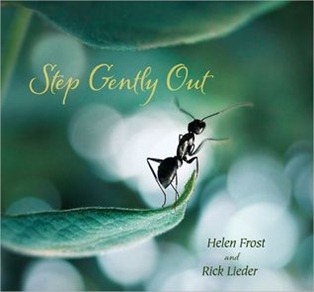
Step Gently Out by Helen Frost, illustrated by Rick Lieder

This picture book celebrates looking closely at the small things in the world around us.  Through a poem that focuses on the insects that you can notice if you slow down and take the time, Frost quietly reminds us all that there is another world beside our own that we often ignore.  Ants are climbing up stems, honeybees buzz past, crickets leap and spiders spin webs.  Children will get to see these insects up close, larger than life in the gorgeous photography that accompanies the poem.  It’s a perfect invitation to take a closer look.

Focusing on the more common insects in our gardens, the poem celebrates the ants, bees and moths that surround us.  Frost speaks about them very poetically, bathed in golden light or shining with stardust. 

Her gentle poem pairs beautifully with the artistic photography that features close ups of the insects in the poem.  The images are stunning and lovely, each focusing closely on an insect.  The morning dew image alone is a breathtaking photograph, but there is one after another that are exceptional.

Combining nature and poetry, this book celebrates both.  It also inspires mindfulness and a slower pace, so that children can make discoveries like this of their own.  Appropriate for ages 4-7.

Reviewed from library copy.

Review: Bugs by the Numbers by Sharon Werner

bugs by the numbers

Bugs by the Numbers by Sharon Werner and Sarah Forss

The creators of Alphabeasties and Other Amazing Types return with a bug book where it is all done by the numbers.  After an energetic introduction, readers turn pages to see bugs made up of numbers.  The numbers have special reference to that insect, whether it is the number of legs, number of eyes, or how far they can jump.  The design of the book is eye-catching and very engaging.  The ground is bright colors that change from page to page and the bulk of the numbers are explained there.  But other pages have large flaps that open:  wood for the termites, a tree for the walking stick, and leaves for the caterpillar.  This is a vibrant book that will have everyone engrossed in learning facts about bugs.

The typographical design is truly amazing with the insects fully rendered in numbers, used in different sizes and amounts of boldness.  The backgrounds are primarily white with large areas of color, leaving the detail to the insects themselves.  It is a strong design that is intriguing and great fun.

This book worked particularly well read-aloud, which is something I had not expected.  The facts read naturally and provide lots of opportunities for further discussion.  There are facts that are well known and others that are strange and intriguing.  It makes for a great book for kids to nod along that they know the information and then in the next sentence to be learning something new.

A great bug book, this deserves a place in every public library.  I know it will be one of my picks for holiday presents for any nature-loving kid.  Appropriate for ages 5-8.

Reviewed from library copy.

Also reviewed by

Jam & Honey: Natural Sweetness

jamhoney

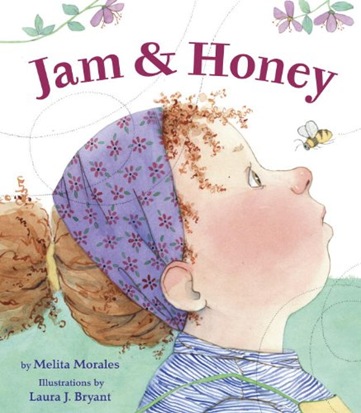
Jam & Honey by Melita Morales, illustrated by Laura J. Bryant

This quiet, gentle book tells the story of a visit to an urban berry patch from two points of view, a girl and a bee.  The girl is headed to the berry patch to pick berry to make into jam.  Her big worry is running into bees, which she does.  But she remembers what her mother told her about staying still and that the bee was interested in nectar not in her.  The bee is heading to the berry patch for nectar to make into honey.  He is worried about running into a human there, which he does.  But he remembers that humans are interested in the berries, so he just flies past.  This parallel story offers a glimpse of urban gardening and emphasizes the importance of our food and other creatures.

Morales has written the book in a verse format that has enough rhyme to make it friendly and bouncy.  There is a rather jaunty tone to the book, making the encounter with the bee less scary than it could have been.  The emphasis is on making food, whether it is by the girl or the bee.  The two halves of the book are written in very similar verse, often repeating patterns from the earlier one.  This ties the two stories together even more firmly.

Bryant’s art makes sure that the reader knows that the book is set in an urban setting without covering it in graffiti or garbage.  Instead, we see a warm friendly neighborhood filled with flowers, pigeons, and bees.  She imbues the illustrations with a natural feel, always having the reader look past greenery and through plants. 

A great pick for insect units or story times or ones about food.  It could also happily be used as a late summer story when the berries are plump and ripe.  Appropriate for ages 3-5.

Reviewed from copy received from Random House.

What the Ladybug Heard

9780805090284

What the Ladybug Heard by Julia Donaldson, illustrated by Lydia Monks

All of the animals on the farm make their own type of noise, except for the little ladybug.  She never says anything at all.  That is until she hears two robbers planning how to steal the farm’s prize cow.  They know just where each animal on the farm sits and what noises they make so that they can find their way in the dark without alerting the farmer.  So the ladybug heads to the farm, tells the animals about the robbers, and comes up with a cunning plan to foil them.  Told in a wonderful romping rhyme and rhythm, this book has immediate appeal.

Donaldson has a great ear for rhythm and rhyme, never pushing it too far to become annoying.  She weaves in humor effortlessly.  The premise for the book is very clever, mixing animal noises with a barnyard mystery and a silent witness.  Monks’ illustrations are done in mixed media which makes them visually interesting.  The painted sheep has a wooly coat that is a photograph of wool.  The bushes around the farm are either photographs of leaves or fabric.  There is just enough of the mixed media to still have a very cohesive feel. 

Get this into your farm storytime and also for any insect unit or story time.  It is a winner of a read, just be prepared for plenty of animal noises and ask the audience to help!  Appropriate for ages 2-4.

Reviewed from copy received from Henry Holt.

Also reviewed by Pied Piper Picks.

I Love Bugs!

I Love Bugs by Emma Dodd

This brightly colored book is a cheerful exploration of the world of insects that is less about scientific accuracy and more about an adoration of our six-legged friends.  The book moves quickly from bug to bug, from “jumpy leapy bugs” to “slimy crawly creepy bugs.”  All are appreciated for their differences until the end when a spider appears!  It is a great twist that children are sure to enjoy.

Dodd’s art is what really takes this book beyond a run-of-the-mill insect book.  Filled with bright colors, an eager child to guide us, and plenty of bug-eyed insects, young readers will feel right at home.  Her illustrations are thick lined and beautifully patterned, bringing the essence of grass, dirt and bugs directly to the reader.

Dodd’s language here is bouncy and pure fun.  She offers rhymes that have a real spring about them.  Since she doesn’t name the insects, children will be eager to name them themselves from caterpillars to ladybugs to grasshoppers.

Add this to a toddler story time and then set out on a bug hunt together.  It could just be cut outs around the children’s room.   This would pair wonderfully with nonfiction picture books about specific insects that will offer enticing details.  Appropriate for ages 1-4.

Reviewed from library copy.

Winnie Finn, Worm Farmer

Winnie Finn, Worm Farmer by Carol Brendler, illustrated by Ard Hoyt

Winnie loves earthworms.  She knows all sorts of facts about them, pulls them around in her wagon, and even races them.  But when the county fair rolls around, she realizes that there is no category for her beloved worms to compete in.  She speaks with three neighbors.  One is growing corn for the fair and needs a good fertilizer.  Another is raising chickens and needs the right feed to make them the best egg layers.  And the third is raising puppies and needs something to get their coats shining.  She makes a deal with each of them that if she finds the answer to their needs they will share the prize with her.  Then she uses her worms to help with the corn, the corn to help with the eggs, and the eggs to help with the shiny coats.  It’s a clever solution from a bright, scientific girl.

I love any book that breaks with the stereotype of girls not liking worms, dirt or animals.  Winnie is a great protagonist for a picture book because she shatters that myth.  She holds and hugs worms with delight.  I also appreciate how intelligent she is and how she solves her own problems by using her brain. 

Brendler’s text is fun to read aloud.  She has taken a traditional tale format and modernized it.  Readers will find themselves in a traditional format and be surprised, which is delightful.  Hoyt’s illustrations are funny, sometimes frenzied, and wiggly with worms.  Any worm haters out there will love the reaction of Winnie’s cat as it grimaces about the worms she loves.

A strong heroine in a modern picture book, this wiggly mass of worms is loads of fun.  Appropriate for ages 4-7.

Reviewed from library copy.