A Couple of Fall Board Books

go baby go

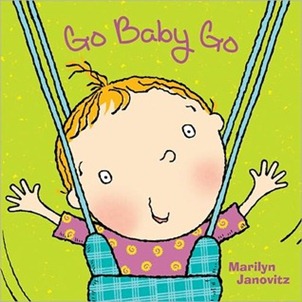
Go Baby Go! by Marilyn Janovitz

As baby gets fussy, they head out to the garden where baby is distracted by all sorts of things.  The bubbles going pop, pop, pop.  The blocks tumbling down and clickity clacking.  There are mud pies, water from the hose, even treats to munch.  Then everything gets quiet as baby falls asleep.

This charmer of the picture book has a jaunty rhythm mixed with plenty of repetition to catch the attention of very small children.  Everything that happens here is what a child would find in their own backyard, making the book all the more interesting to children who will see themselves in it.
scariest thing in the castle

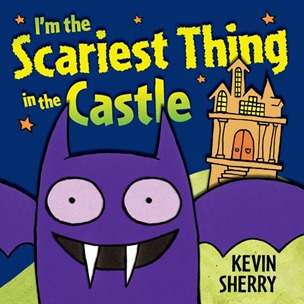
I’m the Scariest Thing in the Castle by Kevin Sherry

This board book has the same colorful, bold artwork as Sherry’s previous picture books.  Here his creature is a merry bat who declares himself scarier than all of the other monsters in the haunted castle.  And he does manage to play pranks and frighten all of the others, until the lights go out. 

This jolly Halloween board book will appeal to small children with its bright colors, humor and the not-very-scary tone.
Review: Same, Same but Different by Jenny Sue Kostecki-Shaw

same same but different

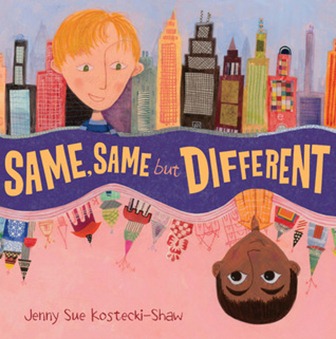
Same, Same but Different by Jenny Sue Kostecki-Shaw

Elliot and Kailash are new pen pals.  As they share letters, they share the differences and similarities of their lives in Elliot’s America and Kailash’s India.  Both boys like to climb trees.  Their families are very different with Elliot living with his mother, father and baby sister and Kailash living with an extended family of 23.  They both have pets, but the pets are different.  Both boys take a bus to school, but the communities are very different except for the traffic.  The boys discover that they can be friends despite their obvious differences by looking to see how much they are actually they same.

Kostecki-Shaw writes with a very positive tone here.  Through the two boys, she demonstrates how we are all so much more similar than we may realize.  At the same time, she rejoices in the differences between the two characters, allowing us to see the different cultures side-by-side.

Her art is very effective as well, rendering both cultures with bright colors, plenty of motion, and a natural energy that captures the eye.  She makes the differences between the cultures quite compelling. 

A perfect book to share in a class along with a pen pal unit, this book is also a good pick for sharing when discussing differences since it takes such a positive approach.  Appropriate for ages 5-7.

Reviewed from copy received from Henry Holt & Company.

Why Do Adults Like Children’s Books?

Oh good grief.  Do we have to do this again? 

Just a second while I fill my Harry Potter mug up and sit at my desk surrounded by children’s books waiting to be reviewed.  Yeah, I don’t have an opinion about this…

Why do adults like children’s books?  Why do adults read comic books?  Why do adults read romances?  Mysteries?  Why do we read anything but the most literate of fiction and nonfiction?

Best of all in the article are the theories about why people like me read children’s books.  It appears I’m a lonely, nervous person desperate for “the pleasure of home-cooking” and looking for a “tolerance towards eccentricity.”  OK, so that last bit about eccentricity may be true.

I’ve got an idea!  How about we all are just allowed to read whatever we darn well want to.  And be free of people creating theories about what makes me odd.  Heck, reading children’s books is actually one of the more normal things in my life.

I predict the next article will be fretting about why adults don’t read any more. 

Review: Your Moon, My Moon by Patricia MacLachlan

your moon my moon

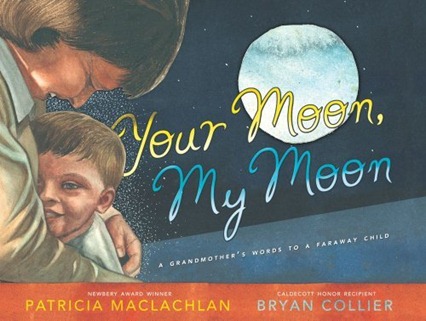
Your Moon, My Moon by Patricia MacLachlan, illustrated by Brian Collier

In her signature poetic text, MacLachlan has created a picture book that celebrates the continued connection between family members who are apart.  Here, a grandmother lives in a cold area of the world, while her grandchild lives far away in Africa.  She watches the snow start to fall while he is in the hot sun.  She wishes they were together to ice skate or together to swim in the lake where he lives.  There are many things that connect them, from the dogs in both places to the sun, but especially the moon, which shines on them both.

MacLachlan weaves two very different places together into one story filled with a poignancy and longing but also a story of love and connection.  For both settings, she pulls the best out of them, celebrating their differences and their similarities at the same time with great skill.  She invites us into memories, special moments, and also into the day-to-day of lives. 

Collier’s illustrations elevate this book further.  Their watercolor and collage use the color of the light to great effect as it moves from African gold to the cool of a northern winter.  People of all colors fill the pages, making it feel all the more inclusive and global.  Collier also uses lines to great effect, sometimes swirling and creating color or intensity changes in the illustrations, otherwise showing currents, mountains or forest. 

Beautifully written and illustrated, this book may be specifically about grandparents and grandchildren, but could also be used for any adult being away from a child they love.  Appropriate for ages 4-6.

Reviewed from copy received from Simon & Schuster Books for Young Readers.

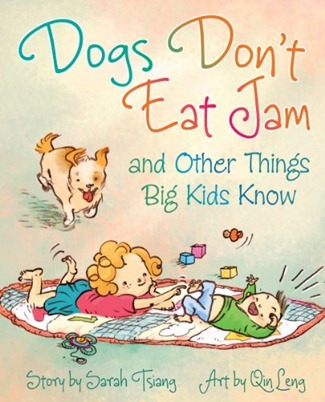
Review: Dogs Don’t Eat Jam and Other Things Big Kids Know by Sarah Tsiang

dogs dont eat jam

Dogs Don’t Eat Jam and Other Things Big Kids Know by Sarah Tsiang, illustrated by Qin Leng

Here in this cheerful picture book, an older sister explains to her new baby brother that he has a lot to learn.  She covers things like the potty, learning to walk, and that things fall down (a lot).  She also covers other things that will delight, like the fact the baby has already done something amazing: made her a big sister.  The book is filled with small encouragements and nothing negative towards the baby coming into the family and no jealousy.  Instead it is a celebration of a new baby, the growth that he will see, and the warm adoration of an older sibling.

Tsiang’s writing here is joyful, filled with the small moments that create a growing baby, the milestones and those smaller times that are too often ignored.  She writes with a gentle tone that suits the subject beautifully, tying all of the moments together into one wise older sister’s encouragement for a new baby.

Leng’s illustrations have a great sense of humor and whimsy.  The lines are loose and flowing, filled with bright colors and plenty of white space as well.  

There are so many books about new babies, but this one is definitely worth looking at.  The text and illustrations combine into a noteworthy package that will delight.  Appropriate for ages 3-5.

Reviewed from copy received from Annick Press.

Teen Brains–Not a New Zombie Novel

National Geographic has a cover story this month all about the process that teen brains undergo to move from a child’s brain to an adult’s.  The science is fascinating, including the tests that have been done to demonstrate the changes the teen brain undergoes.  Anyone working with teens, and especially those of us living with teens, should take a look at this. 

On their website, you can also see a photo gallery, take a quiz about your risk tolerance, and also a video about viewing teens positively.

Thanks to Free Technology for Teachers for the link.

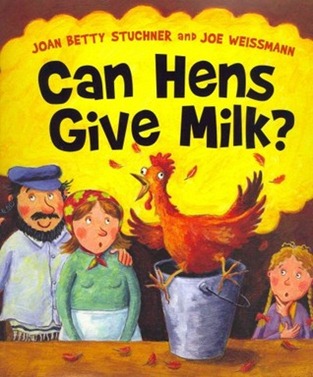
Review: Can Hens Give Milk? by Joan Betty Stuchner

can hens give milk

Can Hens Give Milk? by Joan Betty Stuchner, illustrated by Joe Weissmann

Shlomo and Riva live on a farm where they have five children, twelve hens and one rooster.  Rivka wishes that they had a cow to give the family milk and cheese.  That night, Shlomo had a dream that showed him what they could do.  Cows eat grass and give milk, so he reasoned that if the hens were fed grass, they would give milk too.  But the hens refused to eat the grass.  One of the daughters, Tova, came up with the idea of rolling the grass into pellets that look like the grain that the hens usually eat.  But even then, the hens would not eat the grass.  There was only one thing to do, and that was to force the hens to each eat one pellet of grass.  The family then left them to lay eggs and give milk overnight.  What do you think happened next?  All I will say is that in the end, the family had eggs AND milk.  But how?

This story of a fool and his family is written with great humor.  Children will immediately recognize the nonsense of the logic that Shlomo and his family are using, so they will enjoy seeing the story play out.  There is plenty of opportunity for laughter as new solutions are generated and then also proven to not work.  It’s a story that will have you grinning just because of the silliness of the entire book.

Weissman’s art is bright and silly as well, reveling in the humor of the text.  The dreams of milk and cheese are brought to life as are the hiccupping and indignant hens. 

A silly book that will lend a lot of laughter to a unit or storytime on food, this book reads aloud well.  Appropriate for ages 4-7.

Reviewed from library copy.

Also reviewed by

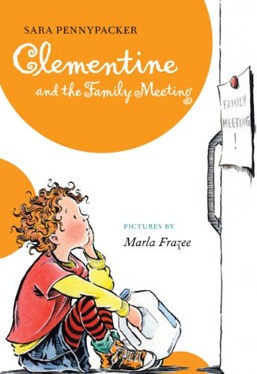
Review: Clementine and the Family Meeting by Sara Pennypacker

clementine and the family meeting

Clementine and the Family Meeting by Sara Pennypacker, illustrated by Marla Frazee

This is the fifth book in the wonderful Clementine series.  In this book, Clementine is very worried because the Family Meeting sign is hung up at home.  She just knows that she has done something wrong again.  So she goes out of her way to demonstrate how kind she is to her little brother, how neat she can be, and how she eats healthy foods.  Clementine is surprised to find out that none of those things are on the agenda, instead their family will have a new addition.  And it’s not the gorilla that Clementine has been asking for.  It’s a new baby!  Clementine knows how she feels about that.  She is not happy at all.  How in the world will their family ever be able to change from the perfection of four people into the odd number of five?

Pennypacker writes Clementine with such a surety and steadiness that readers who have enjoyed the previous books will immediately feel at home between the covers.  Clementine’s family may be changing in numbers, but readers who enjoy the deft parenting, the clever comments, and Clementine herself will be thrilled to know that those things have not changed at all.  In this book, Clementine’s relationship with her younger brother is shown as one of the growth points.  She continues to call him by vegetable names, but their relationship changes and matures too.

Frazee continues to depict a warm and wonderful family that embraces the quirkiness of one another.  From the springing curls on Clementine’s head to the ferocious scowl she gets on her face, Clementine is a vivacious and wonderful character.  My favorite image from the book is where Clementine’s mother and brother are asleep together on the couch with all of his trucks parked around them.  Perfection.

Another stellar addition to the Clementine series.  This is one series that you will want to read in its entirety, because everyone needs a Clementine in their lives.  Appropriate for ages 7-10.

Reviewed from library copy.

Also reviewed by:

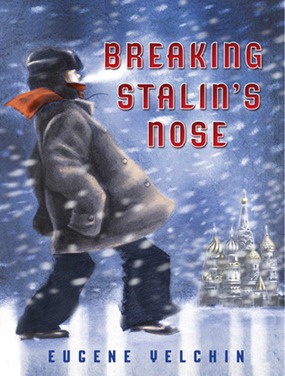
Review: Breaking Stalin’s Nose by Eugene Velchin

breaking stalins nose

Breaking Stalin’s Nose by Eugene Velchin

Released September 27, 2011.

Sasha Zaichek has always wanted to be a Young Pioneer and demonstrate his dedication to Communism and Stalin himself.  At age ten, he has known the laws of the Pioneers for 4 years.  So when his father is suddenly arrested, Sasha has to decide what to do.  He knows that there has been some mistake, that his father has done nothing wrong and that an error was made.  Thrown out of his home, he tries to find a place to spend the night with his aunt, but his uncle will not let him stay.  The next day at school, he pretends all is normal.  But as his day progresses, more and more of the truths behind Stalin Russia are revealed to him and his own truths are tested.

Velchin, who was born and educated in Russia, writes with a simple voice here that belies the darkness hidden just below the surface.  He has created a very naïve protagonist in Sasha, a boy who truly believes in Communism and Stalin.  Told in two days, the story shows how quickly naiveté can crack, crumble and fall away.  Velchin captures the fear that people lived in under the Stalin regime, yet he also shows the resiliency of the human spirit at the same time.

Velchin manages to create a book about a violent regime where the cruelty and fear is foremost, but the violence that would not be appropriate for young readers happens off the page.  This is a book that allows young readers to understand a situation in an intimate way without flinching away from the darkness that is so much a part of it.

This is a powerful book about freedom, Russia, and one young boy’s path to knowledge.  Appropriate for ages 10-12.

Reviewed from copy received from Henry Holt & Company.