2012 Astrid Lindgren Award Nominees

There are 184 candidates from 66 countries nominated for the Astrid Lindgren Memorial Award.  The recipients will be announced on March 20th, 2012.  These are some of my favorite lists to explore, because I get to see names that I would otherwise never see and book covers that I’d never get to glimpse. 

Wales’ First Young People’s Laureate Named


Catherine Fisher will be named the first Young People’s Laureate for Wales, according to the BBC.  Literature Wales will be making the appointment which will be announced by Charlotte Church. 

Here is how the role of the laureate is explained:

It said the Young People’s Laureate post is the first of its kind in the UK and aims to inspire young people in Wales to become involved with reading and creative writing.

Fisher is the author of several fantasy series, including Incarceron, which is my favorite of hers.

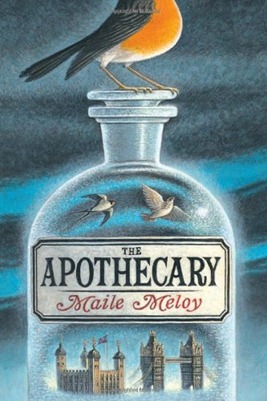
Review: The Apothecary by Maile Meloy

apothecary

The Apothecary by Maile Meloy

Janie and her parents have just fled California and headed to Cold War London.  There she meets Benjamin, a boy who stands up for himself.  As the two of them attempt to follow Soviet spies around London, they discover a real plot, a dangerous one.  When Benjamin’s father disappears as they hide in the cellar below, Benjamin and Janie must try to use an ancient book of potions and spells to try to find him.  But first they have to keep the book and themselves out of the hands of the enemies who are trying to find them.  It’s not that easy when you don’t know who to trust or what to believe in anymore.

When I opened this book, it was like tumbling into a world that felt like home to me, but at the same time surprised and delighted me too.  Meloy’s writing has a solid feel to it, hearkening back in tone to classic children’s books of adventure.  At the same time, she has created a wondrous world to explore, one that she brings to life with strong characters, memorable settings, and a lot of magic. 

The two protagonists are winning characters, filled with both whimsy and charm.  They are characters that readers will relate to instantly.  Their sudden friendship and mutual attraction is written in a way that makes sense.  Both characters are brave, inventive, and creative.  They are just whom one would want to take a grant adventure with. 

The ARC I read of the book only had a few of the illustrations in it, but those that I have seen are beautiful.  The design of the book plays with light and dark and so do the images, many of them capturing moments of action and importance in the story. 

A dazzling fantasy novel, this book also has a strong sense of period and setting that can be missing in magical books.  Appropriate for ages 10-13.

Reviewed from ARC received from Penguin Young Readers Group.

Also reviewed by:

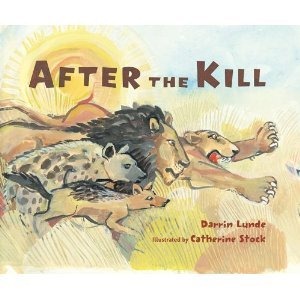
Review: After the Kill by Darrin Lunde

after the kill

After the Kill by Darrin Lunde, illustrated by Catherine Stock

Explore what happens after the lioness kills a zebra on the Serengeti Plain.  While the hunt and the kill are part of the story, they are only the beginning.  After the zebra is killed, the lion pride comes to eat and then other species start to gather.  There are the vultures who share with the lions.  Then the hyena clan that is able to drive the lions away and claim their share.  Jackals use trickery to grab some food for themselves.  The lions reclaim the carcass and continue to eat until they are sated.  Other vultures arrive.  The small scraps of flesh that remain are eaten by meat-eating beetles until the bones are white in the African sun. 

Lunde, a mammalogist at the Smithsonian Institute, creates a compelling story here.  There is no shying away from predator and prey, just a frank description of the food chain.  Nicely, Lunde injects his narrative with plenty of detail, noises, and an obvious love of his subject.  He paints a verbal picture of what is happening, helping young readers better understand what is actually happening.  The pieces of the book in the smaller font have additional scientific information that readers will find fascinating. 

Stock’s illustrations have a bright, hot quality to them thanks to the yellow tones throughout.  The heat of Africa is built into every page.  She also embraces the kill, the scavenging, and the story, creating a book filled with action-filled images.

An unflinching look at the battle for food on the Serengeti Plain, this book will be riveting for young readers.  Appropriate for ages 5-8, though this is a book that some children may find upsetting, so it is important to be aware of the sensitivity of the child you are sharing it with.

Reviewed from copy received from Charlesbridge.

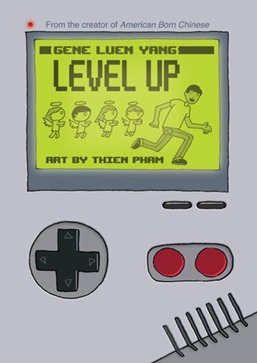
Review: Level Up by Gene Luen Yang

level up

Level Up by Gene Luen Yang, illustrations by Thien Pham

As a child, Dennis was forbidden from playing video games.  When his father died, he played them all the time.  He was even good enough to consider playing on the professional circuit.  But that was before THEY showed up.  Four cute little angels with plenty of attitude and a lot of bossiness seemed to know exactly what Dennis should be doing with his life, and it certainly was not video games.  Instead, they pushed and insisted in his father’s name that he start studying hard and then go to medical school.  But will Dennis find happiness there?  Or will he return to his love of gaming?

Yang captures the tension between following your own dreams and following those of your parents.  The four angels serve as universal parental voices, insisting that the future path is set and that one must fulfill one’s destiny.  The writing is infinitely readable, down-to-earth and yet striking.  The book wrestles with important themes, using the graphic format to lighten things but still looking deeply at the choices that shape a life.

Pham’s illustrations are filled with simple lines, washes of color, and often have a play of light and dark backgrounds in different frames on a page.  But if one looks at the illustrations, they are well rendered, interesting and far more than the simple lines may originally seem.

This book has teen and gamer appeal galore.  Before I got to read it myself, my husband and two sons had to read it first.   Both the theme of video games and the graphic format made it impossible for them to pass up.  Appropriate for ages 12-15.

Reviewed from library copy.

Also reviewed by:

2011 National Book Award Nominees

The nominees for the 2011 National Book Award have been announced.  And this year, the Young People’s Literature category has six nominations instead of the normal five due to miscommunication.

Here are the six nominees:


Chime by Franny Billingsley (my review)

Inside Out and Back Again by Thanhha Lai (my review)

My Name Is Not Easy by Debby Dahl Edwardson


Flesh and Blood So Cheap: The Triangle Fire and Its Legacy by Albert Marrin

Shine by Lauren Myracle

Okay for Now by Gary D. Schmidt (my review)

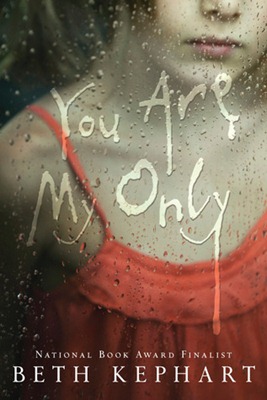
Review: You Are My Only by Beth Kephart

you are my only

You Are My Only by Beth Kephart

Emmy had one joy in life and that was Baby.  Otherwise she was trapped in a violent marriage at age 20.  So when Baby disappeared so did Emmy’s reason to live.  After she is saved from committing suicide by standing on the train tracks, she is committed to a state institution because of her breakdown.  Sophie is a teen who is kept hidden in her home by her mother.  They have moved often, running away from the No Good.  But as she looks out the window and meets Joey, his big dog, and his loving aunts, she is tempted to visit them for real.  Once there, she finds a home that is filled with warmth, love, sweet treats, good books, and everything that is missing from her own.  As their stories continue, readers will find themselves captured by the stories of a mother and daughter who lost each other long ago and are trying to find their way back to one another.

Kephart’s writing is breathtaking.  She uses language that breaks through, explains, dances and delights.  She can also use her words to create such sorrow, to build angst and amplify emotion until the reader is feeling it directly in their own skin.  Here is one such paragraph on Page 13 just after Baby has been stolen:

My baby is gone.  My baby is gone, and I should have called the police first thing.  I should have had a decent, right-thinking thought in my head instead of growing desperate in the trees, draining the day of precious daylight with my every failing footstep.  Peter came home to the red circle of the law’s lights, to the house torn inside out and bright with every watt we own.  To dogs in the woods and yellow rivers of light.  They told Peter right at the end of his second shift.  He smells like refinery and trouble, like the smoke up and down the Delaware River.

She also builds characters in the same way, allowing us to see inside them and to understand them more deeply than they do themselves.  The two female characters are both fragile to the point of fracturing, but also immensely strong in a way that is compelling and never tough.  Their stories parallel one another, both being held against their will, both unsure of what the future will bring, and both of them recovering from loss.

I must also mention the wonderful characters of Miss Cloris and Miss Helen.  At first they are assumed to be two sisters, but they are actually a lesbian couple.  It is a story of love that is told in small moments, gentle connections, and the brilliance of their adoration for one another.  It is also a lifetime of love, because they are both elderly and one is nearing death.  They are exactly the sort of gay characters we need in our teen literature.  They are beautiful, warm, nurturing and normal.

Teens will pick this book up for the story of a stolen baby and the tension of the mother and daughter finding one another.  On the way, they will read a phenomenal book of loss, love, imprisonment and freedom.  Mostly freedom.  Appropriate for ages 13-15.

Reviewed from ARC received from Egmont.

Also reviewed by:

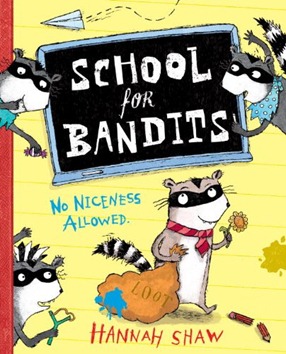
Review: School for Bandits by Hannah Shaw

school for bandits

School for Bandits by Hannah Shaw

Ralph was not a normal raccoon.   He looked like any other raccoon, but he certainly didn’t act like them.  He was polite, clean, and tidy.  His parents were frustrated and so sent him to Bandit School where he could learn to be naughty, dirty and thieving.  Ralph had an awful time in school because he was just too nice.   When his teacher announced the Best Bandit in School competition, Ralph just knew that there was no way he would ever win.  He spent his break reading inside instead of causing trouble out on the streets like his classmates.  Can a nice raccoon ever come out ahead? 

Shaw captures the naughtiness of raccoons with glee.  They are shown with frizzy fur, bad breath, and are often playing pranks and taking other animals’ things.  Yet they are never frightening, despite the worry on other characters’ faces, they are rascals rather than being gang-like.  Children will love many of the touches here, including burping in class and brushing teeth with chocolate.

The text is simple and tells a good story, often crooked on the page.  The illustrations and text work well together, sometimes playing off of one another in style. 

This is a book that speaks to the importance of manners but in a way that remains fun and light-hearted throughout.  Appropriate for ages 4-6.

Reviewed from copy received from Alfred A. Knopf.

Also reviewed by:

New Halloween Books

Here are some newly released Halloween books that are sure to mix shivers and giggles:
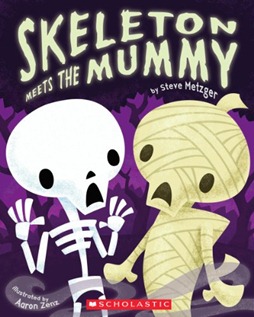
skeleton meets the mummy

Skeleton Meets the Mummy by Steve Metzger, illustrated by Aaron Zenz

Sammy is looking forward to trick-or-treating with his best friend on Halloween night.  His mother catches him before he can leave and asks him to run some soup to his grandmother.  To get there, he has to head through the woods.  He gets scared along the way by a bat, the wind, and even a tree that looks like a monster.  So he’s already jumpy when he hears the footsteps behind him and sees the mummy chasing him!

Told in straight-forward prose, the illustrations are a large part of the appeal here.  They are crisp, clean and vivid.  The characters glow against the dark Halloween backgrounds.  This is a story with a funny twist, plenty of appeal and even a couple of bumps in the dark.
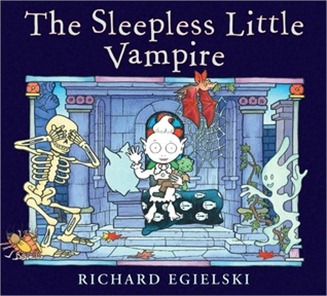
sleepless little vampire

The Sleepless Little Vampire by Richard Egielski

Little Vampire can’t figure out why he is having trouble falling asleep.  It could be the spitting spider.  It could be the flitting bats.  Maybe the cockroaches crawling on the floor?  Or the werewolf howling?  More and more Halloween characters enter the story and create their own noises:  a witch, skeletons, ghosts.  But none of them are the reason he can’t sleep.  Nope, it was just that he was trying too sleep too early.  It wasn’t morning yet!

Egielski bridges the pages brilliantly, moving from one possible cause of being unable to sleep to another.  The final reason will surprise most readers, though as they see the sky lighten they will be able to guess the ending on the final page.  The illustrations get increasingly busy as more characters enter.  The detail makes this a better pick to use one-on-one or with a small group of children. 
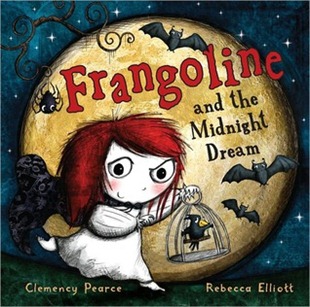
frangoline

Frangoline and the Midnight Dream by Clemency Pearce, illustrated by Rebecca Elliott

Frangoline was a perfect child, neat and clean.  Until the deep of night, when she put on her black cape and escaped the house.  The moon tried to warn her about being in bed, but Frangoline replied, “I’ll do exactly as I please!  I’m Frangoline!”  She climbed down the tree outside her window, ran across the lawn, blew raspberries.  She woke the forest animals but then yelled so loud that she scared them all away rather than them ever scaring her.  She danced and pranced in the graveyard and woke up the ghouls.  When they chased her up the church steeple, she finally got worried.  But where can she go if she’s cornered up there? 

There is a wild delight in this book and in the naughtiness of a little girl having such fun alone in the middle of the night.  The moon plays a big role in the book, warning her of the dangers but also being a sort of parental figure on each page.  The story is silly, clever and has the dark night creepiness along with the ghouls.  But nothing is drawn in a particularly scary way, instead it stays inviting with a strong sense of fun.

All three books are appropriate for ages 4-6. 

All were provided for review by Scholastic.