Review: The Curious World of Calpurnia Tate by Jacqueline Kelly

Curious World of Calpurnia Tate by Jacqueline Kelly

The Curious World of Calpurnia Tate by Jacqueline Kelly (InfoSoup)

Callie returns in triumphant fashion in this second Calpurnia Tate book following the Newbery Honor-winning first novel. Calpurnia continues to study science and nature at her grandfather’s side. Together they begin to dissect worms and insects, moving upwards towards vertebrates. Callie develops several scientific devices to measure latitude and barometric pressure. When the barometric pressure drops seriously low and an unusual gull shows up in the yard, Granddaddy heads to the telegraph office to sound the alarm for coastal areas, but there is little to do in places like Galveston Texas where tens of thousands of lives are lost. Meanwhile, Callie’s brother Travis is continuing to bring home stray animals like armadillos and raccoon, leaving Callie to help hide the evidence. Their cousin who survived the hurricane in Galveston comes to live with them, moving into Callie’s room and bearing secrets of her own. Through it all, Callie struggles with the expectations for girls around the turn of the century, trying to find a way forward towards education rather than marriage.

Kelly writes of science in a way that will have any reader eager to start looking at the writings of Charles Darwin, reading about health issues of cows and horses, dissecting their own grasshoppers, and heading outside to find the North Star. She turns it all into an adventure, filled with outdoor excursions, smelly animals, and rivers to explore. At the same time, it is also a look at the expectations of a girl from a good family and the difference between her future and that of her brothers. Callie’s struggle with this inequity speaks to her courage and her tenacity, two parts of her character that are evident throughout the book. This dual nature of the novel adds lots of depth to the story, allowing fans of nature and fans or strong heroines a shared novel to rejoice about.

Kelly’s characters are wonderfully well rounded. Callie is not perfect and is far more interesting and human for that. She is not patient, hates to play the piano and sew, and speaks up at times that would be unseemly. At the same time she is wonderfully wild, brazen at times, and heroic at others. She stands by those who support her and thwarts those who oppose her. She cunningly uses people’s self interests to promote her own and is constantly learning from those around her. Even the secondary characters are well drawn and have depth. From Granddaddy to Callie’s mother to her cousin Aggie, all can surprise because they are crafted as full human beings.

This romping novel is a fitting and fabulous follow-up to the first. Appropriate for ages 8-12.

Reviewed from copy received from Henry Holt and Co.
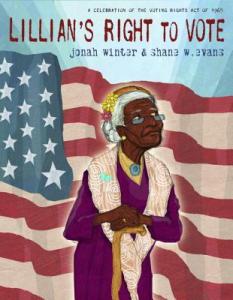
Review: Lillian’s Right to Vote by Jonah Winter

Lillians Right to Vote by Jonah Winter

Lillian’s Right to Vote by Jonah Winter, illustrated by Shane W. Evans (InfoSoup)

This picture book celebrates the 50th anniversary of the Voting Rights Act of 1965. Lillian is a 100-year-old African-American woman who has lived through all of the problems with African Americans voting in the United States. As she climbs the steep hill to her polling place, she remembers all of the steps that led from slavery to being able to openly vote today. She thinks about her great-grandfather who labored as a slave but also lived to see the Civil War come and allow him to vote for the first time.  She remembers her grandfather being charged a poll tax and her uncle being asked unanswerable questions before would be allowed to vote. She remembers running from an angry mob of neighbors who didn’t want women voting. She will never forget the cross burning in their yard. She remembers the people who fought for civil rights, who died for civil rights, who marched for everyone’s rights. She climbs that hill, slowly and steadily, until she reaches her polling place where she can vote without fear of being attacked or turned away.

Winter’s prose is musical and passionate. He draws us all close together and then speaks to us of history and voting and America. He tells us of shameful things that must not be forgotten, of heroes who fell and those who were able to keep marching. He tells us all of our duty in subtle ways that are stirring and moving; that we must vote each and every time, even when it is difficult or there is a steep hill to climb. Winter tells a personal story of voting history in the United States, giving us rich robust story telling rather than dry facts. It is a stirring and noteworthy tale.

Evans’ illustrations are superb. His fine lined illustrations show the determination of Lillian, the horrors of slavery, the dangers of voting, and the courage of many to make changes for the better. His pages swirl with color and texture, fill with sunlight, and dazzle with blue sky. The golden page of the cross burning is disturbing in its vividness, the wash of gold not allowing anywhere to hide.

A gorgeous story accompanied by equally lovely illustrations, this historical picture book is one that should be embraced by elementary teachers during any national election. Appropriate for ages 7-10.

Reviewed from digital galley received from Schwartz & Wade and Edelweiss.

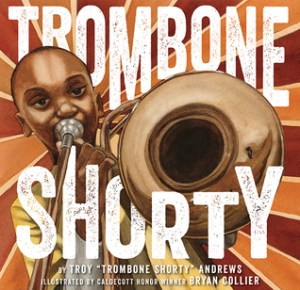
Review: Trombone Shorty by Troy Andrews

Trombone Shorty by Troy Andrews

Trombone Shorty by Troy Andrews, illustrated by Bryan Collier

This autobiographical picture book is about a young boy growing up in the Tremé neighborhood in New Orleans where music was a simple part of everyday life and was always in the air. Tony particularly loved the music and energy of Mardi Gras where he could see brass bands play every day. Troy first played an imaginary instrument and then found a broken trombone that didn’t sound perfect but at least it was something he could play. Troy started to teach himself to play the trombone, an instrument that was almost as tall as he was, which is how he got the nickname of Trombone Shorty. He even slept with his horn in his hands. When Troy gains the attention of Bo Diddley for his playing in the crowd at his concert, Trombone Shorty knows it’s time to form his own band. And he still has his own band today!

Andrews is a Grammy-nominated trombone player and runs the Trombone Shorty Foundation committed to preserving the musical heritage of New Orleans. Andrews writes like a master on these pages which read like music is in the air between them too, just like the air in New Orleans. He shows children how an inspiration to play an instrument can become a lifelong calling. He also shows exactly how music empowers people in a place, gives them strength, creates a united culture, and unifies them. It’s a narrative about the power of music.

Collier’s illustrations are strong and dynamic. He creates motion on the page with his collage illustrations with patterns and textures that weave together. His paintings are a zingy mix of softly rendered closeups filled with detail and personality and then images of people farther away that are rougher but add even more energy to the art.

An inspiring picture book filled with music and vivaciousness, this autobiography celebrates New Orleans and the music in its veins and in one boy specifically. Appropriate for ages 7-10.

Reviewed from copy received from Abrams.

Shirley Hughes Wins Lifetime Achievement Award

Dogger All about Alfie

Shirley Hughes, the popular and prolific author of Dogger and the Alfie series, has won the inaugural Lifetime Achievement Award from Book Trust. She was presented with the award as part of Children’s Book Week.

From the Telegraph article:

Her characters are imprinted on the memories of two or three generations, a recognition of their enduring charm. Shirley continues to innovate and create, providing young children with a love of reading that we know will give them a great start in life.

We often hear about ‘national treasures’, but Shirley Hughes is up there with the best.

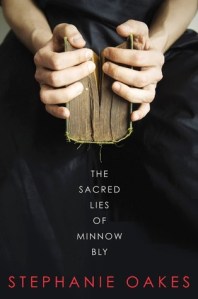
Review: The Sacred Lies of Minnow Bly by Stephanie Oakes

Sacred Lies of Minnow Bly by Stephanie Oakes

The Sacred Lies of Minnow Bly by Stephanie Oakes (InfoSoup)

Raised in a cult, Minnow left normal life behind at age 5 to start a new life in the wilderness with her family, other believers, and the Prophet. Minnow was taught to obey, to fear outsiders, to hate people of color, and to not think for herself. When she started to drift too far from the Community’s teachings, she was punished by having her hands cut off. Now she has been taken into custody after attacking a boy. In juvenile detention, she has plenty of time to think about what she has done and all that has happened to her. Her family is in tatters, her community burned to the ground, and Minnow had a part in all of it. Minnow now has to decide how to share the truth and how much of it she can tell without causing even more harm to those she is trying to protect. She also has to figure out what to believe in and how to trust herself at all.

Oakes has adapted a tale from the Brother’s Grimm as the basis of this story. You can hear the echo of those brutal times throughout this novel for teens. The truth of Minnow’s life is told in fits and starts through flashbacks which makes for tantalizing reading and a book that is impossible to put down. Oakes’ portrayal of the cult is very effective, from the wild premises of the faith itself to its leader, the cult is a devastating mixture of the ridiculous and the savage. Trapped in that world, Minnow learns to find beauty where she can and friends in the most unlikely of people and places. The life in the cult contrasts eerily with the order of juvenile detention where there is violence but also protection, enemies but also friends.

Minnow is a protagonist who begins the book almost like a wounded animal with her faith shattered but still clearly influencing her reactions. As the book progresses and she learns not only who she can trust but also of her own strength and her own duty to herself, Minnow grows and evolves. Not only does she turn away from things that she was clinging to in the beginning, but her own beliefs and language change along the way. The growth is organic and subtle. Minnow also thinks in poetry, connected to the wilderness where she spent most of her life. She sees things through that lens, and the beauty of that place returns to her and the reader again and again throughout the novel, strong and pure and lovely.

A book that wrestles with family, faith and truth, this teen novel is a dark and powerful read. Appropriate for ages 14-18.

Reviewed from ARC received from Dial.

Review: Welcome Home, Bear by Il Sung Na

Welcome Home Bear by Il Sung Na

Welcome Home, Bear: A Book of Animal Habitats by Il Sung Na (InfoSoup)

Bear has been waking up to the same old forest and blue sky day after day, so he decides that he may need to find a new home. He sets off first to climb up a tree to see Bird’s home, but it was too high. Mole’s underground tunnels were stuffy and full of dirt. Goat’s cliff was too dizzying. Octopus’ underwater home was too deep. Polar Bear’s icy home was too cold. Camel’s desert was too hot on his paws. There were more that were too wet and too muddy. Bear was very sad. Where could he live that was just right for him?

Told in humorous and short lines, this picture book explore animal habitats in a lighthearted way. Bear’s exploration shows the differences in the needs of the animals in a subtle way, focusing more on Bear’s reaction to the places in the world. Bear is a great protagonist for this, since readers know from the very first page where he should be living and how different it is from the many places he visits.

Bear’s discomfort with each new habitat is delightfully illustrated to create humorous moments. From being squirted by a surprised octopus to Bear’s evident hatred of deep mud, the book is fast-paced and funny. The illustrations though are far from just being silly. They are lovely too. The habitats are beautifully depicted from the golden desert sand to the lushness of the rain forest. Each page and the animals themselves are textured and have a depth of color that is gorgeous. The final page of the dejected Bear heading back home with his shadow long on the ground is particularly lovely.

A lighthearted and richly illustrated look at animals and their habitats all through the eyes of one adventurous bear. Appropriate for ages 3-5.

Reviewed from digital galley received from Knopf Books for Young Readers and Edelweiss.

Review: Changes by Charlotte Zolotow

Changes by Charlotte Zolotow

Changes: A Child’s First Poetry Collection by Charlotte Zolotow, illustrated by Tiphanie Beeke (InfoSoup)

Celebrate the changing of the seasons with this collection of poetry from master children’s poet, Charlotte Zolotow. The 28 poems move from the joy of the change from one season to the next and then start with a focus on spring. The poems speak of the joy of spring breezes, snow melting, rainfall, violets, and green grass. Summer poems shine with sun, seaside sand, lights at night, and the buzz of insects. Autumn comes next with the joy of fallen leaves, classrooms, firelight, and Halloween. The book finishes with winter and its snow and ice that dazzle in their own way.

The poems here create a whole, a deep look not only at the seasons but also in the power of connecting with nature throughout the year. Zolotow’s mastery shows in each one, her ability to look closely at a small thing, find the immense beauty in it, speak to that and then create a universal experience in words on the page. Everyone will respond to these poems, as they capture those moments in time where we can all connect with nature and with one another.

The illustrations frame each poem, and capture the natural hues of each season. Spring is filled with the brightness of the flowers and grass. Summer is yellow and bright with the sun. Autumn turns golden and orange while winter is blues and whites. There are just enough details to invite readers into the poems and allow the words to really be the focus of the book.

A gorgeous addition to children’s poetry collections, this is one to get into teacher’s hands so they can start using it immediately. Appropriate for ages 4-7.

Reviewed from library copy.

Review: Lucy and Henry Are Twins by Elizabeth Winthrop

Lucy and Henry Are Twins by Elizabeth Winthrop

Lucy and Henry Are Twins by Elizabeth Winthrop, illustrated by Jane Massey (InfoSoup)

Lucy and Henry are toddler twins who spend a merry day together. From waking up where Lucy is wide awake and Henry is slower to move to the way they come downstairs, the personalities of the two children are completely individual. Riding in strollers, the two go to the park where they both explore the different slides, swings and other equipment. Then the two play with a ball. Finally, they head back home again. Their busy day is filled with activity, play and the two of them exploring the world together.

Winthrop keeps this book at just the right level for busy toddlers. The book moves at a brisk pace, showing the different things the children are doing and moving quickly on to the next thing. The text rhymes, which adds to the jaunty feel of the book. The two children are shown equally, sometimes having fun and other times not. Nicely, Winthrop makes sure that each child is brave at times and more skittish at others and happy at times and grumpy at others. Both children are well rounded and believable.

Massey’s illustrations are bright and bold. The children are featured very closely with only the legs and arms of the parents ever in view. This keeps the children at the heart of the story. Interestingly, because the parents are never named or fully seen, this book will work well for gay and lesbian parents and grandparents to share aloud with their little ones.

A particularly strong book for toddlers, this one is not overly sweet and feels like a real outing with toddlers to the park. Appropriate for ages 1-3.

Reviewed from library copy.

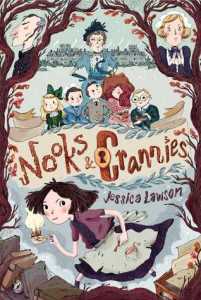
Review: Nooks & Crannies by Jessica Lawson

Nooks and Crannies by Jessica Lawson

Nooks & Crannies by Jessica Lawson (InfoSoup)

Tabitha has been given an envelope and sternly told that her parents have to be the ones to open it. But when she gets home, she finds her parents packing up and getting ready to leave on a lengthy vacation. They are also planning to leave Tabitha in the local orphanage. Once the envelope is open though, their plans change since Tabitha and her parents have been invited to the home of a wealthy countess for the weekend. Once there, Tabitha discovers that she is one of six children who have been invited to the estate and that the countess is searching for the child who is her grandchild. But all is not what it seems and Tabitha also finds out that she is in the middle of a great mystery. With the help of her pet mouse, it is up to Tabitha to solve the mystery and stay alive while doing it!

Lawson offers up a gorgeous mystery here with all sorts of treats along the way. Readers who enjoy a good British whodunit will find so much to love here. There is a great mansion to explore, complete with hidden passages. There are ghosts all around, haunting everyone in the house. There are odd servants, a prickly butler, and a mad countess. Throughout the mystery makes sense and the pleasure of figuring out the mystery is heightened thanks to the twists and turns along the way.

Tabitha is a great protagonist. She is a true friend, one who stands by her mouse. As she gets to know the other children, the sorrow of her own upbringing is heightened and her loneliness which could have been used as a shield is beautifully displayed and then slowly cracked until she is fully engaged with the others. The mystery is the heart of the book but so is the growth of the confidence of Tabitha as she works to solve the mystery and grows a lot in the process.

A strong British mystery, this book is dark and lovely. A great way to spend some summer afternoons. Appropriate for ages 9-12.

Reviewed from copy received from Simon & Schuster.