The Journey by Francesca Sanna

The Journey by Francesca Sanna

The Journey by Francesca Sanna (InfoSoup)

The book begins with a family who enjoys going to the beach together often. But then things change and the war begins. Darkness invades and takes over the landscape, then the children’s father is taken by the war. Their mother hears of people leaving for a safer place, far away. She decides to leave as well. They leave at night, hide in different vehicles along the way. They reach the border but are turned back by a guard. They manage by paying for help to reach the sea, but their journey has not ended. As they continue to travel over dangerous seas and past many borders, the narrator notices that birds too are migrating along with them on their own long journey.

This picture book captures the current refugee crisis through a lens that is very appropriate for children. The impact of war is shown as a dark figure, destroying buildings and wreaking havoc. It envelopes them for awhile, particularly with the death of their father. There is a feeling of a constant state of upheaval and danger, the journey is one with its own dangers but is a way forward away from an even more violent situation. The focus here is on the devastation of war and the turmoil it brings, rather than a specific population. The message is that it could be any of us.

Sanna’s illustrations are so wrenching and evocative. War as a long-fingered destruction that envelopes and changes everything is beautifully shown. The book has a feeling of motion throughout, the long pages leading one on your own journey. The huge guard at the gate, stands horrifyingly large on the page, dwarfing the family. Then alone in the woods, the mother is their safe place and their home yet ever so human as well. The illustrations are artistic, beautiful and speak volumes about the emotions of refugee families.

An important and vital book, this book allows children to understand the plight of refugees in our world and will open hearts. Appropriate for ages 5-7.

Reviewed from digital galley received from Flying Eye Books and Edelweiss.


The Uncorker of Ocean Bottles by Michelle Cuevas

The Uncorker of Ocean Bottles by Michelle Cuevas

The Uncorker of Ocean Bottles by Michelle Cuevas, illustrated by Erin E. Stead (InfoSoup)

The Uncorker of Ocean Bottles lives in a small house on a hill near the sea where he watches for the glint of glass in the waves. It is his job to deliver any messages found in bottles to their rightful owner. Sometimes that means walking only a short distance and other times he must go on a long journey to deliver them. He wishes that one day he would find a message in a bottle that is meant for him, but he never does. One day though, he does find a message with no recipient mentioned. It is an invitation to a party on the beach. He heads into town and asks person after person if this is their message, but it doesn’t belong to any of them. He decides he must go to the party to apologize for not delivering the message to the right person. But what he finds there shows him that some messages are meant for him after all.

Cuevas writes with real poetry in this picture book. Her prose captures the essence of moments with gorgeous descriptions like, “Sometimes the messages were very old, crunchy like leaves in the fall.” The book celebrates the connection that letters bring each of us and takes readers back to a time when messages were written by hand, even if rarely placed in bottles. It is also a book that speaks to the importance of community and feeling like you belong, but also the vitality that can be found in taking the first step towards making that connection.

Stead’s illustrations are dreamy with their pastel colors and fine lined details. Some of them are almost like looking through a keyhole and watching while others encompass the page. There are pages filled with the water of the sea that show both the difficulty of the job and the loneliness of it too. Moments looking alone out of a window capture the isolation the Uncorker is feeling. The colors too add to the emotions of the images both during the isolation and later at the party.

A poetic and beautiful picture book that looks at letters, community and connections in a memorable way. Appropriate for ages 4-6.

Reviewed from ARC received from Dial Books.


This Week’s Tweets, Pins & Tumbls

Here are the links I shared on my Twitter, Pinterest, and Tumblr accounts this week that I think are cool:

You know you've read a good book when you turn the last page and feel a little as if you have lost a friend. - Paul Sweeney For more quotes and inspirations: http://www.lifehack.org/256073/pinterest-8?ref=ppt10:

CHILDREN’S BOOKS

11 Children’s Books That Help Kids Understand Sexism

15 Children’s Books That Help Kids Understand What Differently Abled Kids Are Up Against

19 Children’s Books That Help Kids Understand Feminism

betterbooktitles: Lois Lowry: The Giver Check out the new…

Books to help ease children and teens back into school

Books Your Kids Will Actually Like, Chosen by the People Who Know

I Censor the Books I Read to My Child. I’m Not Ashamed!

Jen Bryant on her research for SIX DOTS, which celebrates Louis Braille as the child inventor he was:

Milwaukee Barbershops Incorporate Books for Kids

The Unexpected, Trashy Joy of Reading Kids’ Books Written by Celebrities

LIBRARIES

Libraries have secrets: The private rooms of North Jersey’s public libraries – Arts and Entertainment

slumbering:

TEEN READS

7 YA Novels We Can’t Wait To Read This Fall

8 New Jane Austen-Inspired YA Books | Brightly

‘90% of YA is crap’: the debate that dominated the Edinburgh book festival

Chirri and Chirra by Kaya Doi

Chirri and Chirra by Kaya Doi

Chirri and Chirra by Kaya Doi

Released September 6, 2016.

Chirri and Chirra are two little girls who wake up early and head out into the forest together on their bicycles. They arrive at the forest cafe where there are tables just right for creatures and people of any size. They order cups of acorn coffee and clover blossom tea. Then they are off again into the forest and they find a bakery with bread and jam of all kinds. A bear and rabbit are eating there too. The girls choose their sandwiches and eat them near a pond. They play in the water, nap under a tree. They bicycle farther on and as the sun is setting come to a forest hotel where they find a room and beds just the right size for them. The day ends with the girls joining in a forest concert as everyone sings together.

This is a translation from the Japanese original, and it works very well. The picture book is delightful and airy, inviting children into a world built just for them. The description may seem a bit too sweet and almost saccharine, but the book is not like that. Instead it has an exceptional childlike nature that fills it with wonder and the joy of exploration. There is a feeling that this is entirely imaginary yet that it may also be delightfully real.

Doi’s illustrations are a large part of the appeal of this book. The two girls are matching except for the buttons on their dresses. The illustrations celebrate the different sizes of creatures and also the food and drink that the girls have along the way. Just the acorn coffee and clover tea will have your mouth watering. Expect plenty of tea parties and sandwiches after reading this.

The first in a series, I am hopeful we will see more of them in translation soon. Appropriate for ages 2-4.

Reviewed from copy received from Enchanted Lion Books.


The Summer Nick Taught His Cats to Read by Curtis Manley

The Summer Nick Taught His Cats to Read by Curtis Manley

The Summer Nick Taught His Cats to Read by Curtis Manley, illustrated by Kate Berube (InfoSoup)

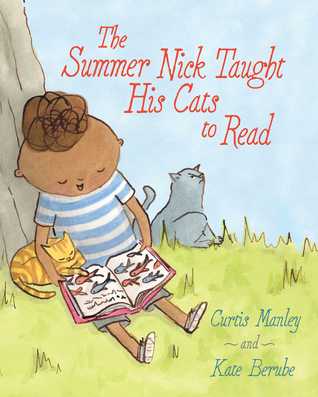
Nick has two pet cats, Verne and Stevenson. They love doing things together, but the cats don’t appreciate it when Nick sits down to read. So Nick decides to teach them to read too. He starts with easy words, but the cats aren’t interested. He moves on to flash cards and soon Verne is paying attention, particularly when the words and books have to do with fish. Verne sounds out words and starts reading books on his own, he even gets his own library card. Stevenson doesn’t seem interested at all though. Verne and Nick have lots of fun acting out the stories that they are reading, though it would be more fun with Stevenson playing too. Then one day Nick discovers pictures that Stevenson has drawn of a pirate story. Could it be that Stevenson is interested after all?

Manley cleverly shows the process of learning to read in this picture book. Moving from simple words to sounds of letters to looking at books on your own and then reading entirely on your own. Delightfully, he also has Stevenson who is a reluctant reader. Stevenson though just needs someone to notice what he is passionate about and suddenly he too is interested in reading. It’s a smart way to show that we are all readers, some of us just need to not read about fish but about pirates!

The illustrations by Berube are friendly and fun. I love that Nick is a child of color and that it is not an “issue” in the book or even mentioned. One special part of the book is Stevenson’s expressions which are pure grumpiness and then can be seen later in the book as purely piratical.

A summery book about reading that will move nicely into the school year. Appropriate for ages 4-6.

Reviewed from copy received from Simon & Schuster.