The Boy Whose Head Was Filled with Stars: A Life of Edwin Hubble by Isabelle Marinov

Cover image

The Boy Whose Head Was Filled with Stars: A Life of Edwin Hubble by Isabelle Marinov, illustrated by Deborah Marcero (9781592703173)

Born in the late 1800s, Edwin loved the stars from a young age. At eight, he was given a telescope by his grandfather, and they headed into the Missouri night to see the stars up close. Edwin was a good student who loved math and learning about the universe, but his father wanted him to do something else with his life. So Edwin studied law before becoming a high school teacher. It wasn’t until after his father’s death that Edwin felt he could study astronomy. His first job was at Mount Wilson Observatory, the world’s largest telescope. There, he spent years studying the Andromeda nebula, eventually proving that it was a separate galaxy. Edwin continued to classify and learn more about galaxies, discovering that they move away from each other and that the further away they are, the faster they move. Eventually, the Hubble Telescope was launched, named after this man who studied the stars and increased our understanding of the universe.

In her debut picture book, Marinov shows real skill in taking a lifetime of accomplishments and making them accessible for young readers. She writes with a tone that shares the facts of Hubble’s life but also shares his personality, his wonder at the universe and the hard work and resilience it took for him to make his discoveries. As Hubble and others ask big questions about the universe, these statements are done in a silver print that elevates them and will have the reader marveling along.

The illustrations are done in a whimsical style that uses fine ink lines to share small details of large telescopes and landscapes. Using the darkest of black ink, Marcero illuminates her pages with stars that sweep across the paper. One gatefold opens to reveal a series of nebulae to wonder at.

A strong and interesting look at one of the most famous astronomers. Appropriate for ages 6-8.

Reviewed from copy provided by Enchanted Lion.
My First Day by Phung Nguyen Quang

Cover image

My First Day by Phung Nguyen Quang and Huynh Kim Lien (9780593306260)

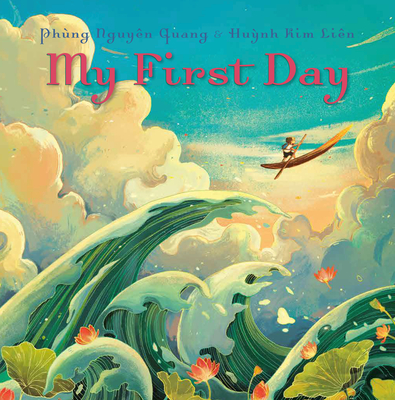
A boy heads out on his own to his first day of school. He lives on the Mekong River and takes a boat to school, this time all alone. He heads out as dawn is breaking in the sky, weaving along the river, through the waves, and entering the mangrove forest. The journey is long, with dark rainy weather at times that then becomes colorful skies. The forest is dark and seems to have creatures all over watching him travel. When he exits the forest, he can see fish skimming under the water, water buffalo along the shore, and soon his friends in their own boats heading to school!

Quang and Lien beautifully takes a universal experience of the first day of school and makes it unique to the Mekong Delta experience. Through this fascinating journey of natural wonder, the main character must be brave and resolute that he can do this by himself. The text is marvelous, quiet at times as the weather or the setting becomes oppressive and then soaring with relief and joy when the weather changes and his destination is in sight.

The illustrations are exceptional, drawing readers deep into the Mekong. The focus is on the boy’s experience, but the river itself is a character too. Its waters glimmer in the shallows with green light, darken with the rain, and are painted with algae green at the mouth of the forest. Dotted with lotus flowers, bubbles and cresting waves, the river and the boy experience this journey together.

A journey to school that is far more than crossing a busy street! Appropriate for ages 4-6.

Reviewed from copy provided by Make Me a World.

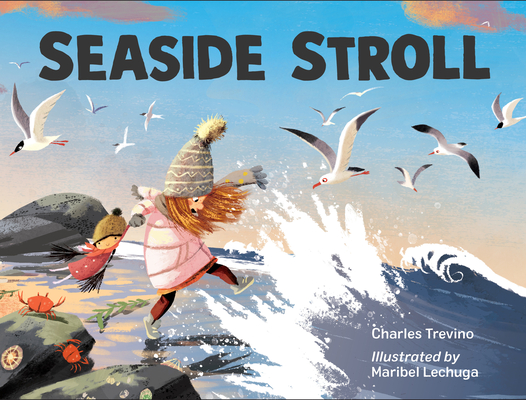
Seaside Stroll by Charles Trevino

Cover image

Seaside Stroll by Charles Trevino, illustrated by Maribel Lechuga (9781580899321)

Told with only words that begin with “s” this picture book is superbly surprising. A little girl and her mother bundle up for a winter visit to the seaside. The little girl brings along her doll, and they explore the snowy sand together. She finds a stick, swings it at the seagulls. There are shells, stones, seaweed and more to discover on the sand. She is surprised when a surge of water takes her doll away and into a tidepool. The doll is soaked and after the doll is saved, the little girl is sopping wet too. Cold and shivering, they leave the beach and head home for a hot shower and a cozy story before bed.

Trevino creates an entire story here, not just a series of words that begin with the same letter. Based on poetry designed in American Sign Language, his book is thoughtful and fascinating. Using clever and smart punctuation, he creates a world of snow and sand for readers to explore alongside his young character. Amazingly, the book reads aloud brilliantly and aloud shows the dynamic nature of language and letters.

The artwork tells much of the story, since the text is so focused and brief. The joy of exploring the cold seaside, the pleasure of discovery and the return home to cozy warmth, all are depicted with bright colors, sunshine and then warm firelight.

Something special. Appropriate for ages 2-4.

Reviewed from e-galley provided by Charlesbridge.

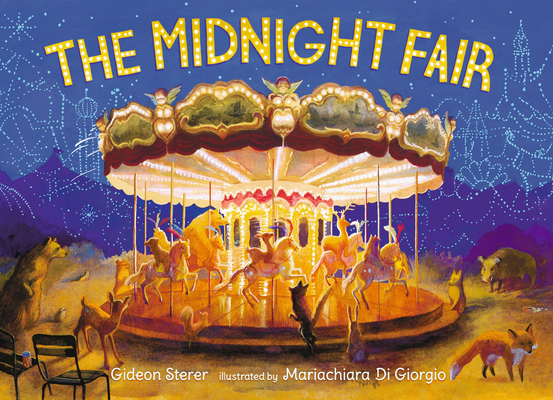
The Midnight Fair by Gideon Sterer

Cover image

The Midnight Fair by Gideon Sterer, illustrated by Mariachiara Di Giorgio (9781536211153)

This wordless picture book tells the story of a county fair set up at the edge of a woods. From the woods, animals peek out at the lights and sounds of the fair as it is built and then filled with activity and people. At night, when the people leave, it’s time for the animals to have some fun. The raccoons sneak in a break in the fence and throw on the electricity. Soon the games, rides and food are open for business with payment in acorns, rocks and leaves. The animals ride the rides, staff the booths, share snacks and have a great time until dawn breaks. They tidy up and head back to the woods, but the surprised man who opens the fair finds plenty of evidence that something happened that night.

This book is so lovely. It takes the shared experience of a county fair for humans and turns it into something strange and wondrous. There are so many moments caught in the images here: a porcupine covered in sweets, a fawn managing to ride a carousel horse, a rabbit whizzing by on the swing ride, and a bear cub buying ice cream with acorns. One after another, the images are immediately iconic and touching without being saccharine. The golden light of the fair lights turns everything magical, just as it does when you go to a fair in person.

This visit to the fair is one that everyone should take, even if you don’t care for the rides. Appropriate for ages 2-4.

Reviewed from e-galley provided by Candlewick.

2021 Ezra Jack Keats Award

Celebrating its 35th anniversary this year, the 2021 winners and honor books of the Ezra Jack Keats Award have been announced. The award is celebrates “exceptional early career authors and illustrators for portraying the multicultural nature of our world in the spirit of Ezra Jack Keats.” Here are this year’s winners:

WRITER AWARD

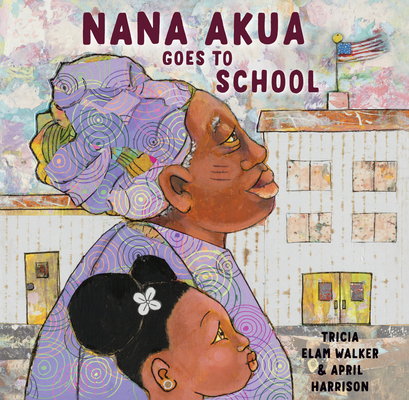
Nana Akua Goes to School by Tricia Elam Walker, illustrated by April Harrison

ILLUSTRATOR AWARD

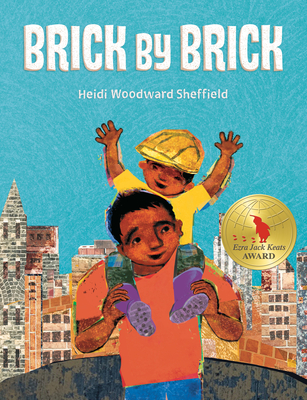
Brick by Brick by Heidi Woodward Sheffield

WRITER HONORS

Can Bears Ski? by Raymond Antrobus, illustrated by Polly Dunbar

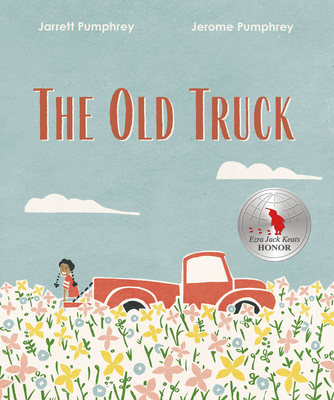
The Old Truck by Jarrett and Jerome Pumphrey

ILLUSTRATOR HONORS

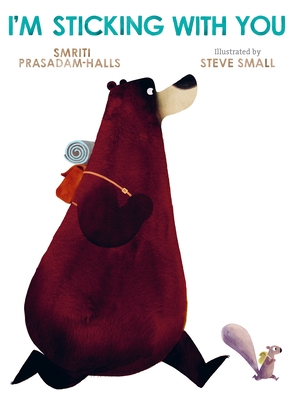
I’m Sticking with You, illustrated by Steve Small, written by Smriti Prasadam-Halls

Cyclops of Central Park, illustrated by Victoria Tentler Krylov, written by Madelyn Rosenberg

Try It!: How Frieda Caplan Changed the Way We Eat by Mara Rockliff

Cover image

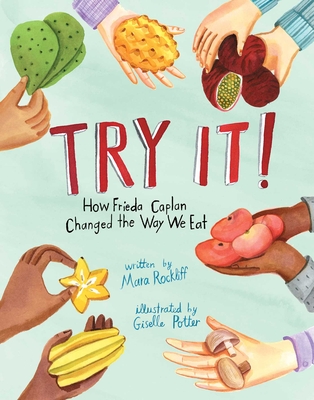
Try It!: How Frieda Caplan Changed the Way We Eat by Mara Rockliff, illustrated by Giselle Potter (9781534460072)

When Frieda Caplan started working at the Seventh Street produce market in Los Angeles, there were only potatoes, bananas, tomatoes and apples for sale. Caplan thought it might be work giving something new a try. So she started selling mushrooms. Soon she was known as the Mushroom Queen and had her own stall at the market. She became known as a person who would taste anything and started selling kiwis, jicama, blood oranges, Asian pears and much more. Over the years she introduced consumers to many new things, including seedless watermelons in 1962, horned melon in 1984, and fresh lychee in 2015. Caplan’s daughters now work with her in her produce stall, introducing finds of their own and offering their unique and informed view of what the next big thing might be.

Rockliff offers a dynamic look at the woman who changed how America eats fruits and vegetables. Her fearless approach to trying new things combined with a deep instinct about what will work for the market. Beautifully, the book focuses on Caplan herself but also richly shows the things that she introduced to American stores. Readers are sure to find new fruits and vegetables on the pages here, and perhaps be brave enough to try then when they make their way to supermarkets across the country.

Potter’s illustrations are richly colored and warm. They show Caplan in the 1950s when she started and then steadily move forward in time, nicely showing the time period through the clothing of the people. The fruits and vegetables are rainbow bright and nicely labeled with their name and the year that Caplan discovered them for the U.S. market.

Bright, intelligent and full of juicy details. Appropriate for ages 4-6.

Reviewed from copy provided by Simon & Schuster.

Seeking an Aurora by Elizabeth Pulford

Cover image

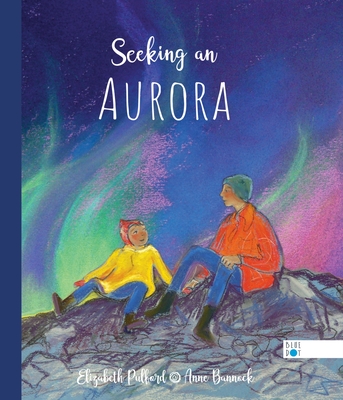
Seeking an Aurora by Elizabeth Pulford, illustrated by Anne Bannock (9781733121279)

A child is awoken by their father in the middle of the night. They head outside into the winter darkness, past the dogs and the cows. The father explains that they are going to see an Aurora, but the child doesn’t know what that means. Are stars in the Aurora? Is the moon? They head up the hill, their breath steaming in the icy air. They sit on the stony ground and look up, marveling together at the colors that streak the sky as the aurora borealis appears. They are silent until their walk back to the house, when the father shares what he knows about the aurora.

Originally published in New Zealand, this picture book is quiet and focused on a specific natural phenomenon. The book is told in very simple language, making it accessible for small children. The gender of the main character is never revealed, since the book is told from their point of view. The anticipation of discovering what the aurora is isn’t lessened by knowing about it ahead of time. The amazement and delight are infectious.

Bannock’s art is full of color even in the nighttime home. Warm reds, bright yellows, deep purples all fill the pages. The colors become more muted as they head outside, the night sky black above them and the stars vivid against it. The icy winter night is shown with a sickle of a moon, bare tree branches, and a layer of snow. The colors of the aurora are captured beautifully in a grand and stirring way that lifts the heart.

Quiet, personal and incredibly moving, this is a glimpse of a natural wonder. Appropriate for ages 3-5.

Reviewed from e-galley provided by Blue Dot.

We Wait for the Sun by Katie McCabe

Cover image

We Wait for the Sun by Katie McCabe, illustrated by Raissa Figueroa (9781250229021)

This picture book is based on one of Dovey Johnson Roundtree’s favorite stories of her childhood and her grandmother, Rachel Bryant Graham. Born over 100 years ago, Roundtree grew up to be a renowned civil rights attorney. She and her grandmother headed into the night in midsummer. They move through the darkness to the woods to gather blackberries. As they walk through the night, other women join them, silent in the dark. The darkness gets thicker as they move into the woods, and Dovey’s grandmother encourages her to hold onto her apron strings and let her eyes adjust. They reach the blackberry clearing and everyone gets to work but not before Dovey gets the first and best berry to eat. They pick berries, the women chatting, until the sky turns pink and at her grandmother’s command the sun rises over the horizon.

McCabe takes a powerful moment in Roundtree’s life and turns it into a picture book that invites children to explore the woods at night and not be afraid. There is a sense of adventure throughout the book illuminated with the wonder of being out in a summer night. The profound silence of the night and its darkness make for a book full of mystery with text that asks to be read in a hushed tone to share the moment with one another all the way through sunrise.

Figueroa’s illustrations are rich and beautiful. She takes the darkness and tinges it with blue, teal and purple to show paths, faces and the women walking together. She also sweeps the path with fireflies and glimmers, adding to the wonder of the book.

A story that serves as an allegory for resilience, going through the darkness and knowing the sun will rise. Appropriate for ages 3-5.

Reviewed from e-galley provided by Roaring Brook Press.

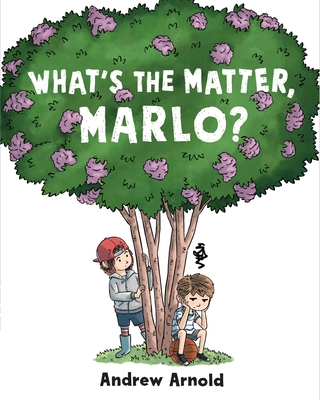
What’s the Matter Marlo? by Andrew Arnold

What’s the Matter Marlo? by Andrew Arnold (9781250223234)

This picture book about friendship explores what happens when a best friend is grieving and angry. Told in the first person, the book draws readers directly into the tale. Two children are best friends, and they do everything together from hide-and-seek to joke books. No matter how well Marlo hides, his best friend can find him. But then one day, something was wrong and Marlo didn’t want to play. He told his friend to go away. Sharing a joke made it even worse and Marlo got angrier and angrier, until his anger took up all the space. But his friend remembered that no matter what they could always find Marlo. That’s when they found out what was going on and did just what a best friend should do, they cried together.

Arnold captures the beauty of a young friendship based on shared humor, a great dog and playing games together. He shows the richness of the friendship and how connected these two children are. That gives the platform for Marlo’s deep anger and anguish to appear. While it is confusing, his friend does just the right thing, staying around and offering comfort and empathy. Remarkably, the book is told in short and approachable sentences, allowing the images to tell a lot of the story too.

The illustrations are full of green grass, backyard spaces, and play. When Marlo’s anger appears, it is a black scribble of emotion that steadily grows to turning all of the pages to pitch black. It is in that moment that his friend finds him. That friend who speaks in first person is marvelously androgynous, able to be either girl or boy and it doesn’t matter at all.

A resonant friendship story about empathy and grief. Appropriate for ages 3-5.

Reviewed from e-galley provided by Roaring Brook Press.