The Book Itch by Vaunda Micheaux Nelson

The Book Itch by Vaunda Micheaux Nelson

The Book Itch: Freedom, Truth & Harlem’s Greatest Bookstore by Vaunda Micheaux Nelson, illustrated by R. Gregory Christie (InfoSoup)

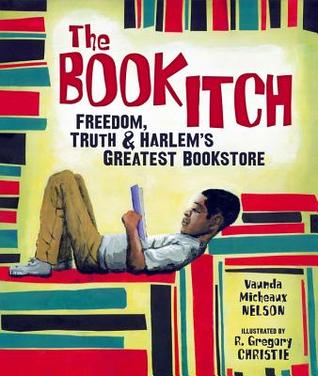
This book is about the National Memorial African Bookstore and how it became a center for black culture in the 1960s. Told from the point of view of the son of Lewis Michaux, the owner of the store, this book looks at the figures like Malcolm X and Muhammad Ali who come to the store. It is also the story of how Michaux fought to have a store, selling books out of a pushcart at first and being denied a business loan from banks. Michaux was known for his slogans which he shouted on the street, told to his son and painted on the front of his store. The book continues through the assassination of Malcolm X. Readers must look to the note at the end to discover what happened to the store.

This nonfiction picture book speaks to the power of bookstores to inform and to keep a culture strong. One man’s vision comes to life thanks to his own determination and also the way that it spoke to others. The choice location near the Apollo Theater also helped get African-American celebrities to come to the store. The choice to have the story told from a child’s point of view was what makes this book appropriate and understandable for children.

The illustrations by Christie are filled with deep color and thick paint. They directly show the effort and intensity of determination of running a book store like this one. Some pages light with oranges and yellows while others are darkened by death.

A powerful book about an important book store and the vital need for information and books as part of a movement. Appropriate for ages 6-9.

Reviewed from library copy.

Solving the Puzzle Under the Sea by Robert Burleigh

Solving the Puzzle Under the Sea by Robert Burleigh

Solving the Puzzle Under the Sea: Marie Tharp Maps the Ocean Floor by Robert Burleigh, illustrated by Raul Colón (InfoSoup)

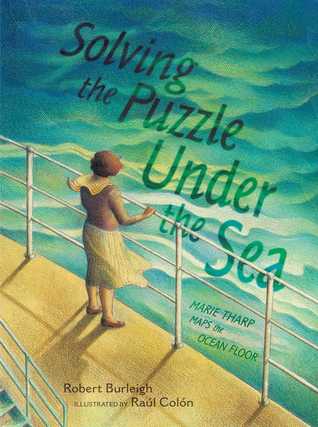
This picture book biography tells the story of Marie Tharp, a scientist who was the first to map the ocean floor. The daughter of a mapmaker, Marie grew up following her father into the field as he created his maps. In the 1940s, Marie became a scientist and looked for a place to focus her attention where she could have a new idea. Scientists were just starting to measure the ocean depths using soundings, using echoes to assess depth. Marie worked to piece all of these measurements together into a map of the ocean floor, revealing mountain ranges under water and helping prove the theory of plate tectonics as she revealed a deep narrow valley running the length of the Atlantic Ocean. Marie Tharp is one of the 20th centuries most important scientists thanks to her discoveries as she mapped the ocean floors of our planet.

Burleigh has once again captured a female scientist and the importance of her role in science and in breaking barriers. The understated drama here is nicely handled, the defensiveness of some male scientists, the way that women were not welcome on boats, and the quiet way that Tharp worked to make her own unique impact on science. As readers see the importance of perseverance in scientific discovers and the importance of resilience in the face of resistance, they will understand that these apply to their own lives as well.

Working once again with Burleigh, Colón shows in images the vital importance that mapping the ocean floor had in understanding our planet and the way that it functions. The mapping of the ocean floor offers great images from the large maps to the underwater scenes that invite readers to think about what lies unseen under the ocean.

A dynamite pick for public and school libraries, this is an opportunity to learn about an important female scientist. Appropriate for ages 7-9.

Reviewed from library copy.

The First Step by Susan E. Goodman

The First Step by Susan E Goodman

The First Step: How One Girl Put Segregation on Trial by Susan E. Goodman, illustrated by E. B. Lewis (InfoSoup)

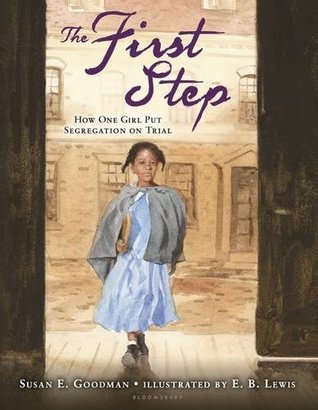
This picture book biography tells the story of Sarah Roberts. Sarah was attending school in Boston in 1847 when she was told that she would have to stop. Instead she would be required to attend the school for African American children across town where there were fewer books and the subjects were not as robust. Sarah’s parents decided not to accept this decision and instead decided to fight for change in the courts. Two lawyers agreed to take Sarah’s case, Robert Morris the second African-American attorney in the United States and Charles Sumner known for his way of orating about justice. Though they lost this first court case challenging school segregation, it set other events in motion and in 1855, Boston became the first major American city to integrate its schools.

Goodman writes an inspiring book about how even losses can begin to change the way people view laws. She does not stop with the longing for change and the case itself, continuing to tell the story of Boston’s changes and then the way that this case led to more cases which resulted in the end of segregation in the nation. This book demonstrates many things to young readers. First that they themselves can create change in the world around them. Second that a loss does not mean the end, it means the fight continues in a different way.

Lewis’ illustrations are done in watercolor and gouache. They echo with historical significance, showing the power of a dream for change, the sorrow of one little girl, and the determination that it takes to make society better. The illustrations range from the subtlety of black and white photographs to the bright colors of change and hope.

A powerful and important story of how children change their world, this picture book is inspiring. Appropriate for ages 7-9.

Reviewed from ARC received from Bloomsbury.

Glow by W.H. Beck

Glow by WH Beck

Glow: Animals with Their Own Night-Lights by W. H. Beck (InfoSoup)

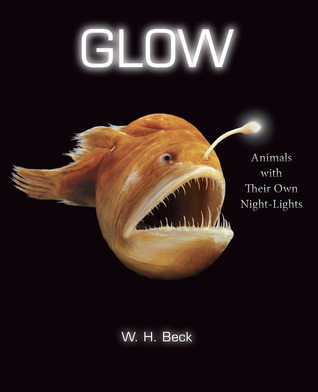
This nonfiction picture book invites young readers to explore the world of bioluminescence. Set against black backgrounds these glowing creatures pop on the page. The book not only shows different organisms that glow, but also explains why they glow too. Children will learn the terms for the chemicals that allow the light to be created and also see that there are some creatures who glow but no one knows quite why. Filled with dazzling photographs, this is a book that will fly off the shelves of public libraries as kids are hooked by the fish on the cover.

Beck has the book written at two levels. The larger font offers a less specific look at the organisms themselves and therefore a simpler experience. The smaller font allows readers to learn more about each creature. More information on each is also found at the end of the book where size, Latin name, and the depth they live at is given for each. This is a book that is engaging and fascinating. The text is restrained and focused, offering enough information to appeal but never standing in the way of the dazzling creatures themselves.

The photographs in the book are exceptional. Each shows the light of the creature against a black background, allowing that creature attention by the reader. The photos were taken by several different photographers, yet they make for a cohesive book thanks to their similar nature and the beauty they depict. I particularly enjoyed the firefly photo and the glowing shoreline.

An awesome book that is sure to appeal to children who enjoy nature and bizarre creatures, this is a winning science book for public libraries. Appropriate for ages 4-7.

Reviewed from copy received from HMH Books for Young Readers.

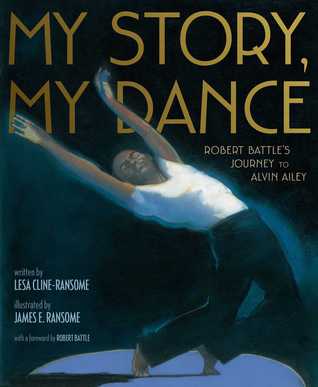
My Story, My Dance by Lesa Cline-Ransome

My Story My Dance by Lesa Cline Ransome

My Story, My Dance: Robert Battle’s Journey to Alvin Ailey by Lesa Cline-Ransome, illustrated by James E. Ransome (InfoSoup)

Starting from his birth through his rise to Artistic Director at the Alvin Ailey American Dance Theater, this picture book celebrates Robert Battle’s life. Born with bowed legs, he was taken in by his aunt and uncle and then raised by his cousin Dessie. It was with Dessie that he discovered a love of music and words. He sang in the church choir and after he got his leg braces off, he began to take karate. At age 13, he started dance late in life for a dancer. Soon Robert was noticed by his high school dance instructor and then auditioned for The New World School of Arts. As he grew, he got to see the Alvin Ailey dance troupe perform and was awed by them. Moving to New York City to attend Julliard, his dancing reached another level and progressively he moved to work with Alvin Ailey. This story of talent and determination celebrates dance and the power it has to communicate.

The prose by Cline-Ransome is spry and fast moving. She shows the importance of family in Robert’s upbringing, even if his mother was not in the picture. The theme of the warmth of family plays throughout the book, from the early pages to the very end where Robert Battle is speaking to the Alvin Ailey audience. The author makes sure to not only talk about the facts of Battle’s life but also shows how his early disability and his willingness to work exceedingly hard played into his later success.

Ransome has done the illustrations in this picture book biography in pastels. The rich colors are gorgeous on the page. He uses them to show the richness of Battle’s life and then when the book shows the movement of dance, he uses them to create the moves from one position to another fluidly across the page in a rainbow of sketches.

A lovely biography on a contemporary figure in American and African-American dance, this picture book is rich and powerful. Appropriate for ages 6-8.

Reviewed from copy received from Simon & Schuster Books for Young Readers.


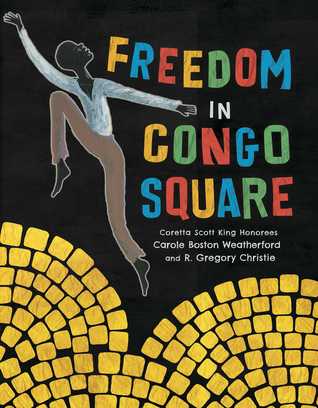
Freedom in Congo Square by Carole Boston Weatherford

Freedom in Congo Square by Carole Boston Weatherford

Freedom in Congo Square by Carole Boston Weatherford, illustrated by R. Gregory Christie (InfoSoup)

A lovely mix of poetry and nonfiction, this picture book takes a serious look at slavery and the unique situation in New Orleans. In New Orleans, Congo Square was the one place where slaves were allowed to congregate once a week on Sundays. The book counts down to Sunday, each day filled with brutal work and the harrowing harshness of slavery. As Sunday approaches, one can feel spirits looking forward to it. When it finally arrived, slaves and free blacks congregated together, able to celebrate the songs and society of the African homes they were stolen from.

This book is carefully framed and placed in history with a combination of a foreward by historian Freddi Williams Evans and an Author’s Note placed at the end of the book. In both places, Congo Square is explained in detail. The real magic though happens with Weatherford’s poetry. It has a rhythm to it, a structure that is almost musical. The text is deceptively simple as it speaks to the depth of human heart even in the face of slavery and the importance of having a place to congregate like Congo Square.

Christie’s illustrations are incredible. They evoke primitive art with the lengthened and stylized people done in deep black. The pages are filled with bright colors that may seem merry, but then they are filled with slaves doing hard work. They also have twisted black trees in the outside scenes, the tortured branches speaking to witnessed horrors.

An important nonfiction picture book that has poetry that sings in mourning about slavery but also sings of the beauty of the strength of the human spirit too. Appropriate for ages 7-9.

Reviewed from copy received from Little Bee Books.

My Top Children’s Nonfiction Picks for 2015

22323666 21965198

The Case for Loving: The Fight for Interracial Marriage by Selina Alko, illustrations by Sean Qualls and Selina Alko

Emmanuel’s Dream: The True Story of Emmanuel Ofosu Yeboah by Laurie Ann Thompson, illustrated by Sean Qualls

23309551 23129884

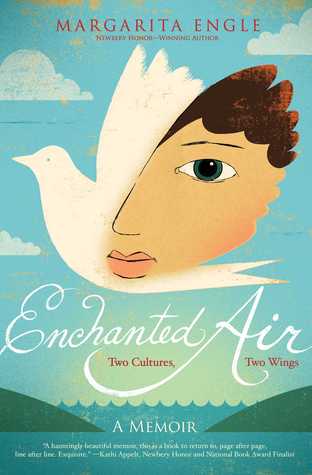
Enchanted Air: Two Cultures, Two Wings by Margarita Engle

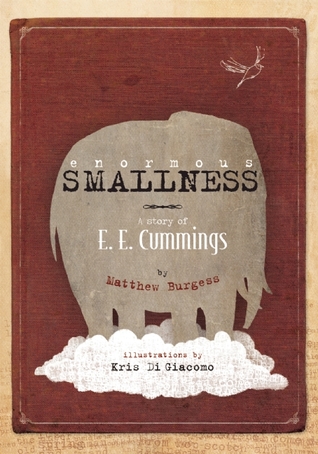
Enormous Smallness: A Story of E.E. Cummings by Matthew Burgess, illustrated by Kris Di Giacomo

25229243 24795948

Finding Winnie: The True Story of the World’s Most Famous Bear by Lindsay Mattick, illustrated by Sophie Blackall

Funny Bones: Posada and His Day of the Dead Calaveras by Duncan Tonatiuh

23217536 22718660

Gordon Parks: How the Photographer Captured Black and White America by Carole Boston Weatherford, illustrated by Jamey Christoph

The House That Jane Built: A Story about Jane Addams by Tanya Lee Stone, illustrated by Kathryn Brown

21548429 22747803

Leontyne Price: Voice of a Century by Carole Boston Weatherford, illustrated by Raul Colon

Mesmerized: How Ben Franklin Solved a Mystery that Baffled All of France by Mara Rockliff, illustrated by Iacopo Bruno

22195449 22551795

My Name Is Truth: The Life of Sojourner Truth by Ann Turner, illustrated by James Ransome

Over the Hills and Far Away: A Treasury of Nursery Rhymes by Elizabeth Hammill and various illustrators

25261696 23379443

Poet: The Remarkable Story of George Moses Horton by Don Tate

The Sky Painter: Louis Fuertes, Bird Artist by Margarita Engle, illustrated by Aliona Bereghici

23417398 18317569

Small Wonders: Jean-Henri Fabre and His World of Insects by Matthew Clark Smith, illustrated by Giuliano Ferri

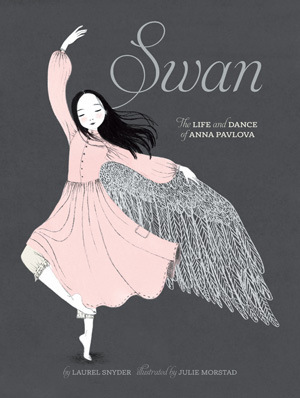
Swan: The Life and Dance of Anna Pavlova by Laurel Snyder, illustrated by Julie Morstad

22522289 23167689

Tricky Vic: The Impossible True Story of the Man Who Sold the Eiffel Tower by Greg Pizzoli

Trombone Shorty by Troy Andrews, illustrated by Bryan Collier

22747807 22718699

Voice of Freedom: Fannie Lou Hamer:The Spirit of the Civil Rights Movement by Carole Bostone Weatherford, illustrated by Ekua Holmes

Water Is Water: A Book about the Water Cycle by Miranda Paul, illustrated by Jason Chin

What in the World? by Nancy Raines Day

What in the World by Nancy Raines Day

What in the World?: Numbers in Nature by Nancy Raines Day, illustrated by Kurt Cyrus (InfoSoup)

In this rhyming counting book, the concept of numerical sets is introduced. The book opens asking “What in the world comes one by one?” It then answers, explaining that the moon, your nose and your mouth come in singles. Then the book counts upwards, each time asking the question of what comes in that set and answering it. The book ends by looking up at the stars and the infinity of them. It invites young readers to start to think about the patterns in the natural world around them.

Day has created a rhyme that makes this book an engaging mix of poetry and science. As the rhyme dances along, the book will inspire conversation and thinking of more things that come in that type of set. The book is wisely limited to a coastal area where a young boy plays, dangling his toes and fingers in the water, sets of ten.

The art is simple enough to allow this book to be both a counting book and a book about sets. Smaller children will merrily count the nine spines on the back of a fish while older children will start to think about other things in their world that match the set. The digital art is bright colored, and cheery.

An engaging math book that can be read at different levels, this rhyming science book will be enjoyed by several ages of child. Appropriate for ages 3-5.

Reviewed from copy received from Beach Lane Books.

Ada Byron Lovelace and the Thinking Machine by Laurie Wallmark

Ada Byron Lovelace and the Thinking Machine by Laurie Wallmark

Ada Byron Lovelace and the Thinking Machine by Laurie Wallmark, illustrated by April Chu (InfoSoup)

Ada Lovelace was born the daughter of the famous poet, Lord Byron. But she was more like her mother and interested in numbers rather than words. As a young woman, Ada invented a flying machine that she did all of the mathematics for. She spent time experimenting with wind and sails to inform her calculations. Despite a health scare that left her blind and paralyzed for some time, Ada continued to learn math and love numbers. When she met Charles Babbage, the inventor of the first mechanical computer, she found a person she could talk to about her love of numbers. It was his machine that inspired her to write the first computer program ever so that others could understand this amazing computer he had built. This makes Ada the first computer programmer.

It is inspiring to see a girl from such an early time period who was clearly a mathematical genius. She had a mother who was also interested in math and supported her daughter’s education and love of numbers throughout her life. This book shows the power of mathematics to inspire new ideas and inventions. It also demonstrates that women in computing goes back to the very beginning.

Chu’s art is done with pencil on paper and then as the copyright information says “colored on an Analytical Engine” also known as a computer. The illustrations are rich and lovely. They have interesting perspectives like looking down on Ada in the bath with her muddy boots on the floor nearby. Ada is shown as an active person, a youthful presence among older people, and shines on the page as she must have in life.

A powerful and inspirational read for children interested in math and science, this picture book will show young readers a heroine that they may never have met before. Appropriate for ages 7-10.

Reviewed from library copy.